Showing posts with label subjectivity. Show all posts

Thursday, July 26, 2012

Attention as Place: Surveying One Square Meter

If you follow the Walker Art Center via blogs, Facebook, or Twitter, you've caught word of ROLU-in-Residence. When I heard that a component of ROLU's residency bears the title "Attention as Place," I was intrigued. Notions of "attention" and "place" are at the core of Open Phenology.

"Attention as Place" is a showcase of interactive and intellectually compelling projects culled from ROLU's Web-based network and temporarily localized in the Walker's Cargill Lounge. While most works in this showcase have a physical aspect, they are more fundamentally about the intangible, the indeterminate, the speculative, or the experiential. And for that reason, viewers can have an intimate, give-and-take experience with any of the 22 projects that compose "Attention as Place."

Take, for instance, Amy Franceschini's SURVEYING ONE METER, an action-based project with the following prompt:

Look for the roped-off One Square Meter at the base of Open Field's hill, near the parking ramp entrance.

Catalog in writing everything you see in a one meter square in Open Field. This could be a text, a poem, or a list. Get as detailed as possible.

The parameters of Franceschini's project calls to my mind The Forest Unseen (book trailer, left) by David G. Haskell. And though the Walker's Open Field is no old growth wilderness, Franceschini's project urges us to see it as it is, how it is, and where it is. Like Open Phenology, Franceschini's project is based on the ethos that our immediate environment has great potential as the stage for re-enchantment and discovery.

Since Tuesday, I've completed two surveys of the square meter, each time depositing my written observations in a designated box in Cargill Lounge. You are welcome to participate in Franceschini's SURVEYING ONE METER. Visit the Walker's Cargill Lounge where a staff person will give you a clipboard with paper and pencil. Venture out to the square meter and tell us what you see.

Saturday, June 30, 2012

The Benefits of Constant Vigilance

Young Green Herons, Minneapolis Sculpture Garden. Photo by Christina
What: Two Green Herons fledglings, seen out of the nest!
Where: Along the east border of the Minneapolis Sculpture Garden, a pair of Green Herons built a nest high in a pine tree. For several months now, Rachel, Christina, and I have been checking on the nest, watching to see that the adults were present and straining our eyes to detect young. In the week before my long vacation, we finally observed indications of a successful brood --- scarcely perceptible, we could see movement of downy head(s) and maybe a small beak at the nest's brim, under a vigilant adult.
When: June 18, 2012
Observers: Christina and Rachel, two colleagues of mine who enthusiastically stepped in as proxy phenologists over my vacation. I'm so grateful to Christina and Rachel for sustaining the continuity of our phenology practice!
Conditions: Elated! (I wasn't there to report on weather or other objective details, so I'll skip ahead to to the subjective conditions.) Upon arriving to town after vacation, the first thing I did was log into my Twitter, @openphenology. I was thrilled to read my colleagues' report of the fledglings and view their terrific photo (above). It all serves as a reminder that phenology entails a continual and regular practice. Or, to use Christina's and my mantra: Constant vigilance!

Tuesday, September 6, 2011

Field Trip: Birding with Nathalie and Hans

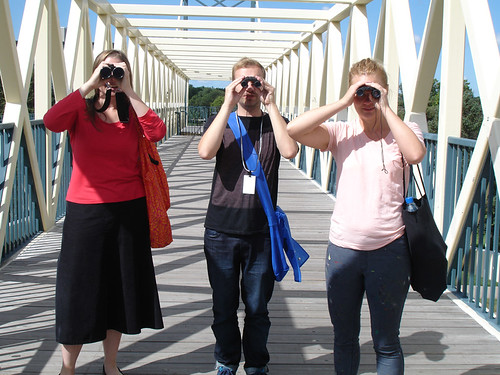
Left to right: Abbie, Hans, and Nathalie
One Tuesday morning in early September, artists Nathalie Djurberg and Hans Berg took a break from marshalling in The Parade to go birding. With binoculars at the ready, they flew the coop, accompanied by Susy Bielak and Abbie Anderson. What follows is a glimpse into their field trip, but first, a brief background on our birders. Nathalie and Hans were spending a week in Minneapolis to install their exhibition, The Parade, which  includes new sculptures informed by the psychology and natural history of birds. Abbie just concluded a summer of weekly nature walks around the Walker and was eager share that experience with visiting artists. Susy, in addition to serving as photographer, interviewer, and scribe for this outing, manages public and interpretive programs at the Walker.
Our excursion began at the picnic tables as Abbie distributed binoculars and describes Open Phenology, her series of nature walks focused on observing ecological phenomena in the Walker’s vicinity. 

Abbie: I’m interested in noticing the life forms around us and observing how they change through the seasons. This means looking for birds migrating, insects molting, flowers blooming, etc. These observations, in turn, are the basis for conversation and learning.

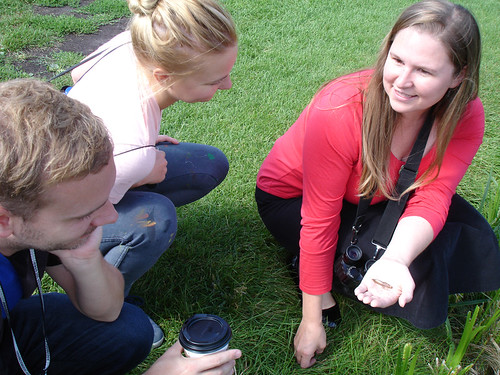
Before spotting any avian species, Abbie gathered the group to inspect the insect world. Getting low to the ground at the water’s edge near Spoonbridge and Cherry, the group examined the exoskeletons left behind by metamorphosing dragonflies.  

Abbie: See these?
Hans: Like ghosts.
Abbie: Larvae is actually Latin for ‘ghost.’
Hans [on metamorphosis]: It’s like one-day evolution.
Nathalie [clearly curious as to why an art educator takes such interest in biology]: So, what exactly do you do at the museum?
Abbie: Yes, I see what you mean. I’m a biology geek who works in an art museum. So beyond my job, which is supporting the Walker’s education and community programs, I’ve appointed myself as the Walker’s in-house amateur naturalist.

The Parade: Nathalie Djurberg with music by Hans Berg
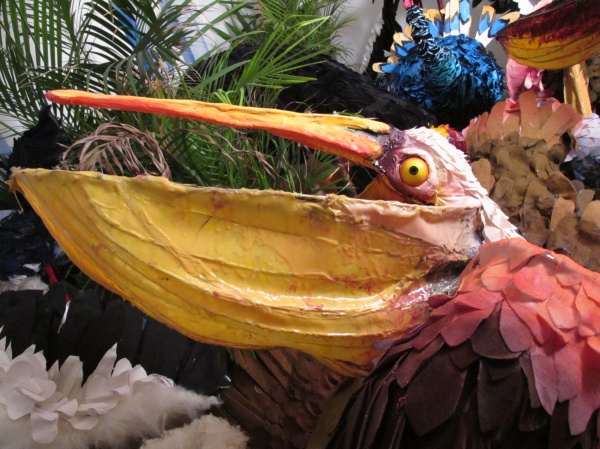
As the group marched over to Loring Park, the conversation shifted to Nathalie’s recent body of work, a veritable parade of sculpted birds (left, click to view larger image).

Susy: Why birds?
Nathalie: Before, birds were the least interesting to me—flock animals. Boring. I love animals and watch a lot of nature programs, but avoided bird programs. Then I came across David Attenborough.
Abbie: His documentary on birds of paradise?
Nathalie: Yeah, that guy!
Abbie: After watching Attenborough in Paradise, I felt like this planet is suddenly a totally different world! An astonishing place, but weird, right?
Nathalie: Yeah, though it was before that one that I got into him. And it changed how I see birds. I had no empathy for birds before. Now I really do.

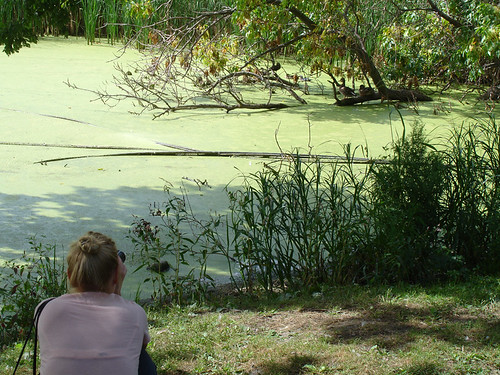
Once across the Hixon Whitney bridge, we again gravitated to water, looking for birds around the pond. By the reeds we discover ducks—not only Mallards, but Wood Ducks, a regal looking waterfowl with a crested head, thin neck, and striking plumage. We spot them as we approach the pond, then peer from the bridge for a clear view. Nathalie runs with her binoculars to the water’s edge for a closer look. We follow.

Abbie [chasing after Nathalie]: I love the investigative impulse!
Abbie [catching up and training binoculars]: You can recognize the Wood Duck by size and shape as well as by its plumage. Their nesting habitat is a tree cavity. Now we build boxes to help them out.
Hans: Are they rare?
Abbie: They’re not too rare, but many birds nest in dead trees, which we cut down. There’s a dead tree by my house that every morning is full of woodpeckers. It’s marvelous to see them. It’s a dead tree, but it’s living to them, because it’s full of bugs.
Nathalie [focusing her binoculars on a male Wood Duck]: Look at its eyes! They’re bright red.
Abbie: The Wood Duck is the showiest bird here.

Nathalie Djurberg, studio view of a work in progress, 2010
Courtesy the artists, Zach Feuer Gallery, New York and Giò Marconi, Milan
After this satisfying encounter, we make our way around the pond, geting back to talking about Nathalie’s sculptures.

Susy: How much of your birds come from actual birds in the world, and how much are derived from sheer imagination?
Nathalie: Most started by my looking at pictures, then really transformed in the process of making them. There were about thirty that came from my imagination. The rest were something specific at the start. Some have transformed so much I couldn’t recognize how they started.
Susy: How do you chose your birds?
Nathalie: I choose the ones I find interesting. Their personalities. How they move their heads. Their colors and patterns.
To witness the pageantry of these feathered forms with your own eyes, venture into the Walker’s Burnet Gallery—The Parade is on view through December 31. In addition to a flock of over eighty delightfully varied bird sculptures, the walls are brought to life by a selection of the artists’ claymation films and the entire space is awash in Hans’ music.
Birding and conversing with Nathalie and Hans has amplified my enjoyment of the show, which is emphatically rich and wild as it is. But after discovering a shared enthusiasm for Attenborough’s BBC documentaries, I found myself thinking, “Wouldn’t David Attenborough just have a field day here!” In a flight of fancy, I imagine a gallery tour led by Attenborough: Clad in khakis with a field guide in his vest pocket, he trains his binoculars on the multitude of exotic species. His hushed voice can hardly contain the exhilaration of catching sight of such strange birds. And lucky for us, this episode of Attenborough’s adventures doesn’t entail travel to an inaccessible tropical paradise, but unfolds in our own back yard.
—Co-authored by Abbie Anderson and Susy Bielak

Sunday, July 17, 2011

"Now I will do nothing but listen. . . . I hear all sounds running together, combined, fused or following, sounds of the city and sounds out of the city, sounds of the day and night. . ."
Walt Whitman

St. Mary's Basilica bells, YouTube media by Markitectonic

If you say hello to me tomorrow morning between 8 and 8:30 am, I won't reply. But I'll most certainly hear you because I'll be engaged in a soundwalk. What is a soundwalk? Jim Cummings, founder of the Acoustic Ecology Institute, defines it as follows:
At its simplest, a soundwalk is just what its name implies: a walk during which you simply pay attention to each sound you encounter. More complex variations can include seeking out the most distant sound audible, or the faintest. Soundwalks are just as interesting in cities as in nature, and indeed, urban acoustic ecology offers many points for reflection and even aesthetic appreciation.

Friday, July 15, 2011

A study in green

The color green can look remarkably vibrant in rainy conditons. Today's report comes from that chromacentric point of view.
Photo by Len Blumin
What: A Green Heron. With the rain and poor lighting, I couldn't get a good shot, so I borrowed this stunning image from a fellow Flickr photographer. I observed it for few minutes, during which it ceaselessly preened itself. This sighting isn't ephemeral or critical to phenology, but it was fun to see in an urban park.
Where: Perched about 15' high in a pine tree, on the eastern edge of the Garden, a lot of traffic noise coming from Hennepin Avenue.
Observer: Abbie
Date/Time: July 15, 10:35 am
Conditions: On-and-off rain, humid, low-hanging clouds obscuring the city skyline.
What: A Japanese beetle, about 3/8" in length. Kinda' pretty but totally pesky! This observation is a good phenological marker, as you can see from this diagram of the Japanese beetle's life cycle.
Where: Water's edge at Spoonbridge and Cherry.
Observer: Abbie
Date/Time: July 15, 10:20 am
Conditions: Wet but not raining

What: Green grass and a troop of mushrooms. Or are these gregarious? Mushrooms in a close group (but not so close as to be a cluster) are said to be a troop. If the group is more scattered and irregular, they are said to be gregarious. Eager for more vocabulary for fungi growth habits? Check it out: http://www.mushroomthejournal.com/greatlakesdata/Terms/troop269.html
Where: Open Field, north edge along Vineland Place
Observer: Abbie
Date/Time: July 15, 10: 45 am
Conditions: Good for growing
General observation for today: Birds were abundant. Those on the ground busied themselves by foraging (gorging?), and those perched were entirely preoccupied with preening. My complete bird list for the day: Northern Cardinal, White-breasted Nuthatch, Rock Pigeon, American Robin, Green Heron, House Finch, Red-winged Blackbird, Mourning Dove, Common Grackle

Friday, July 8, 2011

Guest Blog: Scott Artley joins in on July 8th


On the morning of July 8th, seven people stood at the FlatPak House on the West end of the Minneapolis Sculpture Garden, looking much like some of the other tourists wandering through the area. Only instead of capturing photos of artworks, they donned binoculars to catch a momentary glance of birds. Instead of maps filled with the names of public artists, they held pocket-sized plant identification handbooks and ornithology guides.
Abbie greeted us and explained the concept of phenology: the study of the natural world through the seasons, seeking markers of time and change. It’s a science requiring sustained attention to subtlety—an artistic eye is an asset to environmental inquiry. Abbie’s mantra during the excursion was simple: “What do you notice?”
Although I went to Open Phenology to learn about the natural world around the Walker Art Center campus, I found myself fascinated by the way this group became a community as we wandered over the Whitney Bridge into Loring Park. Although Abbie’s is the only Open Field project that engages with the world of science, it does demonstrate aspects familiar to other Open Field activities:
  • the facilitation of curiosity
  • an ongoing commitment of time and space to step out of the everyday, and
  • the ultimate outcome of sharing an experience together.
Thanks for inviting me along, Abbie, I’m looking forward to joining again.
--Scott Artley
Open Field Coordinator and Open Phenology guest blogger

Open Phenology print by Abigail Woods Anderson

Friday, June 17, 2011

Music and Musings

While Abbie spends this week exploring Canadian flora and fauna I will be filling in with my own (more primitive) Minnesota observations.

I rolled out of bed this morning with the expectation of spending a quiet, meandering morning being delighted by childlike discoveries of my surroundings in and around the Walker Sculpture Garden. Though my wanderings were pleasant, the field and garden were fluttering with activity. Of course! It's a mere day before Rock The Garden, the Walker's annual outdoor music festival. The field and garden were bustling with Walker staff, news crews, and contracted help zipping around like Fraggle Rock (the garden) Doozers to prepare for the event. There also appeared to be a morning wedding ceremony taking place in the Cowles Conservatory. In the midst of all the bustling I did manage to make some exciting discoveries.

I begin with my red-winged blackbird sighting not because they are uncommon to the area but because of my fondness for them. When I moved to Minnesota they were the first new bird I was able to identify.

What: Foraging red-winged blackbird
Where: West side of Walker Sculpture Garden
Observer: Lindsay
Date/Time: June 17, 10:15am
Conditions: Sunny and humid


What: Musicians warming up before a ceremony
Where: Cowles Conservatory
Observer: Lindsay
Date/Time: June 17, 10:18am
Conditions: Cool and stagnant


I have just recently become interested in the act of birding and have great respect for those who do it well primarily because I am realizing that it requires a level of patience that I have not yet cultivated. The above image is one I made while stalking a cardinal, a beautiful bright red cardinal that was not interested in my photographic advances.


I like the anticipation of this image. When will the dahlias begin popping out of the soil? I'll have to go back throughout the summer and check in.

What: Honka dahlia markers
Where: Alene Grossman Memorial Arbor and Flower Garden
Observer: Lindsay
Date/Time: June 17, 10:35am
Conditions: Sunny and humid


I love watching ducklings following their mothers. They look like they must be attached by a magnetic force of some kind. When I was a child I had this game called "Are You My Mother?". It's a little traumatizing now that I think about it. It was a board game with a farm scene depicted on it. Around the board there were little cardboard hens with magnetic bases. The player was a baby chick that also had a magnetic base. The object of the game was to move around the board and find out which of the hens was the chick's mother. The parent hen would reveal itself through its "attraction" to the chick (or a magnet with the opposite charge). Clever, really. Because of this game I will forever associate motherhood with magnets.

What: Ducklings dutifully following mother duck
Where: Under Oldenburg's Spoonbridge and Cherry
Observer: Lindsay
Date/Time: June 17, 10:45am
Conditions: Sunny and humid


Thank you to Abbie for letting me fill in. What a pleasure to spend the morning taking in the activities of a sunny June day, camera in hand and eyes wide open. It should be a mandatory activity for us all.

Friday, June 10, 2011

The Mysterious West End

I accepted Abbie’s invitation to guest host during her absence this week and realized that I hadn’t walked the entire length of the Garden for more than a year. Well acquainted with the east entrance of the garden, my objective was to explore the unknown west end. Laura Robards Gantenbein, MN Artist Fellow, joined me on my excursion, where we passed by little creatures moving about. What really caught my eye however, was the space beyond the garden, a patch of trees on the west wall of the entrance near Dunwoody Blvd.

This mostly banal and unimpressive landscape included a particularly curious tree. Aesthetically I've always been drawn to the grotesque, and this tree was oozing with it, literally.


I’m not much of an arboriculturist, but I’m identifying this as a pine tree, what do you think? This particular pine was completely unabashedly secreting sap amongst its more modest peers. The sap was in various stages of sticky liquid and crystallized residue; I was fascinated. I don’t often analyze sappy trees, but this was the perfect opportunity to indulge.

Nestled in the tree was a morning dove, which didn’t seem to mind the sappy contents. Laura and I tenderly named the bird Cargill, after one of the lounges in the Walker. Having our fill of sap and new friend Cargill we made our way back to the museum and spotted a chipmunk. We named it Bazinet.

Bazzie, Bazzie 2, Bazinetta, were other chipmunks we spotted on the way back that crossed our path shortly after, but to be fair, the original Bazinet stole the chipmunk show.

Thank you for reading and stay tuned for next week’s sightings!

Thursday, June 9, 2011

Further Opening Phenology

The "Open" in Open Phenology has multiple meanings.
  • Making the science of phenology accessible to more people
  • Welcoming all levels of expertise and involvement
  • Valuing transparency, collaboration, and spontaneity
  • Expanding the scope of phenology—observations are not limited to 'biological phenomena,' but encompass the social, cultural, and technological aspects of our environment
  • Acknowledging a blend of objective and subjective approaches
I'm pleased to open up the project to include two guest facilitators/leaders: Adriana and Lindsay.

June 10, 10 am: Open Phenology led by Adriana
Join guest facilitator Adriana for the weekly experiment that is Open Phenology. As usual, the exploration and the conversation start at FlatPak House in the Garden.

June 17, 10 am: Open Phenology led by Lindsay
Join Lindsay, volunteer explorer and nature enthusiast, for this installment of Open Phenology. Meet at FlatPak House in the Garden to see for yourself what's going on around the Walker.

Sunday, June 5, 2011

Nocturnal beings and night visions

Click to enlarge --- it's worth it!
What: A Polyphemus moth
Where: Window screen at my home
Observer: Abbie
Date/Time: June 5, midnight to 1 am
Conditions: Still and partly overcast
 
Zoom out with me, if you will, from Open Phenology's 'micro-local' focus to a 'macro-local' look at our cities on the 45th parallel. It was the night of Northern Spark, the Twin Cities' first nuit blanche featuring participatory art activities from dusk to dawn across Minneapolis and St. Paul. I was at home working on a painting when this spectacular moth alit on my screen. It clung motionless and permit me a few photographs. While it's difficult to judge scale from this image, this species has a wingspan of about 6". As my friend David aptly observed, it's like a lucky rabbit's foot with wings attached.

The Polyphemus is an astonishing creature. Its larva hatch in synchronized broods and undergo a series of moltings followed by a final metamorphosis into the adult moth. Their existence as moths is remarkably fleeting. Individuals live only a few days, just long enough to mate and start the next generation.


Above: Vortex Navigation Company perform "Let's Light a Light," YouTube media by Sean Connaughty (recorded March 2010)

View from within Sky Pesher
By 2 am I had left the lone moth and was nestled into Sky Pesher for Nightshift's headphone concerts. As I listened to Vortex Navigation Company perform "Let's Light a Light," I gazed into the square of sky and envisioned a choreography of great moths, aloft on plumes of pheromones and lured by the light. And I thought of the city, pulsing with blinking bike lights and illuminated with creative phenomena.

Open Phenology is teaching me that for every event I witness, a staggering multitude of events go unseen. As I drove home in the 4 am darkness, the American Robins discerned and heralded the light, commencing a dawn chorus 90 minutes prior to sunrise.

Friday, June 3, 2011

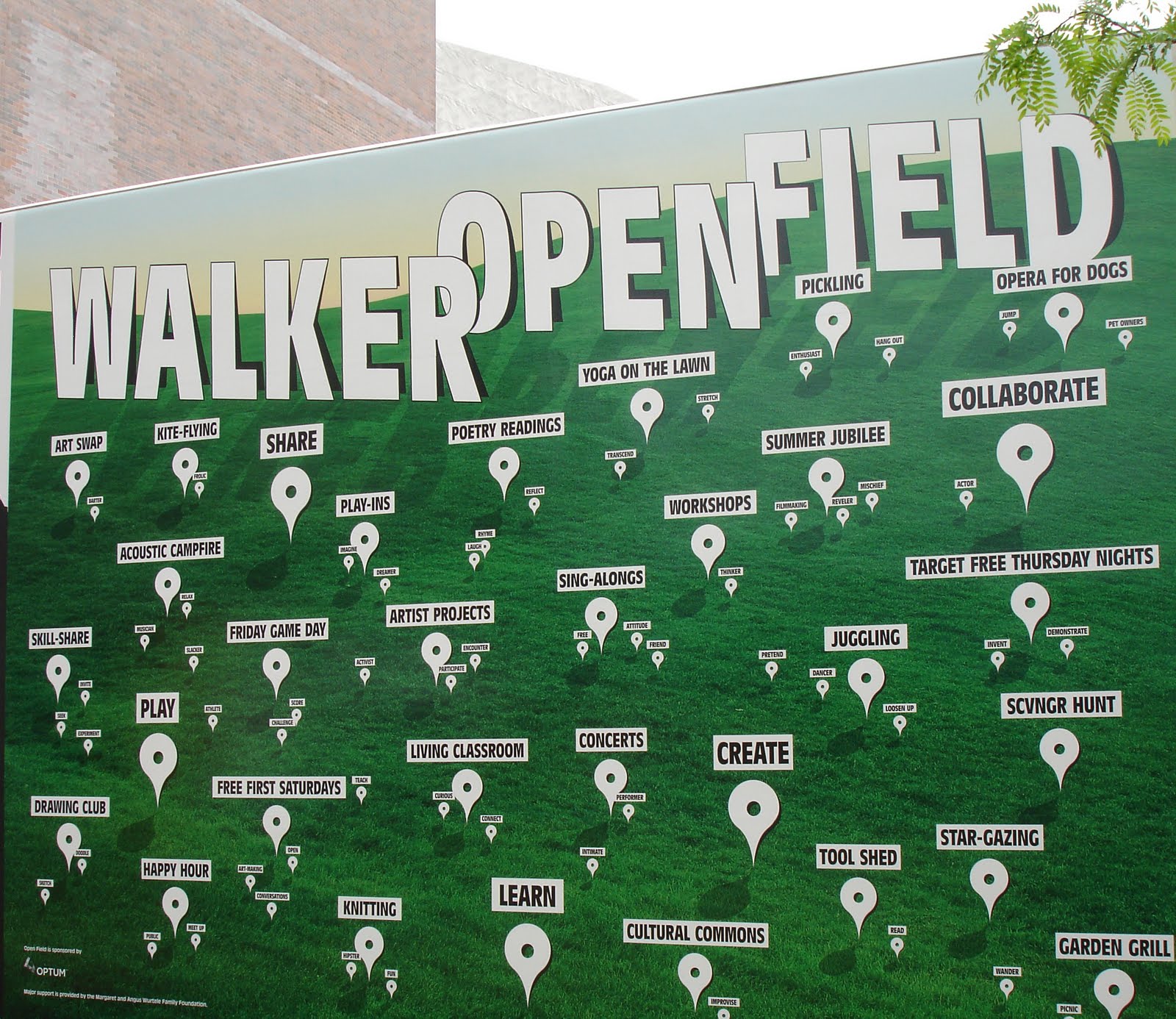
Google placemarks make the scene

Today on Walker Open Field, a team installed this vinyl graphic.

And I added another marker to the Open Phenology Loci map.

Friday, May 27, 2011

Cool, windy, with a chance of Dreams

"In an object you can tell where the boundaries are, but in the weather it’s impossible to say when something begins or ends."—John Cage, 1981

May 27 conditions, Wunderground.com (Weather station at Marriott City Center, Minneapolis)


What: Pierre Huyghe's Wind Chime (after "Dream") transforms the sound environment. Sample its enchanting effect using the player below.
Where: A stand of trees, just north of Spoonbridge and Cherry
Observers: Martha, Renner, Abbie
Date/Time: Installed in mid-May, this work remains on view over the summer months.
Conditions: Cool, windy, and overcast


Above: YouTube media by mostlymark (Recorded August 2009)

The 'dream' in Huyghe's work refers to John Cage's 1948 composition. Use the player below to listen to "Dream" performed by Stephen Drury.

Above: YouTube media by NewMusicXX