http://ttbook.org/book/david-george-haskell-forest-unseen
An inspiring interview with author David George Haskell discussing his book The Forest Unseen: A Year's Watch in Nature.
Showing posts with label ecology. Show all posts
Showing posts with label ecology. Show all posts
Wednesday, May 2, 2012

Friday, September 2, 2011
Of Cities and Ecosystems
Beginning our walk, my colleague Scott and I corroborate a sighting: Twenty Canada Geese on the field at 9 am. Now's the time of year to look around for Canada Geese staging or look up for their V-shaped flight formations. Fall is settling in—just read the signs.
One such sign is seen on the Irene Hixon Whitney Bridge.
Once across the bridge we encounter . . .
Conversing with Scott is like paging through a neighborhood directory. His familiarity with area residents, business owners, and organizations prompts me to exclaim, "Here I thought this was the city, but it turns out it's a small town!" Listening to Scott talk about the neighborhood, the metaphor I'm imagining is an ecosystem, a network of interrelated parts.
Scott also calls my attention to the squirrels as a marker of ecological intervention. The ubiquitous gray squirrel was introduced to the area in the early twentieth century. And concurrent with the gray squirrel's introduction was the extermination of the red squirrel.
Before crossing Lyndale/Hennepin, our attention is drawn to St. Mark's beautiful lawn shaded by majestic elms. Scanning the lawn, we spot a blue tag on just about every tree trunk. Taking a cue from the Walker's free audio guide, Art on Call, Scott dials up "Trees on Call" to see who's on the other end of the line.
What: Scott's call connects us to a tree specialist. The story behind the little blue tags is Dutch Elm Disease. Since nearby trees had been infected, the church took measures to protect these specimens by having a fungicide administered. Dutch Elm Disease (DED) is caused by a fungus, which in turn is transmitted by elm beetles. This makes the beetle the disease vector. And since this is a phenology blog, I speculate about the beetle's life cycle. September is the time that adult beetles make their way to the base of healthy elm trees to overwinter underground. Next year around mid-late April they'll emerge and fly to the elm's tree top to feed on leaves.
Where: St. Mark's Episcopal Cathedral's front lawn
Observers: Scott and Abbie
Date/Time: September 2, 11:40 am
Conditions: Curiosity satiated (for the time being)
One such sign is seen on the Irene Hixon Whitney Bridge.
 |
What: A clothesline, punctuated with colorful scarves and hats, extends the length of the ramp on both ends of the bridge. Since June, The Swatch Team have called fellow knitters, crochet practitioners, and yarn bombers to unite! And last night, their row-by-row radicalism culminated in this guerrilla installation. A clothesline full of utilitarian, handmade textiles surprised the public with its unfettered generosity. Committed to 'yarn bombing with a message,' the flyer from last evening's give-away reads, Help yourself to the warm items you will need this winter. If you would like to contribute, add a drawing, poem, opinion, or creative expression to this line. We are all connected! Where: Bridge between the Minneapolis Sculpture Garden and Loring Park Observers: Abbie and Scott Date/Time: Friday, September 2, 10:20 am Conditions: Partly cloudy, with a view of the park and the city |
Once across the bridge we encounter . . .
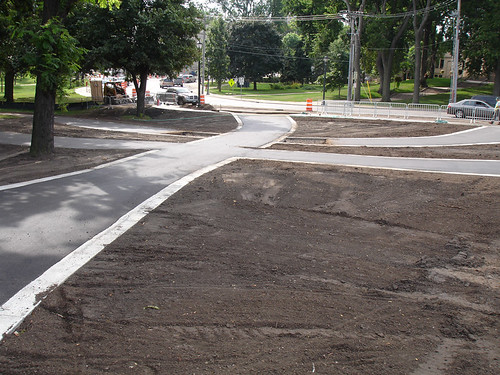 |
| What: A network of freshly paved paths. Scott explains how neighborhood groups, the Parks Board, and municipal entities agreed upon this new configuration to improve safety for pedestrians and cyclists at this high-traffic corner. Scott, having attended Marcy Schulte's Community Walk About (presented as part of Living Classroom), relays a wealth of information about the park's history and its citizen advocates. Where: Loring Park's southwest corner Observers: Scott and Abbie Date/Time: Friday, September 2, 10:30 am Conditions: The dwindling summer season leaves just enough time for the project's finishing touches—signage and landscaping details. |
Scott also calls my attention to the squirrels as a marker of ecological intervention. The ubiquitous gray squirrel was introduced to the area in the early twentieth century. And concurrent with the gray squirrel's introduction was the extermination of the red squirrel.
Before crossing Lyndale/Hennepin, our attention is drawn to St. Mark's beautiful lawn shaded by majestic elms. Scanning the lawn, we spot a blue tag on just about every tree trunk. Taking a cue from the Walker's free audio guide, Art on Call, Scott dials up "Trees on Call" to see who's on the other end of the line.
 | ART ON CALL is to ART as . . . (Images courtesy Walker Art Center) |  |
 | TREES ON CALL is to TREES |  |
What: Scott's call connects us to a tree specialist. The story behind the little blue tags is Dutch Elm Disease. Since nearby trees had been infected, the church took measures to protect these specimens by having a fungicide administered. Dutch Elm Disease (DED) is caused by a fungus, which in turn is transmitted by elm beetles. This makes the beetle the disease vector. And since this is a phenology blog, I speculate about the beetle's life cycle. September is the time that adult beetles make their way to the base of healthy elm trees to overwinter underground. Next year around mid-late April they'll emerge and fly to the elm's tree top to feed on leaves.
Where: St. Mark's Episcopal Cathedral's front lawn
Observers: Scott and Abbie
Date/Time: September 2, 11:40 am
Conditions: Curiosity satiated (for the time being)
Wednesday, August 17, 2011
No Lake is an Island
Today at 1 pm there's a public event to launch the islands.
Read more about who's involved in this management initiative and how the islands work at Josephine Marcotty's True North Star Tribune blog: http://www.startribune.com/local/blogs/127522343.html.
Friday, June 24, 2011
Going West in Search of Wild
 |
| Open Phenology collaborator Jim shares his field guide and expertise. |
 Well, that begs the question: "What is wild?" What do terms like 'wilderness' or 'nature' denote, and what do we mean to exclude by using these words? It's an enigma to ponder because 'nature' seems to encompass everything, and yet most of us harbor the notion that nature has boundaries.
Once outside the urban yard's monoculture and the garden's cultivated display, does the land revert to its natural state? To the casual glance, perhaps it appears so. But upon examination, the answer is emphatically no. At every turn, introduced species were flourishing. And so we challenged ourselves to piece together, through observation and speculation, a semblance of this ecosystem's 'natural state.' And we wondered about the near future of this piece of land. Would our city or this neighborhood support and sustain the maintenance work necessary to keep invasives at bay?
What: Select observations described below
Where: Less than 1/2 mile west of FlatPak House, map above
Observers: Abbie, Jim, Martha, Renner
Date/Time: June 24, 10 to 11:30 am
Conditions: Sunny and warm
- Cottony wisps (likely cottonwood and aspen seeds) are aloft and litter the ground (Related resource: 'Plant profile' video about the cottonwood)
- Motherwort, flowering
- Cow parsnip, stalks are tall (some about 6') and seeds are forming (Related vocabulary: Umbel)
- Garlic mustard, second year plants have seed pods (Related resource: Why this plant is an ecological threat and what to do about it)
- Garlic mustard, first year plants are only basal rosettes, with no tall flowering stalk (Related hypothesis: We encountered a plot of exclusively first year plants and speculated that it might be the leading edge of the invasion)
- Elderberry plant, flowering
- Elderberry plant, berries ripening
- Deadly nightshade, flowering
- Jack-in-the-pulpit, berries ripening but still very green
- Mulberry, fruits ripening, but many are still pale
- Fleabane, flowering, a small bee (~3 or 4mm) observed
- Burdock, stalks are about 3' and still no flowers, aphids are observed on some individual plants
- Buckthorn, fruits ripening, but still green (Related resource: Why is buckthorn such a problem and what you can do about it)
- Spittle bug, shrouded in its spittle foam
- Wild ginger, flowers appear to be fading
- Wild sarsaparilla, leafstalks getting tall but no flowers observed
Thursday, June 23, 2011
The Myth of Phenological Time Travel
In the 14 days since my last post, I traveled from the forty-fifth to the fiftieth parallel and back. Could a trip to Canada be phenological time travel? Would I find myself stepping back to an earlier point in spring?
Well, that's a nice theory, but it turns out that contrasting Location A with Location B is a bit like the proverbial comparison of apples to oranges. Sure, up North the foliage was still tinged with spring's yellow-green, the lilacs were freshly blooming, and the water was colder. But the ecological landscapes were vastly different from one another. By traveling 5° north, I had left the deciduous forest and entered the boreal forest. The phenological players (plants, animals, etc) were so different that their life cycle events were not so much behind as they were simply incomparable. So, while I was on leave from Location A, here's a quick survey of phenological events at Location B:
Phenology is about continuity. To succeed at this science, one must tend to a given locality with regularity. So, tomorrow as I resume my periodic surveys of the familiar Location A, I wonder what changes (incremental or monumental) may have occurred for this nasturtium plant? Or this robin?
 |
| Location A (Minneapolis Sculpture Garden) |
 |
| Location B (western Ontario) |
- Common Loons with chicks; Yellow Warblers tending a nest; Small-mouth bass nesting; dragonflies abundant; mayflies present; tiger swallowtails frequently sighted; mosquitoes scarce; no saturniids (Luna or Polyphemus moths) observed; Flowering plants included: pink lady slippers, star flowers, mountain ash, wild blueberries, wild iris, bunch berry, wild rose, columbine, and spotted coral root; Mosses' calyptra were still in place over developing capsules (click here for diagram, here for photo)

 |
| May 27: Nasturtium in the Garden's Arbor |
 |
| June 10: American Robin |
Phenology is about continuity. To succeed at this science, one must tend to a given locality with regularity. So, tomorrow as I resume my periodic surveys of the familiar Location A, I wonder what changes (incremental or monumental) may have occurred for this nasturtium plant? Or this robin?
Subscribe to:
Posts (Atom)