- June 8: Nestlings seen, just barely visible by their movement and still within the nest
- June 18: 3 chicks seen out of the nest and up in the pine branches, documented by my colleague Christina (photo)
- July 2: We see one dead chick on the ground
- July 11: We notice the nest is significantly dismantled (photo). Is this evidence of predation?
- Mid-July: We see a second dead heron chick on the ground
- August 4: Wildlife rescue service picks up a third chick, reportedly not doing well
Showing posts with label awareness. Show all posts
Showing posts with label awareness. Show all posts
Saturday, September 15, 2012
What Little I Know
Gentle reader, I owe you an update about the green herons and their brood. I would have been more forthcoming had there been happy news to share. But I haven't been eager to report the sad things we've witnessed in the Garden. Here's an outline of what little I know:

Thursday, July 26, 2012
Attention as Place: Surveying One Square Meter
If you follow the Walker Art Center via blogs, Facebook, or Twitter, you've caught word of ROLU-in-Residence. When I heard that a component of ROLU's residency bears the title "Attention as Place," I was intrigued. Notions of "attention" and "place" are at the core of Open Phenology.
"Attention as Place" is a showcase of interactive and intellectually compelling projects culled from ROLU's Web-based network and temporarily localized in the Walker's Cargill Lounge. While most works in this showcase have a physical aspect, they are more fundamentally about the intangible, the indeterminate, the speculative, or the experiential. And for that reason, viewers can have an intimate, give-and-take experience with any of the 22 projects that compose "Attention as Place."
Take, for instance, Amy Franceschini's SURVEYING ONE METER, an action-based project with the following prompt:
 Look for the roped-off One Square Meter at the base of Open Field's hill, near the parking ramp entrance.
Catalog in writing everything you see in a one meter square in Open Field. This could be a text, a poem, or a list. Get as detailed as possible.
Since Tuesday, I've completed two surveys of the square meter, each time depositing my written observations in a designated box in Cargill Lounge. You are welcome to participate in Franceschini's SURVEYING ONE METER. Visit the Walker's Cargill Lounge where a staff person will give you a clipboard with paper and pencil. Venture out to the square meter and tell us what you see.
"Attention as Place" is a showcase of interactive and intellectually compelling projects culled from ROLU's Web-based network and temporarily localized in the Walker's Cargill Lounge. While most works in this showcase have a physical aspect, they are more fundamentally about the intangible, the indeterminate, the speculative, or the experiential. And for that reason, viewers can have an intimate, give-and-take experience with any of the 22 projects that compose "Attention as Place."
Take, for instance, Amy Franceschini's SURVEYING ONE METER, an action-based project with the following prompt:
Catalog in writing everything you see in a one meter square in Open Field. This could be a text, a poem, or a list. Get as detailed as possible.
| The parameters of Franceschini's project calls to my mind The Forest Unseen (book trailer, left) by David G. Haskell. And though the Walker's Open Field is no old growth wilderness, Franceschini's project urges us to see it as it is, how it is, and where it is. Like Open Phenology, Franceschini's project is based on the ethos that our immediate environment has great potential as the stage for re-enchantment and discovery. |
Since Tuesday, I've completed two surveys of the square meter, each time depositing my written observations in a designated box in Cargill Lounge. You are welcome to participate in Franceschini's SURVEYING ONE METER. Visit the Walker's Cargill Lounge where a staff person will give you a clipboard with paper and pencil. Venture out to the square meter and tell us what you see.
Saturday, June 30, 2012
The Benefits of Constant Vigilance
 |
| Young Green Herons, Minneapolis Sculpture Garden. Photo by Christina |
Where: Along the east border of the Minneapolis Sculpture Garden, a pair of Green Herons built a nest high in a pine tree. For several months now, Rachel, Christina, and I have been checking on the nest, watching to see that the adults were present and straining our eyes to detect young. In the week before my long vacation, we finally observed indications of a successful brood --- scarcely perceptible, we could see movement of downy head(s) and maybe a small beak at the nest's brim, under a vigilant adult.
When: June 18, 2012
Observers: Christina and Rachel, two colleagues of mine who enthusiastically stepped in as proxy phenologists over my vacation. I'm so grateful to Christina and Rachel for sustaining the continuity of our phenology practice!
Conditions: Elated! (I wasn't there to report on weather or other objective details, so I'll skip ahead to to the subjective conditions.) Upon arriving to town after vacation, the first thing I did was log into my Twitter, @openphenology. I was thrilled to read my colleagues' report of the fledglings and view their terrific photo (above). It all serves as a reminder that phenology entails a continual and regular practice. Or, to use Christina's and my mantra: Constant vigilance!
Thursday, June 7, 2012
Yes! Young!
What: The Green Herons have young in the nest! For the first time, we see it with our own eyes! We struggle to document it, but the nest's too far, obscured, and poorly lit. But through binoculars, you can see a parent perched on the nest and at the nest's brim, movement of a little beak and the top of a fuzzy head.
Where: East border of the Minneapolis Sculpture Garden
When: Thursday, June 7, 2012 at about 5:30 pm
Observers: Abbie and Christina
Conditions: Sunny and hot.
Where: East border of the Minneapolis Sculpture Garden
When: Thursday, June 7, 2012 at about 5:30 pm
Observers: Abbie and Christina
Conditions: Sunny and hot.
Friday, May 11, 2012
Green Herons, Amazingly Enough
 |
What: Amazingly enough, a pair of Green Herons are nesting in a pine tree, with a view of the Minneapolis Sculpture Garden.
Where: Hoping that these birds will successfully raise their young, I won't be too specific about the exact location. Except to say that it is remarkable they didn't choose a spot further from city noise and disruption.
When: After repeat sightings on May 9, 10, and 11, we're concluding that these herons are not just passing through --- they are established residents with a nest and hopefully offspring.
Observers: Christina, Rachel, Abbie
|
Wednesday, May 2, 2012
Suggested Reading: Microattention by a Contemplative Scientist
http://ttbook.org/book/david-george-haskell-forest-unseen
An inspiring interview with author David George Haskell discussing his book The Forest Unseen: A Year's Watch in Nature.
An inspiring interview with author David George Haskell discussing his book The Forest Unseen: A Year's Watch in Nature.
Wednesday, November 30, 2011
Mesmerized by the Murmuration
Today presented a delightful opportunity to return to the Open Phenology philosophy:
What: A murmuration of starlings! A truly mesmerizing sight! Curious about this? Read more here.
Where: At the south edge of the Minneapolis Sculpture Garden. Other observers report that the flock makes its way here from Loring Park and then tends to continue West.
Observers: Abbie, Masami, Michael, Ben, Courtney, and others. Actually, this one is a real crowd pleaser. Everone walking by paused and commented.
Date/Time: Wednesday, November 30, 4:30 pm. The phenomena concluded by about 4:45.
Conditions: Overcast, around 40 degrees
Witness. Change. Together.
What: A murmuration of starlings! A truly mesmerizing sight! Curious about this? Read more here.
Where: At the south edge of the Minneapolis Sculpture Garden. Other observers report that the flock makes its way here from Loring Park and then tends to continue West.
Observers: Abbie, Masami, Michael, Ben, Courtney, and others. Actually, this one is a real crowd pleaser. Everone walking by paused and commented.
Date/Time: Wednesday, November 30, 4:30 pm. The phenomena concluded by about 4:45.
Conditions: Overcast, around 40 degrees
Sunday, October 9, 2011
Wait, wait—what season is it?

Where: Lake of the Isles (click here for map)
Observers: Abbie and Mary
Date/Time: 10:30 am, Sunday, October 9
Conditions: Unseasonably warm, the day's temperature was to reach 80°

Is this an "autumn blooming cherry," or is has the tree's clock been confused by recent weather patterns?
Tuesday, September 6, 2011
Field Trip: Birding with Nathalie and Hans
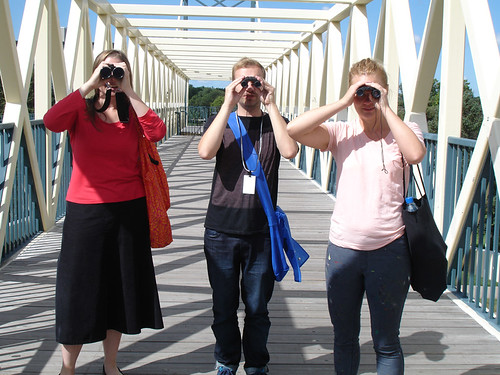 |
| Left to right: Abbie, Hans, and Nathalie |
Our excursion began at the picnic tables as Abbie distributed binoculars and describes Open Phenology, her series of nature walks focused on observing ecological phenomena in the Walker’s vicinity.
Abbie: I’m interested in noticing the life forms around us and observing how they change through the seasons. This means looking for birds migrating, insects molting, flowers blooming, etc. These observations, in turn, are the basis for conversation and learning.
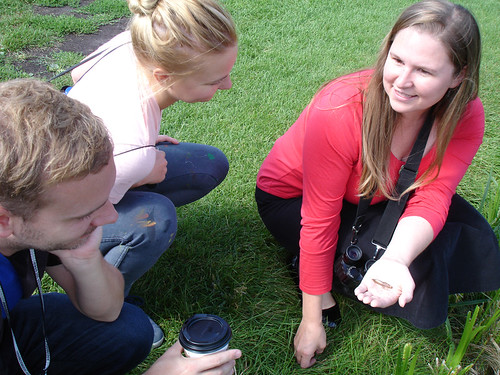
Abbie: See these?
Hans: Like ghosts.
Abbie: Larvae is actually Latin for ‘ghost.’
Hans [on metamorphosis]: It’s like one-day evolution.
Nathalie [clearly curious as to why an art educator takes such interest in biology]: So, what exactly do you do at the museum?
Abbie: Yes, I see what you mean. I’m a biology geek who works in an art museum. So beyond my job, which is supporting the Walker’s education and community programs, I’ve appointed myself as the Walker’s in-house amateur naturalist.
 |
| The Parade: Nathalie Djurberg with music by Hans Berg |
Susy: Why birds?
Nathalie: Before, birds were the least interesting to me—flock animals. Boring. I love animals and watch a lot of nature programs, but avoided bird programs. Then I came across David Attenborough.
Abbie: His documentary on birds of paradise?
Nathalie: Yeah, that guy!
Abbie: After watching Attenborough in Paradise, I felt like this planet is suddenly a totally different world! An astonishing place, but weird, right?
Nathalie: Yeah, though it was before that one that I got into him. And it changed how I see birds. I had no empathy for birds before. Now I really do.
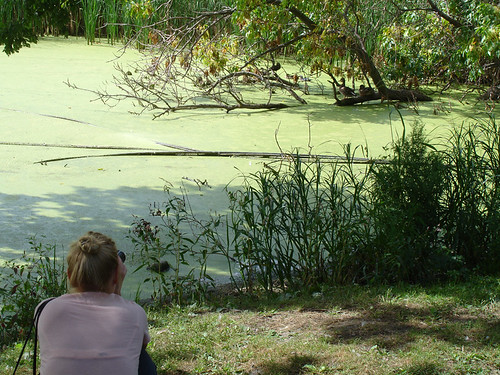
Abbie [chasing after Nathalie]: I love the investigative impulse!
Abbie [catching up and training binoculars]: You can recognize the Wood Duck by size and shape as well as by its plumage. Their nesting habitat is a tree cavity. Now we build boxes to help them out.
Hans: Are they rare?
Abbie: They’re not too rare, but many birds nest in dead trees, which we cut down. There’s a dead tree by my house that every morning is full of woodpeckers. It’s marvelous to see them. It’s a dead tree, but it’s living to them, because it’s full of bugs.
Nathalie [focusing her binoculars on a male Wood Duck]: Look at its eyes! They’re bright red.
Abbie: The Wood Duck is the showiest bird here.
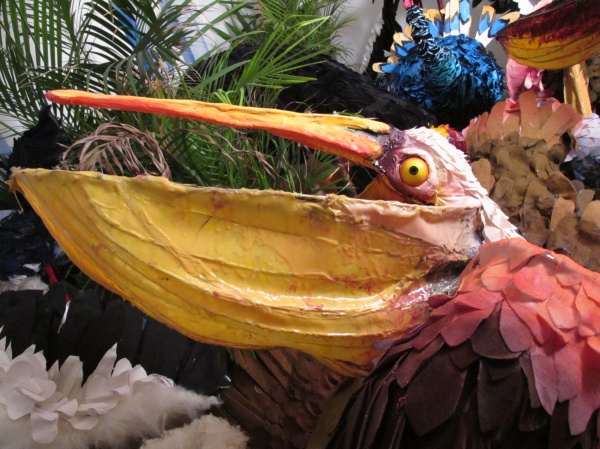 |
| Nathalie Djurberg, studio view of a work in progress, 2010 Courtesy the artists, Zach Feuer Gallery, New York and Giò Marconi, Milan |
Susy: How much of your birds come from actual birds in the world, and how much are derived from sheer imagination?
Nathalie: Most started by my looking at pictures, then really transformed in the process of making them. There were about thirty that came from my imagination. The rest were something specific at the start. Some have transformed so much I couldn’t recognize how they started.
Susy: How do you chose your birds?
Nathalie: I choose the ones I find interesting. Their personalities. How they move their heads. Their colors and patterns.
To witness the pageantry of these feathered forms with your own eyes, venture into the Walker’s Burnet Gallery—The Parade is on view through December 31. In addition to a flock of over eighty delightfully varied bird sculptures, the walls are brought to life by a selection of the artists’ claymation films and the entire space is awash in Hans’ music.
Birding and conversing with Nathalie and Hans has amplified my enjoyment of the show, which is emphatically rich and wild as it is. But after discovering a shared enthusiasm for Attenborough’s BBC documentaries, I found myself thinking, “Wouldn’t David Attenborough just have a field day here!” In a flight of fancy, I imagine a gallery tour led by Attenborough: Clad in khakis with a field guide in his vest pocket, he trains his binoculars on the multitude of exotic species. His hushed voice can hardly contain the exhilaration of catching sight of such strange birds. And lucky for us, this episode of Attenborough’s adventures doesn’t entail travel to an inaccessible tropical paradise, but unfolds in our own back yard.
—Co-authored by Abbie Anderson and Susy Bielak
Friday, August 26, 2011
Larvae* at Large
You can see a lot just by observing.—Yogi Berra
What you see is what you see.—Frank Stella
So, just what was to be seen today? The first animal that got our attention was a hawk, in flight and calling. David and I agreed it was either a Sharp-shinned or Cooper's and a good start to the day. And heading over to the pond, seeing a single nymph (below) led to seeing dozens.

Where: Clinging to aquatic plants growing in the shallow west edge of the pond at Spoonbridge and Cherry
Observers: Abbie, David, and Elizabeth
Date/Time: Friday, August 26, about 10:10 am
Conditions: Sunny. July's oppressive heat is a thing of the past.
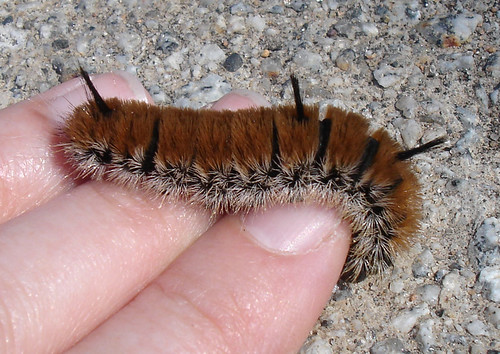
As a phenologist, albeit an amateur, this observation prompts important questions. First, what species were we seeing? Just one or a few varieties? These exuviae were about 1.5" long, and had I been vigilant, I might have glimpsed a dragonfly making its exit. Second, when exactly did these nymphs emerge? I didn't notice them last week, but had I simply failed to see them? Or was this legitimately a recent phenomenon?

Where: Eye-level on a flowering plant, arbor at the north edge of the Sculpture Garden
Observers: Spotted by David, observed by Abbie and Elizabeth
Date/Time: Friday, August 26, 10:35 am
Where: East edge of the Sculpture Garden, base of the stairs to the Irene Hixon Whitney Bridge.
Observers: Abbie and Kristen
Date/Time: Friday, August 26, at about 11:30 am
*Larva (plural larvae), is Latin for 'ghost.' A larva is the juvenile form of any animal that undergoes metamorphosis into its adult form. A caterpillar is the larval form of moths and caterpillars, while nymph is the larval form of dragonflies and damselflies. All this talk of larvae reminds me of the Goldenrod Gall Fly, that saccharine treat I learned about when Sarina joined Open Phenology on July 8.
Friday, July 29, 2011
Simulated Soundwalk
A soundwalk is any excursion whose main purpose is listening to the environment. Today I was joined by Brian, a friend, composer, sound engineer, and educator. The sound collage below roughly represents a few of the auditory sensations along our path through the Sculpture Garden. (And just like in real life, some of these sounds are soft and others a little louder...)
Above: YouTube media by waitingline
Above: Vimeo media by Maureen Mcsmith
Above: YouTube media by jkontrad
Above: YouTube media by Greg Holmes of thelope.com
Above: YouTube media by yaaren
What: Part of our process was imagining how the Walker's sound environment changes through the seasons. For example, by late July, the Red-Winged Blackbirds don't sound like this anymore. A detailed map of our soundwalk is available here, with descriptions at each placemarker. If you're interested in trying a soundwalk on your own, here is a suggested 'score' I adapted from an essay by Hildegard Westerkamp. Additional thanks to Frauke Behrendt for support and resources.
Where: Minneapolis Sculpture Garden
Observers (Listeners): Abbie and Brian
Date/Time: Friday, July 29, 10 to 11 am
Conditions: Hot, sunny, sonic
Above: YouTube media by waitingline
Above: Vimeo media by Maureen Mcsmith
Above: YouTube media by jkontrad
Above: YouTube media by Greg Holmes of thelope.com
Above: YouTube media by yaaren
What: Part of our process was imagining how the Walker's sound environment changes through the seasons. For example, by late July, the Red-Winged Blackbirds don't sound like this anymore. A detailed map of our soundwalk is available here, with descriptions at each placemarker. If you're interested in trying a soundwalk on your own, here is a suggested 'score' I adapted from an essay by Hildegard Westerkamp. Additional thanks to Frauke Behrendt for support and resources.
Where: Minneapolis Sculpture Garden
Observers (Listeners): Abbie and Brian
Date/Time: Friday, July 29, 10 to 11 am
Conditions: Hot, sunny, sonic
Monday, July 18, 2011
Grackle Vernacular
Above: YouTube media by laynie0705
What: Since it is World Listening Day I make extra efforts to notice the sonic qualities of Garden ongoings. I hear young Common Grackles vocalizing. Watching them, I see they are begging food from their parents. It looked like what you see above, but with lots more needy pleading.
Where: West edge of the Sculpture Garden, by FlatPak House
Observer: Abbie
Date/Time: July 18, 8:10 am
Conditions: Warm, sunny
What: I hear a sudden squawk and it focuses my attention to a clash in a low tree branch. A few Cedar Waxwings get the message that they're not wanted here and fly away. I may have missed them entirely had it not been for the noisy complaint of the Common Grackle.
Where: West edge of the Sculpture Garden, by FlatPak House
Observer: Abbie
Date/Time: July 18, 8:15 am
Conditions: Warm, sunny
Sunday, July 17, 2011
"Now I will do nothing but listen. . . . I hear all sounds running together, combined, fused or following, sounds of the city and sounds out of the city, sounds of the day and night. . ."
St. Mary's Basilica bells, YouTube media by Markitectonic
If you say hello to me tomorrow morning between 8 and 8:30 am, I won't reply. But I'll most certainly hear you because I'll be engaged in a soundwalk. What is a soundwalk? Jim Cummings, founder of the Acoustic Ecology Institute, defines it as follows:
Walt Whitman
St. Mary's Basilica bells, YouTube media by Markitectonic
If you say hello to me tomorrow morning between 8 and 8:30 am, I won't reply. But I'll most certainly hear you because I'll be engaged in a soundwalk. What is a soundwalk? Jim Cummings, founder of the Acoustic Ecology Institute, defines it as follows:
At its simplest, a soundwalk is just what its name implies: a walk during which you simply pay attention to each sound you encounter. More complex variations can include seeking out the most distant sound audible, or the faintest. Soundwalks are just as interesting in cities as in nature, and indeed, urban acoustic ecology offers many points for reflection and even aesthetic appreciation.
Tuesday, July 12, 2011
Cicada, droning unseen
| What: Cicada song, probably a 'dog day cicada.' (No, this isn't my field recording. This audio is a different species, Tibicen auriferus, courtesy the outstanding library of cicada recordings at InsectSingers.com.) Where: W 22nd St between Garfield and Harriet Avenues Observer: Abbie Date/Time: July 12, 5:50 pm Conditions: Sunny, warm, pleasant |


Cicada? Ah, summer! [. . .on to the next thought. . .]But with the Open Phenology mindset, my awareness behaves differently:
Cicada? And it's... July 12! Hey, isn't that the first I've heard this year? [inventorying recent memory...] No, no, none yet—I would have noticed. Will it sing again? Only that once? Eventually, (when, do you think?) the cicada chorus will be a regular feature of the summer afternoon sounds. Late summer, that is. Sigh...
Friday, July 8, 2011
Guest Blog: Scott Artley joins in on July 8th

On the morning of July 8th, seven people stood at the FlatPak House on the West end of the Minneapolis Sculpture Garden, looking much like some of the other tourists wandering through the area. Only instead of capturing photos of artworks, they donned binoculars to catch a momentary glance of birds. Instead of maps filled with the names of public artists, they held pocket-sized plant identification handbooks and ornithology guides.
Abbie greeted us and explained the concept of phenology: the study of the natural world through the seasons, seeking markers of time and change. It’s a science requiring sustained attention to subtlety—an artistic eye is an asset to environmental inquiry. Abbie’s mantra during the excursion was simple: “What do you notice?”
Although I went to Open Phenology to learn about the natural world around the Walker Art Center campus, I found myself fascinated by the way this group became a community as we wandered over the Whitney Bridge into Loring Park. Although Abbie’s is the only Open Field project that engages with the world of science, it does demonstrate aspects familiar to other Open Field activities:
- the facilitation of curiosity
- an ongoing commitment of time and space to step out of the everyday, and
- the ultimate outcome of sharing an experience together.
Thanks for inviting me along, Abbie, I’m looking forward to joining again.
--Scott Artley
Open Field Coordinator and Open Phenology guest blogger
Open Phenology print by Abigail Woods Anderson
Friday, July 1, 2011
Constant Vigilance Post Script
Returning to my desk after Open Phenology, my colleague Scott Artley is thrilled to report a hawk seen soaring over the Sculpture Garden. And I recollect that yes, I heard what must have been a hawk's cry. But I was so preoccupied watching thirteen-lined ground squirrels and robins that I didn't look up. Come to think of it, I bet that hawk had the little ground animals in its sights, too!
Next Friday (July 8), Scott Artley will join Open Phenology. In hopes that the hawk might make another appearance, I'm studying the field marks and calls of a few likely species: Red-tailed Hawk, Sharp-shinned Hawk, and American Kestrel.
Post-post script: Here's something to ponder: Where are the grackles today? Usually (so far this summer, that is), Common Grackles are emphatically abundant in the garden, but today I didn't see them. Could it be the heat? Hmm...
Next Friday (July 8), Scott Artley will join Open Phenology. In hopes that the hawk might make another appearance, I'm studying the field marks and calls of a few likely species: Red-tailed Hawk, Sharp-shinned Hawk, and American Kestrel.
Post-post script: Here's something to ponder: Where are the grackles today? Usually (so far this summer, that is), Common Grackles are emphatically abundant in the garden, but today I didn't see them. Could it be the heat? Hmm...
Constant Vigilance!
I was chatting with my colleague Christina when I hit upon this truism: constant vigilance is the foundation of good phenological practice. Christina, catching the reference I unwittingly made, explained that Harry Potter's Professor Alastor "Mad-Eye" Moody employs this same motto of "Constant Vigilance!" to teach Defense Against the Dark Arts. But now back to my familiar domain, that of Muggles, Citizen Science, and natural phenomena in the Walker's vicinity. In my June 23 post, I anticipated seeing changes, these being among them:


What: Nasturtium flowering, leaf at ~5" diameter
Where: Arlene Grossman Memorial Arbor
Observers: Abbie (July 1)
Date/Time: May 27 (left) and about 10:20 am on July 1 (right)
Conditions: Sweltering heat (July 1)


What: American Robin juvenile. While these pictures document different individuals, the emphasis is on change over time (June 10 to July 1)—most noticeably, the development of functional flight feathers.The robin on the right, though about the same size as an adult, can be recognized as juvenile by the plumage. See the speckled breast?
Where: Sculpture Garden, by Scott Burton's Seat-Leg Table (July 1)
Observers: Abbie (July 1)
Date/Time: June 10 (left) and about 10:30 am on July 1 (right)
Conditions: Sweltering heat (July 1) (eighty-some degrees)
So, besides Alastor Moody and myself, who else might call for "constant vigilance?" A gardener, naturally. Not to battle the Dark Arts so much as to keep horticultural entropy at bay. On today's survey, I noticed a team of three gardeners tending to the arbor.
 What: Iris leaves, tied in a knot and trimmed, to keep the garden looking orderly. And, in practical terms, this fastidious management allows light to reach the iris' neighbors
Where: Arlene Grossman Memorial Arbor
Observers: Abbie
Date/Time: July 1, about 10:15 am
Conditions: Sunny, hot (eighty-some degrees), and humid
 What: Clematis—about 5' tall and flowering—trained with twine to climb the arbor
Where: Arlene Grossman Memorial Arbor
Observers: Abbie
Date/Time: July 1, about 10:15 am
Conditions: Sunny, hot (eighty-some degrees), and humid
Constant vigilance is hyperbole, of course, but it's something to strive for. Anticipation has a positive influence on awareness.Take for example the Como Park Zoo and Conservatory's corpse flower. Again, props to my colleague Christina who watched the flower webcam with steadfast attention and even made a timely pilgrimage to witness the rare bloom. My vigilance, on the other hand, faltered, and I'm kicking myself for missing it.
If you'd like to prepare for July in hopes of not missing out, here's a tool to help you anticipate: Jim Gilbert's phenology report for July 2010 (PDF, 416 kb).

What: Nasturtium flowering, leaf at ~5" diameter
Where: Arlene Grossman Memorial Arbor
Observers: Abbie (July 1)
Date/Time: May 27 (left) and about 10:20 am on July 1 (right)
Conditions: Sweltering heat (July 1)

What: American Robin juvenile. While these pictures document different individuals, the emphasis is on change over time (June 10 to July 1)—most noticeably, the development of functional flight feathers.The robin on the right, though about the same size as an adult, can be recognized as juvenile by the plumage. See the speckled breast?
Where: Sculpture Garden, by Scott Burton's Seat-Leg Table (July 1)
Observers: Abbie (July 1)
Date/Time: June 10 (left) and about 10:30 am on July 1 (right)
Conditions: Sweltering heat (July 1) (eighty-some degrees)
So, besides Alastor Moody and myself, who else might call for "constant vigilance?" A gardener, naturally. Not to battle the Dark Arts so much as to keep horticultural entropy at bay. On today's survey, I noticed a team of three gardeners tending to the arbor.
Where: Arlene Grossman Memorial Arbor
Observers: Abbie
Date/Time: July 1, about 10:15 am
Conditions: Sunny, hot (eighty-some degrees), and humid
Where: Arlene Grossman Memorial Arbor
Observers: Abbie
Date/Time: July 1, about 10:15 am
Conditions: Sunny, hot (eighty-some degrees), and humid
Constant vigilance is hyperbole, of course, but it's something to strive for. Anticipation has a positive influence on awareness.Take for example the Como Park Zoo and Conservatory's corpse flower. Again, props to my colleague Christina who watched the flower webcam with steadfast attention and even made a timely pilgrimage to witness the rare bloom. My vigilance, on the other hand, faltered, and I'm kicking myself for missing it.
If you'd like to prepare for July in hopes of not missing out, here's a tool to help you anticipate: Jim Gilbert's phenology report for July 2010 (PDF, 416 kb).
Friday, June 10, 2011
The Mysterious West End
I accepted Abbie’s invitation to guest host during her absence this week and realized that I hadn’t walked the entire length of the Garden for more than a year. Well acquainted with the east entrance of the garden, my objective was to explore the unknown west end. Laura Robards Gantenbein, MN Artist Fellow, joined me on my excursion, where we passed by little creatures moving about. What really caught my eye however, was the space beyond the garden, a patch of trees on the west wall of the entrance near Dunwoody Blvd.
This mostly banal and unimpressive landscape included a particularly curious tree. Aesthetically I've always been drawn to the grotesque, and this tree was oozing with it, literally.
I’m not much of an arboriculturist, but I’m identifying this as a pine tree, what do you think? This particular pine was completely unabashedly secreting sap amongst its more modest peers. The sap was in various stages of sticky liquid and crystallized residue; I was fascinated. I don’t often analyze sappy trees, but this was the perfect opportunity to indulge.
Nestled in the tree was a morning dove, which didn’t seem to mind the sappy contents. Laura and I tenderly named the bird Cargill, after one of the lounges in the Walker. Having our fill of sap and new friend Cargill we made our way back to the museum and spotted a chipmunk. We named it Bazinet.
Bazzie, Bazzie 2, Bazinetta, were other chipmunks we spotted on the way back that crossed our path shortly after, but to be fair, the original Bazinet stole the chipmunk show.
Thank you for reading and stay tuned for next week’s sightings!
This mostly banal and unimpressive landscape included a particularly curious tree. Aesthetically I've always been drawn to the grotesque, and this tree was oozing with it, literally.
I’m not much of an arboriculturist, but I’m identifying this as a pine tree, what do you think? This particular pine was completely unabashedly secreting sap amongst its more modest peers. The sap was in various stages of sticky liquid and crystallized residue; I was fascinated. I don’t often analyze sappy trees, but this was the perfect opportunity to indulge.
Nestled in the tree was a morning dove, which didn’t seem to mind the sappy contents. Laura and I tenderly named the bird Cargill, after one of the lounges in the Walker. Having our fill of sap and new friend Cargill we made our way back to the museum and spotted a chipmunk. We named it Bazinet.
Bazzie, Bazzie 2, Bazinetta, were other chipmunks we spotted on the way back that crossed our path shortly after, but to be fair, the original Bazinet stole the chipmunk show.
Thank you for reading and stay tuned for next week’s sightings!
Sunday, June 5, 2011
Nocturnal beings and night visions
 |
| Click to enlarge --- it's worth it! |
Where: Window screen at my home
Observer: Abbie
Date/Time: June 5, midnight to 1 am
Conditions: Still and partly overcast
Zoom out with me, if you will, from Open Phenology's 'micro-local' focus to a 'macro-local' look at our cities on the 45th parallel. It was the night of Northern Spark, the Twin Cities' first nuit blanche featuring participatory art activities from dusk to dawn across Minneapolis and St. Paul. I was at home working on a painting when this spectacular moth alit on my screen. It clung motionless and permit me a few photographs. While it's difficult to judge scale from this image, this species has a wingspan of about 6". As my friend David aptly observed, it's like a lucky rabbit's foot with wings attached.
The Polyphemus is an astonishing creature. Its larva hatch in synchronized broods and undergo a series of moltings followed by a final metamorphosis into the adult moth. Their existence as moths is remarkably fleeting. Individuals live only a few days, just long enough to mate and start the next generation.
Above: Vortex Navigation Company perform "Let's Light a Light," YouTube media by Sean Connaughty (recorded March 2010)
 |
| View from within Sky Pesher |
Open Phenology is teaching me that for every event I witness, a staggering multitude of events go unseen. As I drove home in the 4 am darkness, the American Robins discerned and heralded the light, commencing a dawn chorus 90 minutes prior to sunrise.
Friday, May 27, 2011
Cool, windy, with a chance of Dreams
"In an object you can tell where the boundaries are, but in the weather it’s impossible to say when something begins or ends."—John Cage, 1981

Above: YouTube media by mostlymark (Recorded August 2009)
The 'dream' in Huyghe's work refers to John Cage's 1948 composition. Use the player below to listen to "Dream" performed by Stephen Drury.
Above: YouTube media by NewMusicXX
 |
| May 27 conditions, Wunderground.com (Weather station at Marriott City Center, Minneapolis) |

What: Pierre Huyghe's Wind Chime (after "Dream") transforms the sound environment. Sample its enchanting effect using the player below.
Where: A stand of trees, just north of Spoonbridge and Cherry
Observers: Martha, Renner, Abbie
Date/Time: Installed in mid-May, this work remains on view over the summer months.
Conditions: Cool, windy, and overcast
Above: YouTube media by mostlymark (Recorded August 2009)
The 'dream' in Huyghe's work refers to John Cage's 1948 composition. Use the player below to listen to "Dream" performed by Stephen Drury.
Above: YouTube media by NewMusicXX
Subscribe to:
Posts (Atom)