Showing posts with label vocabulary. Show all posts

Friday, September 2, 2011

Of Cities and Ecosystems

Beginning our walk, my colleague Scott and I corroborate a sighting: Twenty Canada Geese on the field at 9 am. Now's the time of year to look around for Canada Geese staging or look up for their V-shaped flight formations. Fall is settling in—just read the signs.

One such sign is seen on the Irene Hixon Whitney Bridge.
What: A clothesline, punctuated with colorful scarves and hats, extends the length of the ramp on both ends of the bridge. Since June, The Swatch Team have called fellow knitters, crochet practitioners, and yarn bombers to unite! And last night, their row-by-row radicalism culminated in this guerrilla installation. A clothesline full of utilitarian, handmade textiles surprised the public with its unfettered generosity. Committed to 'yarn bombing with a message,' the flyer from last evening's give-away reads,
Help yourself to the warm items you will need this winter. If you would like to contribute, add a drawing, poem, opinion, or creative expression to this line. We are all connected!
Where: Bridge between the Minneapolis Sculpture Garden and Loring Park
Observers: Abbie and Scott
Date/Time: Friday, September 2, 10:20 am
Conditions: Partly cloudy, with a view of the park and the city

Once across the bridge we encounter . . .
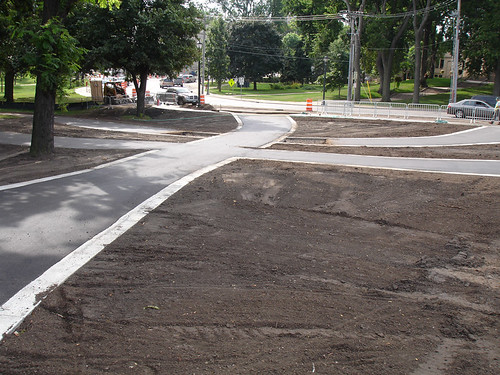
What: A network of freshly paved paths. Scott explains how neighborhood groups, the Parks Board, and municipal entities agreed upon this new configuration to improve safety for pedestrians and cyclists at this high-traffic corner. Scott, having attended Marcy Schulte's Community Walk About (presented as part of Living Classroom), relays a wealth of information about the park's history and its citizen advocates.
Where: Loring Park's southwest corner
Observers: Scott and Abbie
Date/Time: Friday, September 2, 10:30 am
Conditions: The dwindling summer season leaves just enough time for the project's finishing touches—signage and landscaping details.
Conversing with Scott is like paging through a neighborhood directory. His familiarity with area residents, business owners, and organizations prompts me to exclaim, "Here I thought this was the city, but it turns out it's a small town!" Listening to Scott talk about the neighborhood, the metaphor I'm imagining is an ecosystem, a network of interrelated parts.

Scott also calls my attention to the squirrels as a marker of ecological intervention. The ubiquitous gray squirrel was introduced to the area in the early twentieth century. And concurrent with the gray squirrel's introduction was the extermination of the red squirrel.

Before crossing Lyndale/Hennepin, our attention is drawn to St. Mark's beautiful lawn shaded by majestic elms. Scanning the lawn, we spot a blue tag on just about every tree trunk. Taking a cue from the Walker's free audio guide, Art on Call, Scott dials up "Trees on Call" to see who's on the other end of the line.

ART ON CALL
is to
ART
as . . .

(Images courtesy 
Walker Art Center)


TREES ON CALL
is to
TREES


What: Scott's call connects us to a tree specialist. The story behind the little blue tags is Dutch Elm Disease. Since nearby trees had been infected, the church took measures to protect these specimens by having a fungicide administered. Dutch Elm Disease (DED) is caused by a fungus, which in turn is transmitted by elm beetles. This makes the beetle the disease vector. And since this is a phenology blog, I speculate about the beetle's life cycle. September is the time that adult beetles make their way to the base of healthy elm trees to overwinter underground. Next year around mid-late April they'll emerge and fly to the elm's tree top to feed on leaves.
Where: St. Mark's Episcopal Cathedral's front lawn
Observers: Scott and Abbie
Date/Time: September 2, 11:40 am
Conditions: Curiosity satiated (for the time being)

Friday, August 26, 2011

Larvae* at Large

You can see a lot just by observing.—Yogi Berra
What you see is what you see.—Frank Stella

So, just what was to be seen today? The first animal that got our attention was a hawk, in flight and calling. David and I agreed it was either a Sharp-shinned or Cooper's and a good start to the day. And heading over to the pond, seeing a single nymph (below) led to seeing dozens.
What: Abundant exuviae, the discarded exoskeletons left by dragonflies in their transition from aquatic larvae to terrestrial, winged adults. (Resource: Dragonfly Biology 101)
Where: Clinging to aquatic plants growing in the shallow west edge of the pond at Spoonbridge and Cherry
Observers: Abbie, David, and Elizabeth
Date/Time: Friday, August 26, about 10:10 am
Conditions: Sunny. July's oppressive heat is a thing of the past.

As a phenologist, albeit an amateur, this observation prompts important questions. First, what species were we seeing? Just one or a few varieties? These exuviae were about 1.5" long, and had I been vigilant, I might have glimpsed a dragonfly making its exit. Second, when exactly did these nymphs emerge? I didn't notice them last week, but had I simply failed to see them? Or was this legitimately a recent phenomenon?
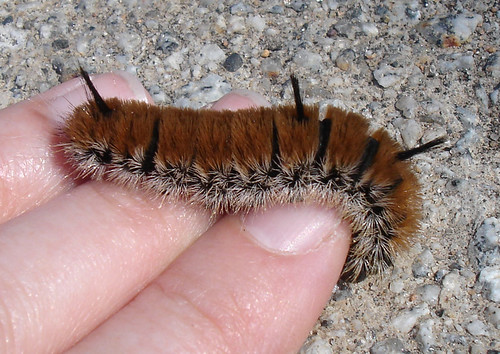
What: Caterpillar, unidentified and stationary
Where: Eye-level on a flowering plant, arbor at the north edge of the Sculpture Garden
Observers: Spotted by David, observed by Abbie and Elizabeth
Date/Time: Friday, August 26, 10:35 am


What: Another unidentified caterpillar, this one was scurrying across the sidewalk
Where: East edge of the Sculpture Garden, base of the stairs to the Irene Hixon Whitney Bridge.
Observers: Abbie and Kristen
Date/Time: Friday, August 26, at about 11:30 am

*Larva (plural larvae), is Latin for 'ghost.' A larva is the juvenile form of any animal that undergoes metamorphosis into its adult form. A caterpillar is the larval form of moths and caterpillars, while nymph is the larval form of dragonflies and damselflies. All this talk of larvae reminds me of the Goldenrod Gall Fly, that saccharine treat I learned about when Sarina joined Open Phenology on July 8.

Sunday, July 17, 2011

"Now I will do nothing but listen. . . . I hear all sounds running together, combined, fused or following, sounds of the city and sounds out of the city, sounds of the day and night. . ."
Walt Whitman

St. Mary's Basilica bells, YouTube media by Markitectonic

If you say hello to me tomorrow morning between 8 and 8:30 am, I won't reply. But I'll most certainly hear you because I'll be engaged in a soundwalk. What is a soundwalk? Jim Cummings, founder of the Acoustic Ecology Institute, defines it as follows:
At its simplest, a soundwalk is just what its name implies: a walk during which you simply pay attention to each sound you encounter. More complex variations can include seeking out the most distant sound audible, or the faintest. Soundwalks are just as interesting in cities as in nature, and indeed, urban acoustic ecology offers many points for reflection and even aesthetic appreciation.

Friday, July 15, 2011

A study in green

The color green can look remarkably vibrant in rainy conditons. Today's report comes from that chromacentric point of view.
Photo by Len Blumin
What: A Green Heron. With the rain and poor lighting, I couldn't get a good shot, so I borrowed this stunning image from a fellow Flickr photographer. I observed it for few minutes, during which it ceaselessly preened itself. This sighting isn't ephemeral or critical to phenology, but it was fun to see in an urban park.
Where: Perched about 15' high in a pine tree, on the eastern edge of the Garden, a lot of traffic noise coming from Hennepin Avenue.
Observer: Abbie
Date/Time: July 15, 10:35 am
Conditions: On-and-off rain, humid, low-hanging clouds obscuring the city skyline.
What: A Japanese beetle, about 3/8" in length. Kinda' pretty but totally pesky! This observation is a good phenological marker, as you can see from this diagram of the Japanese beetle's life cycle.
Where: Water's edge at Spoonbridge and Cherry.
Observer: Abbie
Date/Time: July 15, 10:20 am
Conditions: Wet but not raining

What: Green grass and a troop of mushrooms. Or are these gregarious? Mushrooms in a close group (but not so close as to be a cluster) are said to be a troop. If the group is more scattered and irregular, they are said to be gregarious. Eager for more vocabulary for fungi growth habits? Check it out: http://www.mushroomthejournal.com/greatlakesdata/Terms/troop269.html
Where: Open Field, north edge along Vineland Place
Observer: Abbie
Date/Time: July 15, 10: 45 am
Conditions: Good for growing
General observation for today: Birds were abundant. Those on the ground busied themselves by foraging (gorging?), and those perched were entirely preoccupied with preening. My complete bird list for the day: Northern Cardinal, White-breasted Nuthatch, Rock Pigeon, American Robin, Green Heron, House Finch, Red-winged Blackbird, Mourning Dove, Common Grackle

Friday, June 24, 2011

Going West in Search of Wild

Open Phenology collaborator Jim shares his field guide and expertise.
As Open Phenology attracts participants, the project's collaborative nature is taking shape. For example, this week's survey benefited from Jim's knowledge of botany and his intrepid impulse to explore the western fringe of the Walker's vicinity. So we left the manicured landscape of lawn and garden to investigate the wilder environs of wetland and forest.

Well, that begs the question: "What is wild?" What do terms like 'wilderness' or 'nature' denote, and what do we mean to exclude by using these words? It's an enigma to ponder because 'nature' seems to encompass everything, and yet most of us harbor the notion that nature has boundaries.

Once outside the urban yard's monoculture and the garden's cultivated display, does the land revert to its natural state? To the casual glance, perhaps it appears so. But upon examination, the answer is emphatically no. At every turn, introduced species were flourishing. And so we challenged ourselves to piece together, through observation and speculation, a semblance of this ecosystem's 'natural state.' And we wondered about the near future of this piece of land. Would our city or this neighborhood support and sustain the maintenance work necessary to keep invasives at bay?

What: Select observations described below
Where: Less than 1/2 mile west of FlatPak House, map above
Observers: Abbie, Jim, Martha, Renner
Date/Time: June 24, 10 to 11:30 am
Conditions: Sunny and warm