Showing posts with label collectivity. Show all posts

Thursday, July 26, 2012

Attention as Place: Surveying One Square Meter

If you follow the Walker Art Center via blogs, Facebook, or Twitter, you've caught word of ROLU-in-Residence. When I heard that a component of ROLU's residency bears the title "Attention as Place," I was intrigued. Notions of "attention" and "place" are at the core of Open Phenology.

"Attention as Place" is a showcase of interactive and intellectually compelling projects culled from ROLU's Web-based network and temporarily localized in the Walker's Cargill Lounge. While most works in this showcase have a physical aspect, they are more fundamentally about the intangible, the indeterminate, the speculative, or the experiential. And for that reason, viewers can have an intimate, give-and-take experience with any of the 22 projects that compose "Attention as Place."

Take, for instance, Amy Franceschini's SURVEYING ONE METER, an action-based project with the following prompt:

Look for the roped-off One Square Meter at the base of Open Field's hill, near the parking ramp entrance.

Catalog in writing everything you see in a one meter square in Open Field. This could be a text, a poem, or a list. Get as detailed as possible.

The parameters of Franceschini's project calls to my mind The Forest Unseen (book trailer, left) by David G. Haskell. And though the Walker's Open Field is no old growth wilderness, Franceschini's project urges us to see it as it is, how it is, and where it is. Like Open Phenology, Franceschini's project is based on the ethos that our immediate environment has great potential as the stage for re-enchantment and discovery.

Since Tuesday, I've completed two surveys of the square meter, each time depositing my written observations in a designated box in Cargill Lounge. You are welcome to participate in Franceschini's SURVEYING ONE METER. Visit the Walker's Cargill Lounge where a staff person will give you a clipboard with paper and pencil. Venture out to the square meter and tell us what you see.

Tuesday, July 17, 2012

The Suddenly Uncommon Common Grackle

(Or less common, anyhow.)

Phenomena are often detected by the presence of something. But sometimes they are inferred by the absence of something.

In May and June, I couldn't step foot in the Minneapolis Sculpture Garden without seeing and hearing Common Grackles. Usually dozens of them. But in the heat of July, they seem to have disappeared. I noticed this same phenomenon last year (post from July 1, 2011), too.

Curious about their peculiar absence, I surf over to E-Bird to explore the data. It looks as though my observations might fit the general pattern.
Here's a data visualization showing the frequency of Common Grackles on checklists submitted for Hennepin County, 2000-2012. The frequency of Common Grackles peak the week of May 1 at about 35%. Then frequency drops off and by mid-July it reaches lows close to 10%. I'm not sure how to explain this. But based on my observations of the Sculpture Garden, Common Grackles (adults as well as the new brood) vacate the nesting area once young reach the juvenile stage. It could be that during the juvenile stage of their development, Common Grackles redistribute & congregate in specific locations---locations where only 10% of checklists are generated. And that by contrast, during the nesting & fledgling phasea, Common Grackles are seen in 30% of locations where E-Bird checklists are generated.

To view a larger version of this interactive graph, courtesy E-Bird, click here.
What is "frequency"? Refer to the E-Bird glossary by clicking here.


Wednesday, May 9, 2012

Open Phenology is now micro-blogging!

Hello, Open Phenology followers!

I've been running short on time to post, so please check out my micro-blogging @openphenology, twitter.com/openphenology.

Christina and I went nest-spotting in the arborvitae hedges that line the Garden's four courtyards. We saw one aggressive Common Grackle chasing a Gray Squirrel. We saw a silent Mourning Dove on its nest. And we saw an anxious, vocal pair of Common Grackles, possibly with their nestling? Wish I could be more confident about this observation, but the individual was obscured by foliage and I didn't have my binoculars.

Friday, September 2, 2011

Of Cities and Ecosystems

Beginning our walk, my colleague Scott and I corroborate a sighting: Twenty Canada Geese on the field at 9 am. Now's the time of year to look around for Canada Geese staging or look up for their V-shaped flight formations. Fall is settling in—just read the signs.

One such sign is seen on the Irene Hixon Whitney Bridge.
What: A clothesline, punctuated with colorful scarves and hats, extends the length of the ramp on both ends of the bridge. Since June, The Swatch Team have called fellow knitters, crochet practitioners, and yarn bombers to unite! And last night, their row-by-row radicalism culminated in this guerrilla installation. A clothesline full of utilitarian, handmade textiles surprised the public with its unfettered generosity. Committed to 'yarn bombing with a message,' the flyer from last evening's give-away reads,
Help yourself to the warm items you will need this winter. If you would like to contribute, add a drawing, poem, opinion, or creative expression to this line. We are all connected!
Where: Bridge between the Minneapolis Sculpture Garden and Loring Park
Observers: Abbie and Scott
Date/Time: Friday, September 2, 10:20 am
Conditions: Partly cloudy, with a view of the park and the city

Once across the bridge we encounter . . .
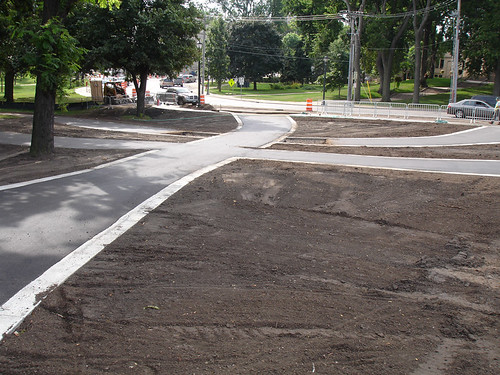
What: A network of freshly paved paths. Scott explains how neighborhood groups, the Parks Board, and municipal entities agreed upon this new configuration to improve safety for pedestrians and cyclists at this high-traffic corner. Scott, having attended Marcy Schulte's Community Walk About (presented as part of Living Classroom), relays a wealth of information about the park's history and its citizen advocates.
Where: Loring Park's southwest corner
Observers: Scott and Abbie
Date/Time: Friday, September 2, 10:30 am
Conditions: The dwindling summer season leaves just enough time for the project's finishing touches—signage and landscaping details.
Conversing with Scott is like paging through a neighborhood directory. His familiarity with area residents, business owners, and organizations prompts me to exclaim, "Here I thought this was the city, but it turns out it's a small town!" Listening to Scott talk about the neighborhood, the metaphor I'm imagining is an ecosystem, a network of interrelated parts.

Scott also calls my attention to the squirrels as a marker of ecological intervention. The ubiquitous gray squirrel was introduced to the area in the early twentieth century. And concurrent with the gray squirrel's introduction was the extermination of the red squirrel.

Before crossing Lyndale/Hennepin, our attention is drawn to St. Mark's beautiful lawn shaded by majestic elms. Scanning the lawn, we spot a blue tag on just about every tree trunk. Taking a cue from the Walker's free audio guide, Art on Call, Scott dials up "Trees on Call" to see who's on the other end of the line.

ART ON CALL
is to
ART
as . . .

(Images courtesy 
Walker Art Center)


TREES ON CALL
is to
TREES


What: Scott's call connects us to a tree specialist. The story behind the little blue tags is Dutch Elm Disease. Since nearby trees had been infected, the church took measures to protect these specimens by having a fungicide administered. Dutch Elm Disease (DED) is caused by a fungus, which in turn is transmitted by elm beetles. This makes the beetle the disease vector. And since this is a phenology blog, I speculate about the beetle's life cycle. September is the time that adult beetles make their way to the base of healthy elm trees to overwinter underground. Next year around mid-late April they'll emerge and fly to the elm's tree top to feed on leaves.
Where: St. Mark's Episcopal Cathedral's front lawn
Observers: Scott and Abbie
Date/Time: September 2, 11:40 am
Conditions: Curiosity satiated (for the time being)

Wednesday, August 17, 2011

No Lake is an Island

Biking to work yesterday, I happened upon a crew busying themselves at Spring Lake's shore. "What's this all about?" I asked a guy dressed in bib waders. Ted from BlueWing Environmental Solutions and Technologies, as he turned out to be, explained that he's part of a project to improve Spring Lake's water quality. Ted was working with people from Midwest Floating Island and members of the American Society of Landscape Architects to install seven "floating treatment wetlands." Once in place, these islands made of recycled plastics and foam are colonized by microbes and plants which do the work of extracting excess nutrients from the impaired wetland.

Today at 1 pm there's a public event to launch the islands.

Read more about who's involved in this management initiative and how the islands work at Josephine Marcotty's True North Star Tribune blog: http://www.startribune.com/local/blogs/127522343.html.

Thursday, July 14, 2011

Hey, listen up!

World Listening Day is next Monday, July 18. To participate, I'm planning a 30-minute soundwalk at 8 am, starting at FlatPak House. This is a pilot experience to inform the "Soundwalk Listening Experiment" planned for July 29. I've posted some resources about outdoor listening and acoustic ecology on this site's Soundwalk Page.

Friday, July 8, 2011

You gonna' eat that?

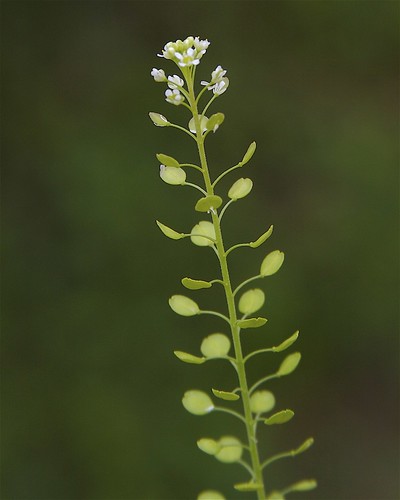
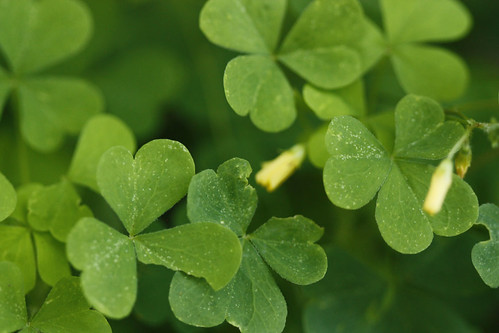
Open Phenology collaborator Sarina was our guide to the veritable supermarket of the urban Loring Park.
Pepper/Spice?
Cereal?
Tangy greens?
Duck Potato?

Photos, left to right: Pepperweed by Dan Mullen; Dock weed by Abbie; Wood sorrel by Judi Cox; Arrowhead by Dave

Thinking of plants in these terms (edible/non-edible) must play a role in learning, because Sarina was identifying plants left and right, up and down, and sharing this knowledge with other eager participants.

Care to join us for dessert? Perhaps later this season we'll harvest some goldenrod galls. Here's a fact that's hard to believe (but easy to remember): Inside each gall is a larval fly absorbing sugar from the plant, and if you get it at the right time of year, it's a sweet treat! That's right—to eat!

What else did the ten of us see today? Click here to review some of our observations.

Guest Blog: Scott Artley joins in on July 8th


On the morning of July 8th, seven people stood at the FlatPak House on the West end of the Minneapolis Sculpture Garden, looking much like some of the other tourists wandering through the area. Only instead of capturing photos of artworks, they donned binoculars to catch a momentary glance of birds. Instead of maps filled with the names of public artists, they held pocket-sized plant identification handbooks and ornithology guides.
Abbie greeted us and explained the concept of phenology: the study of the natural world through the seasons, seeking markers of time and change. It’s a science requiring sustained attention to subtlety—an artistic eye is an asset to environmental inquiry. Abbie’s mantra during the excursion was simple: “What do you notice?”
Although I went to Open Phenology to learn about the natural world around the Walker Art Center campus, I found myself fascinated by the way this group became a community as we wandered over the Whitney Bridge into Loring Park. Although Abbie’s is the only Open Field project that engages with the world of science, it does demonstrate aspects familiar to other Open Field activities:
  • the facilitation of curiosity
  • an ongoing commitment of time and space to step out of the everyday, and
  • the ultimate outcome of sharing an experience together.
Thanks for inviting me along, Abbie, I’m looking forward to joining again.
--Scott Artley
Open Field Coordinator and Open Phenology guest blogger

Open Phenology print by Abigail Woods Anderson

Thursday, June 9, 2011

Further Opening Phenology

The "Open" in Open Phenology has multiple meanings.
  • Making the science of phenology accessible to more people
  • Welcoming all levels of expertise and involvement
  • Valuing transparency, collaboration, and spontaneity
  • Expanding the scope of phenology—observations are not limited to 'biological phenomena,' but encompass the social, cultural, and technological aspects of our environment
  • Acknowledging a blend of objective and subjective approaches
I'm pleased to open up the project to include two guest facilitators/leaders: Adriana and Lindsay.

June 10, 10 am: Open Phenology led by Adriana
Join guest facilitator Adriana for the weekly experiment that is Open Phenology. As usual, the exploration and the conversation start at FlatPak House in the Garden.

June 17, 10 am: Open Phenology led by Lindsay
Join Lindsay, volunteer explorer and nature enthusiast, for this installment of Open Phenology. Meet at FlatPak House in the Garden to see for yourself what's going on around the Walker.

Sunday, June 5, 2011

Nocturnal beings and night visions

Click to enlarge --- it's worth it!
What: A Polyphemus moth
Where: Window screen at my home
Observer: Abbie
Date/Time: June 5, midnight to 1 am
Conditions: Still and partly overcast
 
Zoom out with me, if you will, from Open Phenology's 'micro-local' focus to a 'macro-local' look at our cities on the 45th parallel. It was the night of Northern Spark, the Twin Cities' first nuit blanche featuring participatory art activities from dusk to dawn across Minneapolis and St. Paul. I was at home working on a painting when this spectacular moth alit on my screen. It clung motionless and permit me a few photographs. While it's difficult to judge scale from this image, this species has a wingspan of about 6". As my friend David aptly observed, it's like a lucky rabbit's foot with wings attached.

The Polyphemus is an astonishing creature. Its larva hatch in synchronized broods and undergo a series of moltings followed by a final metamorphosis into the adult moth. Their existence as moths is remarkably fleeting. Individuals live only a few days, just long enough to mate and start the next generation.


Above: Vortex Navigation Company perform "Let's Light a Light," YouTube media by Sean Connaughty (recorded March 2010)

View from within Sky Pesher
By 2 am I had left the lone moth and was nestled into Sky Pesher for Nightshift's headphone concerts. As I listened to Vortex Navigation Company perform "Let's Light a Light," I gazed into the square of sky and envisioned a choreography of great moths, aloft on plumes of pheromones and lured by the light. And I thought of the city, pulsing with blinking bike lights and illuminated with creative phenomena.

Open Phenology is teaching me that for every event I witness, a staggering multitude of events go unseen. As I drove home in the 4 am darkness, the American Robins discerned and heralded the light, commencing a dawn chorus 90 minutes prior to sunrise.