- June 8: Nestlings seen, just barely visible by their movement and still within the nest
- June 18: 3 chicks seen out of the nest and up in the pine branches, documented by my colleague Christina (photo)
- July 2: We see one dead chick on the ground
- July 11: We notice the nest is significantly dismantled (photo). Is this evidence of predation?
- Mid-July: We see a second dead heron chick on the ground
- August 4: Wildlife rescue service picks up a third chick, reportedly not doing well
Showing posts with label continuity. Show all posts
Showing posts with label continuity. Show all posts
Saturday, September 15, 2012
What Little I Know
Gentle reader, I owe you an update about the green herons and their brood. I would have been more forthcoming had there been happy news to share. But I haven't been eager to report the sad things we've witnessed in the Garden. Here's an outline of what little I know:

Saturday, June 30, 2012
The Benefits of Constant Vigilance
 |
| Young Green Herons, Minneapolis Sculpture Garden. Photo by Christina |
Where: Along the east border of the Minneapolis Sculpture Garden, a pair of Green Herons built a nest high in a pine tree. For several months now, Rachel, Christina, and I have been checking on the nest, watching to see that the adults were present and straining our eyes to detect young. In the week before my long vacation, we finally observed indications of a successful brood --- scarcely perceptible, we could see movement of downy head(s) and maybe a small beak at the nest's brim, under a vigilant adult.
When: June 18, 2012
Observers: Christina and Rachel, two colleagues of mine who enthusiastically stepped in as proxy phenologists over my vacation. I'm so grateful to Christina and Rachel for sustaining the continuity of our phenology practice!
Conditions: Elated! (I wasn't there to report on weather or other objective details, so I'll skip ahead to to the subjective conditions.) Upon arriving to town after vacation, the first thing I did was log into my Twitter, @openphenology. I was thrilled to read my colleagues' report of the fledglings and view their terrific photo (above). It all serves as a reminder that phenology entails a continual and regular practice. Or, to use Christina's and my mantra: Constant vigilance!
Thursday, May 31, 2012
Still there!
I was getting worried about those Green Herons after noticing their absence. Was the brood unsuccessful and the pair abandoned the nest?
- Friday, May 25 at 10 am: nest check, no herons seen
- Friday, May 25 at 4:45 pm: nest check, no herons seen
- Tuesday, May 29, 10:30 am: nest check, no herons seen
Wednesday, May 9, 2012
Open Phenology is now micro-blogging!
Hello, Open Phenology followers!
I've been running short on time to post, so please check out my micro-blogging @openphenology, twitter.com/openphenology.
Christina and I went nest-spotting in the arborvitae hedges that line the Garden's four courtyards. We saw one aggressive Common Grackle chasing a Gray Squirrel. We saw a silent Mourning Dove on its nest. And we saw an anxious, vocal pair of Common Grackles, possibly with their nestling? Wish I could be more confident about this observation, but the individual was obscured by foliage and I didn't have my binoculars.
Wednesday, May 2, 2012
Suggested Reading: Microattention by a Contemplative Scientist
http://ttbook.org/book/david-george-haskell-forest-unseen
An inspiring interview with author David George Haskell discussing his book The Forest Unseen: A Year's Watch in Nature.
An inspiring interview with author David George Haskell discussing his book The Forest Unseen: A Year's Watch in Nature.
Sunday, October 9, 2011
Wait, wait—what season is it?

Where: Lake of the Isles (click here for map)
Observers: Abbie and Mary
Date/Time: 10:30 am, Sunday, October 9
Conditions: Unseasonably warm, the day's temperature was to reach 80°

Is this an "autumn blooming cherry," or is has the tree's clock been confused by recent weather patterns?
Saturday, August 27, 2011
Subdividing the Summer
A month ago, when cicada calls sparked my curiosity, I corresponded with a cicada enthusiast who remarked,

August 12: Eastern Forktails on the scene, abundant

August 19: Abundant and diverse dragonflies and damselflies. A lot of unfinished work in terms identification.

August 26: Emergence of an unidentified dragonfly, as inferred by the presence of abundant exuviae.

August 26: Damselflies (possibly a species of sprite) mating; Eastern Forktails are still present but (by my estimation) less abundant than 2 weeks prior.
If I added some expertise and methodology (some science, if you will) to my practice, how sophisticated could this chronology become? But rather than pursuing a single focus (dragonflies, for example), Open Phenology cast its net broadly. I've had the opportunity to share this project with collaborators with diverse specialties, ranging from ornithology to botany, audio engineering to phenology, sculpture conservation to ecology. Open Phenology's expansive approach is key to its strenghths:
"I love the way cicadas subdivide the summer for me. I suppose studying any summer fauna does the same."And though I'm very green at my 'studies,' I share this impression. I say 'impression' because my haphazard observations are painted with a broad brush rather than rendered by well-informed study and systematic record-keeping. None-the-less, here's how my sub-divided summer has played out:
August 12: Eastern Forktails on the scene, abundant
August 19: Abundant and diverse dragonflies and damselflies. A lot of unfinished work in terms identification.
August 26: Emergence of an unidentified dragonfly, as inferred by the presence of abundant exuviae.
August 26: Damselflies (possibly a species of sprite) mating; Eastern Forktails are still present but (by my estimation) less abundant than 2 weeks prior.
If I added some expertise and methodology (some science, if you will) to my practice, how sophisticated could this chronology become? But rather than pursuing a single focus (dragonflies, for example), Open Phenology cast its net broadly. I've had the opportunity to share this project with collaborators with diverse specialties, ranging from ornithology to botany, audio engineering to phenology, sculpture conservation to ecology. Open Phenology's expansive approach is key to its strenghths:
- Accessible to multiple publics, Open Phenology has no prerequisite knowledge base or skill set.
- Open Phenology values synthesis and interconnections as a way of understanding the world.
- Open Phenology promotes non-hierarchical exchange of information.
- Through facilitated conversations and discovery, Open Phenology emphasizes empirical observation. A frame is drawn around this activity, calling attention to its legitimacy and authenticity.
- In addition to recording what we do see, participants are encouraged to consider what we don't see and this leads to speculations, hyphotheses, and sustained curiosity.
Throughout the summer I've been negotiating Open Phenology's ambiguous relation to science. I have maintained all along that Open Phenology is not science, and while I'm content with this, it makes me wonder about lost opportunities. How would I modify Open Phenology to bring it into alignment with scientific inquiry? Specialization is the answer. Here are some citizen science endeavors on my radar:
- Use Cornell Ornithology Lab's NestWatch or eBird to collect data on birds.
- Participate in the Minnesota Odonata Survey Project
- Collect and share information about Lepidoptera on BAMONA (Butterflies and Moths of North America)
- Join USA National Phenology Network's call to take the pulse of our planet. Select one or two species to study and record.
Friday, August 26, 2011
Larvae* at Large
You can see a lot just by observing.—Yogi Berra
What you see is what you see.—Frank Stella
So, just what was to be seen today? The first animal that got our attention was a hawk, in flight and calling. David and I agreed it was either a Sharp-shinned or Cooper's and a good start to the day. And heading over to the pond, seeing a single nymph (below) led to seeing dozens.

Where: Clinging to aquatic plants growing in the shallow west edge of the pond at Spoonbridge and Cherry
Observers: Abbie, David, and Elizabeth
Date/Time: Friday, August 26, about 10:10 am
Conditions: Sunny. July's oppressive heat is a thing of the past.
As a phenologist, albeit an amateur, this observation prompts important questions. First, what species were we seeing? Just one or a few varieties? These exuviae were about 1.5" long, and had I been vigilant, I might have glimpsed a dragonfly making its exit. Second, when exactly did these nymphs emerge? I didn't notice them last week, but had I simply failed to see them? Or was this legitimately a recent phenomenon?

Where: Eye-level on a flowering plant, arbor at the north edge of the Sculpture Garden
Observers: Spotted by David, observed by Abbie and Elizabeth
Date/Time: Friday, August 26, 10:35 am
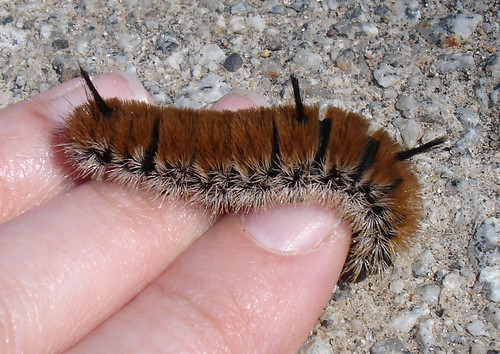
Where: East edge of the Sculpture Garden, base of the stairs to the Irene Hixon Whitney Bridge.
Observers: Abbie and Kristen
Date/Time: Friday, August 26, at about 11:30 am
*Larva (plural larvae), is Latin for 'ghost.' A larva is the juvenile form of any animal that undergoes metamorphosis into its adult form. A caterpillar is the larval form of moths and caterpillars, while nymph is the larval form of dragonflies and damselflies. All this talk of larvae reminds me of the Goldenrod Gall Fly, that saccharine treat I learned about when Sarina joined Open Phenology on July 8.

Friday, August 12, 2011
While You Were(n't) Looking
Where: Pond perimeter, near Spoonbridge and Cherry
Observers: Abbie (and, via Internet, Kurt Mead, MOSP educator and scientist, who identified this insect by species name)
Date/Time: Friday, August 12, 10:20 am
Conditions: Overcast and 70°-ish
 |  |  |
Where: Arlene Grossman Memorial Arbor and Flower Garden, north edge of the Minneapolis Sculpture Garden
Observer: Abbie
Date/Time: Friday, August 12, 10:30 am
Conditions: a-buzz with insect pollinators and pests
 |  |  |
Where: Minneapolis Sculpture Garden and The Grove (entrance to the Walker off Vineland Place)
Observer: Abbie
Date/Time: Friday, August 12, between 10 and 11 am
Conditions: Warm and overcast—insistently summery with incipient signs of autumn
Tuesday, July 26, 2011
WAS // NOW
On my bike ride to work this morning, I made a short list of how things were but are no longer:
- Dock weed
- was: green flower stalks . . .
- now: rusty spindles
- Canada thistle
- was: flowering . . .
- now: almost all gone to down
- Bee balm
- was: unnoticed . . .
- now: beautiful pale violet blossoms
- Cow parsnip
- was: green umbels with seeds forming . . .
- now: umbels are brown in color
- Clovers
- was: in June, only white clover flowers
- now: by July, the purple clovers complement the scenery
Monday, July 11, 2011
Dock Swatch
Inspired by an observation the Open Phenology group made last Friday, I collected specimens to create this "dock swatch." As the plants' flower spires turn rusty in color, you'll spy this 'weed' proliferating on banked sides of highways.
Friday, July 1, 2011
Constant Vigilance!
I was chatting with my colleague Christina when I hit upon this truism: constant vigilance is the foundation of good phenological practice. Christina, catching the reference I unwittingly made, explained that Harry Potter's Professor Alastor "Mad-Eye" Moody employs this same motto of "Constant Vigilance!" to teach Defense Against the Dark Arts. But now back to my familiar domain, that of Muggles, Citizen Science, and natural phenomena in the Walker's vicinity. In my June 23 post, I anticipated seeing changes, these being among them:


What: Nasturtium flowering, leaf at ~5" diameter
Where: Arlene Grossman Memorial Arbor
Observers: Abbie (July 1)
Date/Time: May 27 (left) and about 10:20 am on July 1 (right)
Conditions: Sweltering heat (July 1)


What: American Robin juvenile. While these pictures document different individuals, the emphasis is on change over time (June 10 to July 1)—most noticeably, the development of functional flight feathers.The robin on the right, though about the same size as an adult, can be recognized as juvenile by the plumage. See the speckled breast?
Where: Sculpture Garden, by Scott Burton's Seat-Leg Table (July 1)
Observers: Abbie (July 1)
Date/Time: June 10 (left) and about 10:30 am on July 1 (right)
Conditions: Sweltering heat (July 1) (eighty-some degrees)
So, besides Alastor Moody and myself, who else might call for "constant vigilance?" A gardener, naturally. Not to battle the Dark Arts so much as to keep horticultural entropy at bay. On today's survey, I noticed a team of three gardeners tending to the arbor.
 What: Iris leaves, tied in a knot and trimmed, to keep the garden looking orderly. And, in practical terms, this fastidious management allows light to reach the iris' neighbors
Where: Arlene Grossman Memorial Arbor
Observers: Abbie
Date/Time: July 1, about 10:15 am
Conditions: Sunny, hot (eighty-some degrees), and humid
 What: Clematis—about 5' tall and flowering—trained with twine to climb the arbor
Where: Arlene Grossman Memorial Arbor
Observers: Abbie
Date/Time: July 1, about 10:15 am
Conditions: Sunny, hot (eighty-some degrees), and humid
Constant vigilance is hyperbole, of course, but it's something to strive for. Anticipation has a positive influence on awareness.Take for example the Como Park Zoo and Conservatory's corpse flower. Again, props to my colleague Christina who watched the flower webcam with steadfast attention and even made a timely pilgrimage to witness the rare bloom. My vigilance, on the other hand, faltered, and I'm kicking myself for missing it.
If you'd like to prepare for July in hopes of not missing out, here's a tool to help you anticipate: Jim Gilbert's phenology report for July 2010 (PDF, 416 kb).

What: Nasturtium flowering, leaf at ~5" diameter
Where: Arlene Grossman Memorial Arbor
Observers: Abbie (July 1)
Date/Time: May 27 (left) and about 10:20 am on July 1 (right)
Conditions: Sweltering heat (July 1)

What: American Robin juvenile. While these pictures document different individuals, the emphasis is on change over time (June 10 to July 1)—most noticeably, the development of functional flight feathers.The robin on the right, though about the same size as an adult, can be recognized as juvenile by the plumage. See the speckled breast?
Where: Sculpture Garden, by Scott Burton's Seat-Leg Table (July 1)
Observers: Abbie (July 1)
Date/Time: June 10 (left) and about 10:30 am on July 1 (right)
Conditions: Sweltering heat (July 1) (eighty-some degrees)
So, besides Alastor Moody and myself, who else might call for "constant vigilance?" A gardener, naturally. Not to battle the Dark Arts so much as to keep horticultural entropy at bay. On today's survey, I noticed a team of three gardeners tending to the arbor.
Where: Arlene Grossman Memorial Arbor
Observers: Abbie
Date/Time: July 1, about 10:15 am
Conditions: Sunny, hot (eighty-some degrees), and humid
Where: Arlene Grossman Memorial Arbor
Observers: Abbie
Date/Time: July 1, about 10:15 am
Conditions: Sunny, hot (eighty-some degrees), and humid
Constant vigilance is hyperbole, of course, but it's something to strive for. Anticipation has a positive influence on awareness.Take for example the Como Park Zoo and Conservatory's corpse flower. Again, props to my colleague Christina who watched the flower webcam with steadfast attention and even made a timely pilgrimage to witness the rare bloom. My vigilance, on the other hand, faltered, and I'm kicking myself for missing it.
If you'd like to prepare for July in hopes of not missing out, here's a tool to help you anticipate: Jim Gilbert's phenology report for July 2010 (PDF, 416 kb).
Subscribe to:
Posts (Atom)