Showing posts with label speculation. Show all posts
Showing posts with label speculation. Show all posts
Wednesday, November 21, 2012
Woolly What Now?
What: Woolly Alder Aphids!
Where: I found these on the underside of branches on a small alder tree by Spring Lake (west of the Minneapolis Sculpture Garden about a quarter mile).
When: November 21, 2012 at 8:15 am
Observers: Abbie --- I was captivated . . . and more than a little creeped out. What on earth is this bizarre stuff? Was it fungus? Something man-made? Or something unearthly and alien, which seemed just as likely. So I contacted a professional naturalist friend of mine who identified these Woolly Alder Aphids.
Conditions: Breezy and brisk

Thursday, July 26, 2012
Attention as Place: Surveying One Square Meter
If you follow the Walker Art Center via blogs, Facebook, or Twitter, you've caught word of ROLU-in-Residence. When I heard that a component of ROLU's residency bears the title "Attention as Place," I was intrigued. Notions of "attention" and "place" are at the core of Open Phenology.
"Attention as Place" is a showcase of interactive and intellectually compelling projects culled from ROLU's Web-based network and temporarily localized in the Walker's Cargill Lounge. While most works in this showcase have a physical aspect, they are more fundamentally about the intangible, the indeterminate, the speculative, or the experiential. And for that reason, viewers can have an intimate, give-and-take experience with any of the 22 projects that compose "Attention as Place."
Take, for instance, Amy Franceschini's SURVEYING ONE METER, an action-based project with the following prompt:
 Look for the roped-off One Square Meter at the base of Open Field's hill, near the parking ramp entrance.
Catalog in writing everything you see in a one meter square in Open Field. This could be a text, a poem, or a list. Get as detailed as possible.
Since Tuesday, I've completed two surveys of the square meter, each time depositing my written observations in a designated box in Cargill Lounge. You are welcome to participate in Franceschini's SURVEYING ONE METER. Visit the Walker's Cargill Lounge where a staff person will give you a clipboard with paper and pencil. Venture out to the square meter and tell us what you see.
"Attention as Place" is a showcase of interactive and intellectually compelling projects culled from ROLU's Web-based network and temporarily localized in the Walker's Cargill Lounge. While most works in this showcase have a physical aspect, they are more fundamentally about the intangible, the indeterminate, the speculative, or the experiential. And for that reason, viewers can have an intimate, give-and-take experience with any of the 22 projects that compose "Attention as Place."
Take, for instance, Amy Franceschini's SURVEYING ONE METER, an action-based project with the following prompt:
Catalog in writing everything you see in a one meter square in Open Field. This could be a text, a poem, or a list. Get as detailed as possible.
| The parameters of Franceschini's project calls to my mind The Forest Unseen (book trailer, left) by David G. Haskell. And though the Walker's Open Field is no old growth wilderness, Franceschini's project urges us to see it as it is, how it is, and where it is. Like Open Phenology, Franceschini's project is based on the ethos that our immediate environment has great potential as the stage for re-enchantment and discovery. |
Since Tuesday, I've completed two surveys of the square meter, each time depositing my written observations in a designated box in Cargill Lounge. You are welcome to participate in Franceschini's SURVEYING ONE METER. Visit the Walker's Cargill Lounge where a staff person will give you a clipboard with paper and pencil. Venture out to the square meter and tell us what you see.
Thursday, May 31, 2012
Still there!
I was getting worried about those Green Herons after noticing their absence. Was the brood unsuccessful and the pair abandoned the nest?
- Friday, May 25 at 10 am: nest check, no herons seen
- Friday, May 25 at 4:45 pm: nest check, no herons seen
- Tuesday, May 29, 10:30 am: nest check, no herons seen
Wednesday, May 2, 2012
Suggested Reading: Microattention by a Contemplative Scientist
http://ttbook.org/book/david-george-haskell-forest-unseen
An inspiring interview with author David George Haskell discussing his book The Forest Unseen: A Year's Watch in Nature.
An inspiring interview with author David George Haskell discussing his book The Forest Unseen: A Year's Watch in Nature.
Thursday, February 2, 2012
Flock Clock
What: About 100 American Robins. They are almost entirely silent, making scarcely a peep as the arrive in small flocks. I make a quick count, noticing that any given tree provides perch for10–25 loosely clustered individuals.
Where: The southwest corner of the Sculpture Garden, where linden trees line Vineland Place as it bends north, before becoming Kenwood Parkway. Also in the locust trees that grow in the median.
Observers: Abbie
Date/Time: Wednesday, February 1 at about 5:20 pm
Conditions: Identification was challenging since the light at this hour was barely sufficient. I could faintly descry their reddish robin breasts. By their silhouettes, I knew their tails were too long to be starlings and they didn't have crests like cardinals or waxwings.
In the past several weeks, leaving work has been my opportunity to see flocks of European Starlings, American Crows, Dark-Eyed Juncos, and American Robins. Each flock seems to be characterized by their own pattern, behavior, size, and timing. Which flock is on the move earliest in the day (relative to sunset)? Which flock is most fleeting, most ephemeral and likely to be missed? When do these patterns begin in the winter season, and when will the flocks dissipate as spring approaches? But to really understand this 'flock clock,' I'd need extended observations a few times a week, say, from 4-6:30 pm. Given my narrow aperture of observation, from 5 to 5:30 on weekdays, here's a summary of what I've seen:
Most abundant—easily numbering in the thousands—are the American Crows. Since December, I've seen a stream of them flying high in the sky every evening, usually in an easterly or northeasterly direction. Sometimes I've seen them densely populating the trees in Loring Park.
Next in number are the European Starlings. But I can't get a handle on their timing. I haven't seen them in weeks, but my colleague saw them last night after 6 pm.
When I've seen groups of Dark-Eyed Juncos, they were not in flight, but rather on the ground under the arborvitae. I haven't seen them in over a month, but maybe they're just around when I'm not there to see them.
So far, the most understated of the flock phenomena is the American Robin. Also,this is the newest indicator on the flock clock. I know many stick around through the winter, but I haven't seen them in flocks until late January.
Where: The southwest corner of the Sculpture Garden, where linden trees line Vineland Place as it bends north, before becoming Kenwood Parkway. Also in the locust trees that grow in the median.
Observers: Abbie
Date/Time: Wednesday, February 1 at about 5:20 pm
Conditions: Identification was challenging since the light at this hour was barely sufficient. I could faintly descry their reddish robin breasts. By their silhouettes, I knew their tails were too long to be starlings and they didn't have crests like cardinals or waxwings.
In the past several weeks, leaving work has been my opportunity to see flocks of European Starlings, American Crows, Dark-Eyed Juncos, and American Robins. Each flock seems to be characterized by their own pattern, behavior, size, and timing. Which flock is on the move earliest in the day (relative to sunset)? Which flock is most fleeting, most ephemeral and likely to be missed? When do these patterns begin in the winter season, and when will the flocks dissipate as spring approaches? But to really understand this 'flock clock,' I'd need extended observations a few times a week, say, from 4-6:30 pm. Given my narrow aperture of observation, from 5 to 5:30 on weekdays, here's a summary of what I've seen:
Most abundant—easily numbering in the thousands—are the American Crows. Since December, I've seen a stream of them flying high in the sky every evening, usually in an easterly or northeasterly direction. Sometimes I've seen them densely populating the trees in Loring Park.
Next in number are the European Starlings. But I can't get a handle on their timing. I haven't seen them in weeks, but my colleague saw them last night after 6 pm.
When I've seen groups of Dark-Eyed Juncos, they were not in flight, but rather on the ground under the arborvitae. I haven't seen them in over a month, but maybe they're just around when I'm not there to see them.
So far, the most understated of the flock phenomena is the American Robin. Also,this is the newest indicator on the flock clock. I know many stick around through the winter, but I haven't seen them in flocks until late January.
Monday, December 12, 2011
Dawn Chorus on Vineland Place
What: A dawn chorus of (presumably) European Starlings
Where: Too dark to see, the calls and chatter seemed to come from the arborvitae at the Sculpture Garden's south edge
Observer: Abbie
Date/Time: Monday, December 12, 7 am
Conditions: Overcast and warmer than previous days, so warm I had no need for gloves
Where: Too dark to see, the calls and chatter seemed to come from the arborvitae at the Sculpture Garden's south edge
Observer: Abbie
Date/Time: Monday, December 12, 7 am
Conditions: Overcast and warmer than previous days, so warm I had no need for gloves
Sunday, October 9, 2011
Wait, wait—what season is it?

Where: Lake of the Isles (click here for map)
Observers: Abbie and Mary
Date/Time: 10:30 am, Sunday, October 9
Conditions: Unseasonably warm, the day's temperature was to reach 80°

Is this an "autumn blooming cherry," or is has the tree's clock been confused by recent weather patterns?
Friday, September 2, 2011
Of Cities and Ecosystems
Beginning our walk, my colleague Scott and I corroborate a sighting: Twenty Canada Geese on the field at 9 am. Now's the time of year to look around for Canada Geese staging or look up for their V-shaped flight formations. Fall is settling in—just read the signs.
One such sign is seen on the Irene Hixon Whitney Bridge.
Once across the bridge we encounter . . .
Conversing with Scott is like paging through a neighborhood directory. His familiarity with area residents, business owners, and organizations prompts me to exclaim, "Here I thought this was the city, but it turns out it's a small town!" Listening to Scott talk about the neighborhood, the metaphor I'm imagining is an ecosystem, a network of interrelated parts.
Scott also calls my attention to the squirrels as a marker of ecological intervention. The ubiquitous gray squirrel was introduced to the area in the early twentieth century. And concurrent with the gray squirrel's introduction was the extermination of the red squirrel.
Before crossing Lyndale/Hennepin, our attention is drawn to St. Mark's beautiful lawn shaded by majestic elms. Scanning the lawn, we spot a blue tag on just about every tree trunk. Taking a cue from the Walker's free audio guide, Art on Call, Scott dials up "Trees on Call" to see who's on the other end of the line.
What: Scott's call connects us to a tree specialist. The story behind the little blue tags is Dutch Elm Disease. Since nearby trees had been infected, the church took measures to protect these specimens by having a fungicide administered. Dutch Elm Disease (DED) is caused by a fungus, which in turn is transmitted by elm beetles. This makes the beetle the disease vector. And since this is a phenology blog, I speculate about the beetle's life cycle. September is the time that adult beetles make their way to the base of healthy elm trees to overwinter underground. Next year around mid-late April they'll emerge and fly to the elm's tree top to feed on leaves.
Where: St. Mark's Episcopal Cathedral's front lawn
Observers: Scott and Abbie
Date/Time: September 2, 11:40 am
Conditions: Curiosity satiated (for the time being)
One such sign is seen on the Irene Hixon Whitney Bridge.
 |
What: A clothesline, punctuated with colorful scarves and hats, extends the length of the ramp on both ends of the bridge. Since June, The Swatch Team have called fellow knitters, crochet practitioners, and yarn bombers to unite! And last night, their row-by-row radicalism culminated in this guerrilla installation. A clothesline full of utilitarian, handmade textiles surprised the public with its unfettered generosity. Committed to 'yarn bombing with a message,' the flyer from last evening's give-away reads, Help yourself to the warm items you will need this winter. If you would like to contribute, add a drawing, poem, opinion, or creative expression to this line. We are all connected! Where: Bridge between the Minneapolis Sculpture Garden and Loring Park Observers: Abbie and Scott Date/Time: Friday, September 2, 10:20 am Conditions: Partly cloudy, with a view of the park and the city |
Once across the bridge we encounter . . .
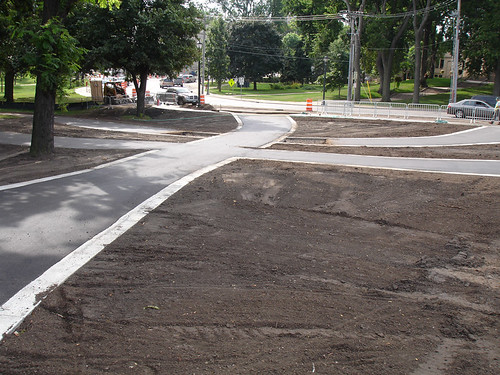 |
| What: A network of freshly paved paths. Scott explains how neighborhood groups, the Parks Board, and municipal entities agreed upon this new configuration to improve safety for pedestrians and cyclists at this high-traffic corner. Scott, having attended Marcy Schulte's Community Walk About (presented as part of Living Classroom), relays a wealth of information about the park's history and its citizen advocates. Where: Loring Park's southwest corner Observers: Scott and Abbie Date/Time: Friday, September 2, 10:30 am Conditions: The dwindling summer season leaves just enough time for the project's finishing touches—signage and landscaping details. |
Scott also calls my attention to the squirrels as a marker of ecological intervention. The ubiquitous gray squirrel was introduced to the area in the early twentieth century. And concurrent with the gray squirrel's introduction was the extermination of the red squirrel.
Before crossing Lyndale/Hennepin, our attention is drawn to St. Mark's beautiful lawn shaded by majestic elms. Scanning the lawn, we spot a blue tag on just about every tree trunk. Taking a cue from the Walker's free audio guide, Art on Call, Scott dials up "Trees on Call" to see who's on the other end of the line.
 | ART ON CALL is to ART as . . . (Images courtesy Walker Art Center) |  |
 | TREES ON CALL is to TREES |  |
What: Scott's call connects us to a tree specialist. The story behind the little blue tags is Dutch Elm Disease. Since nearby trees had been infected, the church took measures to protect these specimens by having a fungicide administered. Dutch Elm Disease (DED) is caused by a fungus, which in turn is transmitted by elm beetles. This makes the beetle the disease vector. And since this is a phenology blog, I speculate about the beetle's life cycle. September is the time that adult beetles make their way to the base of healthy elm trees to overwinter underground. Next year around mid-late April they'll emerge and fly to the elm's tree top to feed on leaves.
Where: St. Mark's Episcopal Cathedral's front lawn
Observers: Scott and Abbie
Date/Time: September 2, 11:40 am
Conditions: Curiosity satiated (for the time being)
Saturday, August 27, 2011
Subdividing the Summer
A month ago, when cicada calls sparked my curiosity, I corresponded with a cicada enthusiast who remarked,

August 12: Eastern Forktails on the scene, abundant

August 19: Abundant and diverse dragonflies and damselflies. A lot of unfinished work in terms identification.

August 26: Emergence of an unidentified dragonfly, as inferred by the presence of abundant exuviae.

August 26: Damselflies (possibly a species of sprite) mating; Eastern Forktails are still present but (by my estimation) less abundant than 2 weeks prior.
If I added some expertise and methodology (some science, if you will) to my practice, how sophisticated could this chronology become? But rather than pursuing a single focus (dragonflies, for example), Open Phenology cast its net broadly. I've had the opportunity to share this project with collaborators with diverse specialties, ranging from ornithology to botany, audio engineering to phenology, sculpture conservation to ecology. Open Phenology's expansive approach is key to its strenghths:
"I love the way cicadas subdivide the summer for me. I suppose studying any summer fauna does the same."And though I'm very green at my 'studies,' I share this impression. I say 'impression' because my haphazard observations are painted with a broad brush rather than rendered by well-informed study and systematic record-keeping. None-the-less, here's how my sub-divided summer has played out:
August 12: Eastern Forktails on the scene, abundant
August 19: Abundant and diverse dragonflies and damselflies. A lot of unfinished work in terms identification.
August 26: Emergence of an unidentified dragonfly, as inferred by the presence of abundant exuviae.
August 26: Damselflies (possibly a species of sprite) mating; Eastern Forktails are still present but (by my estimation) less abundant than 2 weeks prior.
If I added some expertise and methodology (some science, if you will) to my practice, how sophisticated could this chronology become? But rather than pursuing a single focus (dragonflies, for example), Open Phenology cast its net broadly. I've had the opportunity to share this project with collaborators with diverse specialties, ranging from ornithology to botany, audio engineering to phenology, sculpture conservation to ecology. Open Phenology's expansive approach is key to its strenghths:
- Accessible to multiple publics, Open Phenology has no prerequisite knowledge base or skill set.
- Open Phenology values synthesis and interconnections as a way of understanding the world.
- Open Phenology promotes non-hierarchical exchange of information.
- Through facilitated conversations and discovery, Open Phenology emphasizes empirical observation. A frame is drawn around this activity, calling attention to its legitimacy and authenticity.
- In addition to recording what we do see, participants are encouraged to consider what we don't see and this leads to speculations, hyphotheses, and sustained curiosity.
Throughout the summer I've been negotiating Open Phenology's ambiguous relation to science. I have maintained all along that Open Phenology is not science, and while I'm content with this, it makes me wonder about lost opportunities. How would I modify Open Phenology to bring it into alignment with scientific inquiry? Specialization is the answer. Here are some citizen science endeavors on my radar:
- Use Cornell Ornithology Lab's NestWatch or eBird to collect data on birds.
- Participate in the Minnesota Odonata Survey Project
- Collect and share information about Lepidoptera on BAMONA (Butterflies and Moths of North America)
- Join USA National Phenology Network's call to take the pulse of our planet. Select one or two species to study and record.
Friday, August 26, 2011
Larvae* at Large
You can see a lot just by observing.—Yogi Berra
What you see is what you see.—Frank Stella
So, just what was to be seen today? The first animal that got our attention was a hawk, in flight and calling. David and I agreed it was either a Sharp-shinned or Cooper's and a good start to the day. And heading over to the pond, seeing a single nymph (below) led to seeing dozens.

Where: Clinging to aquatic plants growing in the shallow west edge of the pond at Spoonbridge and Cherry
Observers: Abbie, David, and Elizabeth
Date/Time: Friday, August 26, about 10:10 am
Conditions: Sunny. July's oppressive heat is a thing of the past.
As a phenologist, albeit an amateur, this observation prompts important questions. First, what species were we seeing? Just one or a few varieties? These exuviae were about 1.5" long, and had I been vigilant, I might have glimpsed a dragonfly making its exit. Second, when exactly did these nymphs emerge? I didn't notice them last week, but had I simply failed to see them? Or was this legitimately a recent phenomenon?

Where: Eye-level on a flowering plant, arbor at the north edge of the Sculpture Garden
Observers: Spotted by David, observed by Abbie and Elizabeth
Date/Time: Friday, August 26, 10:35 am
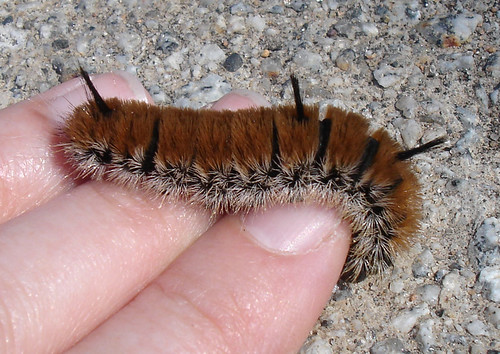
Where: East edge of the Sculpture Garden, base of the stairs to the Irene Hixon Whitney Bridge.
Observers: Abbie and Kristen
Date/Time: Friday, August 26, at about 11:30 am
*Larva (plural larvae), is Latin for 'ghost.' A larva is the juvenile form of any animal that undergoes metamorphosis into its adult form. A caterpillar is the larval form of moths and caterpillars, while nymph is the larval form of dragonflies and damselflies. All this talk of larvae reminds me of the Goldenrod Gall Fly, that saccharine treat I learned about when Sarina joined Open Phenology on July 8.

Friday, August 5, 2011
Noisy Streets and Quiet Gardens

The morning of August 5th was a hot one. Two brave phenologists were not deterred. We met at the FlatPak House, and feeling bold, decided to make a trip across the Armajani bridge to Loring Park. Our plan was take the stroll and observe carefully, embracing the time in our morning to appreciate our surroundings. As we walked up the steps we were struck with the loud roar of traffic from below. The sound and speed of the moving cars took on a different meaning from our elevated prospect. We reflected on the chaos of everyday life, and became more aware of the drone of noise always around us in a city. From this position we even spotted some sunflowers on the side of the road. Such a thing would surely go unnoticed from our car. We were off to great start!


The sound of traffic went as suddenly as it came. Once across the bridge we were greeted with green grass and peaceful quiet. In the morning heat the park was lush and filled with many shades of green. Tall grasses and cattails had completely overtaken a section of the pond. Not even a patch of open water could be seen. In them we heard the rusting of birds and other animals. It seemed a nice and shady spot for many small critters.


Our stroll through the park gave us an opportunity to appreciate the overwhelming amount of growth during the season. Beautiful flowers were everywhere as were mallards and butterflies. As we made our way back to the bridge we felt energized and rejuvenated from the trip. Taking in our surroundings in this way was refreshing. We discussed how easy it is to miss all the exciting things happening in your immediate surroundings. As we climbed up the steps, my fellow phenologist commented that the sky looked unmistakably of summer. I agreed and we wondered if our conclusion was due to context or if we were on to something. Does the look of the sky really change through the seasons? If so, in what ways? Readers, if you were to picture a quintessential summertime sky, would it look like this?

Friday, July 29, 2011
Simulated Soundwalk
A soundwalk is any excursion whose main purpose is listening to the environment. Today I was joined by Brian, a friend, composer, sound engineer, and educator. The sound collage below roughly represents a few of the auditory sensations along our path through the Sculpture Garden. (And just like in real life, some of these sounds are soft and others a little louder...)
Above: YouTube media by waitingline
Above: Vimeo media by Maureen Mcsmith
Above: YouTube media by jkontrad
Above: YouTube media by Greg Holmes of thelope.com
Above: YouTube media by yaaren
What: Part of our process was imagining how the Walker's sound environment changes through the seasons. For example, by late July, the Red-Winged Blackbirds don't sound like this anymore. A detailed map of our soundwalk is available here, with descriptions at each placemarker. If you're interested in trying a soundwalk on your own, here is a suggested 'score' I adapted from an essay by Hildegard Westerkamp. Additional thanks to Frauke Behrendt for support and resources.
Where: Minneapolis Sculpture Garden
Observers (Listeners): Abbie and Brian
Date/Time: Friday, July 29, 10 to 11 am
Conditions: Hot, sunny, sonic
Above: YouTube media by waitingline
Above: Vimeo media by Maureen Mcsmith
Above: YouTube media by jkontrad
Above: YouTube media by Greg Holmes of thelope.com
Above: YouTube media by yaaren
What: Part of our process was imagining how the Walker's sound environment changes through the seasons. For example, by late July, the Red-Winged Blackbirds don't sound like this anymore. A detailed map of our soundwalk is available here, with descriptions at each placemarker. If you're interested in trying a soundwalk on your own, here is a suggested 'score' I adapted from an essay by Hildegard Westerkamp. Additional thanks to Frauke Behrendt for support and resources.
Where: Minneapolis Sculpture Garden
Observers (Listeners): Abbie and Brian
Date/Time: Friday, July 29, 10 to 11 am
Conditions: Hot, sunny, sonic
Tuesday, July 26, 2011
Median: No Man's Land or Guerilla Garden
 | |||
| Abbie in the 'median garden' Photo by Christina |
Where: Median between Hennepin and Lyndale Avenues (see the Walker in the background)
Observers: Christina and Abbie
Date/Time: Tuesday, July 26, about 3 pm
Conditions: Sunny, hot, traffic
Rumor has it these sunflowers are non-conformists, the rogue plantings of horticultural vandals. The next median to the north (behind me in the photo) is uniformly planted with tall grasses, evidence of some management plan though I don't know the details.
If you know the dirt on medians, roadsides, highway clover-leafs, or the centers of round-abouts, and the powers that battle over these marginalized territories, please do tell! Broadcast your comments here.
Saturday, July 23, 2011
By light of luciferin and luciferase
Though this post strays far afield from my Walker-centric focus, it merits mention because fireflies, to me, are the very symbol of fleeting summer. Their bioluminescence results from the reaction of two chemicals, luciferin and luciferase. Let this be a challenge to you to venture outdoors in the evening to spot these insects that are homely by day and hypnotic by night.
Where: Waseca airport
Observer: Abbie, Scott, Emily
Date/Time: July 22 evening into night
Conditions: Mosquitoey
Above: Vimeo media by John Dunstan
What: FirefliesWhere: Waseca airport
Observer: Abbie, Scott, Emily
Date/Time: July 22 evening into night
Conditions: Mosquitoey
Friday, July 8, 2011
Cheetah-bug!
 |
| July 8, 11:30 am: Dragonflies animate the field |
Where: Walker Open Field—iron stakes and caution tape protect the new sod. Scanning the perimeter, every stake is claimed by a dragonfly. What could be the reason? Heat? Vantage point? I must have seen 20 individuals and I wondered if they would be around at all if not for the stakes offering a feature on the landscape.
Observer: Abbie
Date/Time: July 8, 11:30 am
Conditions: Hot, slight breeze
Friday, June 24, 2011
Going West in Search of Wild
 |
| Open Phenology collaborator Jim shares his field guide and expertise. |
 Well, that begs the question: "What is wild?" What do terms like 'wilderness' or 'nature' denote, and what do we mean to exclude by using these words? It's an enigma to ponder because 'nature' seems to encompass everything, and yet most of us harbor the notion that nature has boundaries.
Once outside the urban yard's monoculture and the garden's cultivated display, does the land revert to its natural state? To the casual glance, perhaps it appears so. But upon examination, the answer is emphatically no. At every turn, introduced species were flourishing. And so we challenged ourselves to piece together, through observation and speculation, a semblance of this ecosystem's 'natural state.' And we wondered about the near future of this piece of land. Would our city or this neighborhood support and sustain the maintenance work necessary to keep invasives at bay?
What: Select observations described below
Where: Less than 1/2 mile west of FlatPak House, map above
Observers: Abbie, Jim, Martha, Renner
Date/Time: June 24, 10 to 11:30 am
Conditions: Sunny and warm
- Cottony wisps (likely cottonwood and aspen seeds) are aloft and litter the ground (Related resource: 'Plant profile' video about the cottonwood)
- Motherwort, flowering
- Cow parsnip, stalks are tall (some about 6') and seeds are forming (Related vocabulary: Umbel)
- Garlic mustard, second year plants have seed pods (Related resource: Why this plant is an ecological threat and what to do about it)
- Garlic mustard, first year plants are only basal rosettes, with no tall flowering stalk (Related hypothesis: We encountered a plot of exclusively first year plants and speculated that it might be the leading edge of the invasion)
- Elderberry plant, flowering
- Elderberry plant, berries ripening
- Deadly nightshade, flowering
- Jack-in-the-pulpit, berries ripening but still very green
- Mulberry, fruits ripening, but many are still pale
- Fleabane, flowering, a small bee (~3 or 4mm) observed
- Burdock, stalks are about 3' and still no flowers, aphids are observed on some individual plants
- Buckthorn, fruits ripening, but still green (Related resource: Why is buckthorn such a problem and what you can do about it)
- Spittle bug, shrouded in its spittle foam
- Wild ginger, flowers appear to be fading
- Wild sarsaparilla, leafstalks getting tall but no flowers observed
Thursday, June 23, 2011
The Myth of Phenological Time Travel
In the 14 days since my last post, I traveled from the forty-fifth to the fiftieth parallel and back. Could a trip to Canada be phenological time travel? Would I find myself stepping back to an earlier point in spring?
Well, that's a nice theory, but it turns out that contrasting Location A with Location B is a bit like the proverbial comparison of apples to oranges. Sure, up North the foliage was still tinged with spring's yellow-green, the lilacs were freshly blooming, and the water was colder. But the ecological landscapes were vastly different from one another. By traveling 5° north, I had left the deciduous forest and entered the boreal forest. The phenological players (plants, animals, etc) were so different that their life cycle events were not so much behind as they were simply incomparable. So, while I was on leave from Location A, here's a quick survey of phenological events at Location B:
Phenology is about continuity. To succeed at this science, one must tend to a given locality with regularity. So, tomorrow as I resume my periodic surveys of the familiar Location A, I wonder what changes (incremental or monumental) may have occurred for this nasturtium plant? Or this robin?
 |
| Location A (Minneapolis Sculpture Garden) |
 |
| Location B (western Ontario) |
- Common Loons with chicks; Yellow Warblers tending a nest; Small-mouth bass nesting; dragonflies abundant; mayflies present; tiger swallowtails frequently sighted; mosquitoes scarce; no saturniids (Luna or Polyphemus moths) observed; Flowering plants included: pink lady slippers, star flowers, mountain ash, wild blueberries, wild iris, bunch berry, wild rose, columbine, and spotted coral root; Mosses' calyptra were still in place over developing capsules (click here for diagram, here for photo)

 |
| May 27: Nasturtium in the Garden's Arbor |
 |
| June 10: American Robin |
Phenology is about continuity. To succeed at this science, one must tend to a given locality with regularity. So, tomorrow as I resume my periodic surveys of the familiar Location A, I wonder what changes (incremental or monumental) may have occurred for this nasturtium plant? Or this robin?
Friday, June 10, 2011
The Mysterious West End
I accepted Abbie’s invitation to guest host during her absence this week and realized that I hadn’t walked the entire length of the Garden for more than a year. Well acquainted with the east entrance of the garden, my objective was to explore the unknown west end. Laura Robards Gantenbein, MN Artist Fellow, joined me on my excursion, where we passed by little creatures moving about. What really caught my eye however, was the space beyond the garden, a patch of trees on the west wall of the entrance near Dunwoody Blvd.
This mostly banal and unimpressive landscape included a particularly curious tree. Aesthetically I've always been drawn to the grotesque, and this tree was oozing with it, literally.
I’m not much of an arboriculturist, but I’m identifying this as a pine tree, what do you think? This particular pine was completely unabashedly secreting sap amongst its more modest peers. The sap was in various stages of sticky liquid and crystallized residue; I was fascinated. I don’t often analyze sappy trees, but this was the perfect opportunity to indulge.
Nestled in the tree was a morning dove, which didn’t seem to mind the sappy contents. Laura and I tenderly named the bird Cargill, after one of the lounges in the Walker. Having our fill of sap and new friend Cargill we made our way back to the museum and spotted a chipmunk. We named it Bazinet.
Bazzie, Bazzie 2, Bazinetta, were other chipmunks we spotted on the way back that crossed our path shortly after, but to be fair, the original Bazinet stole the chipmunk show.
Thank you for reading and stay tuned for next week’s sightings!
This mostly banal and unimpressive landscape included a particularly curious tree. Aesthetically I've always been drawn to the grotesque, and this tree was oozing with it, literally.
I’m not much of an arboriculturist, but I’m identifying this as a pine tree, what do you think? This particular pine was completely unabashedly secreting sap amongst its more modest peers. The sap was in various stages of sticky liquid and crystallized residue; I was fascinated. I don’t often analyze sappy trees, but this was the perfect opportunity to indulge.
Nestled in the tree was a morning dove, which didn’t seem to mind the sappy contents. Laura and I tenderly named the bird Cargill, after one of the lounges in the Walker. Having our fill of sap and new friend Cargill we made our way back to the museum and spotted a chipmunk. We named it Bazinet.
Bazzie, Bazzie 2, Bazinetta, were other chipmunks we spotted on the way back that crossed our path shortly after, but to be fair, the original Bazinet stole the chipmunk show.
Thank you for reading and stay tuned for next week’s sightings!
Friday, June 3, 2011
Just able to fly

Where: Between Mark di Suvero's Arikidea and Jenny Holzer's The Living Series
Observer: Abbie
Date/Time: June 3, 9:10 am
Conditions: Warm, sunny, hazy
Subscribe to:
Posts (Atom)