Showing posts with label unseen. Show all posts

Wednesday, December 19, 2012

Robin Buffet (or, What Would Aldo See?)

Determined to see the starlings, my favorite aerial dance troupe, I tore away from my desk at 4:30. Alas, not a single starling. So preoccupied with the starlings' absence, I almost missed the robins' presence.

What: About thirty American Robins, actively sifting through leaf litter for morsels
Where: Under the arbor vitae and in the leaf litter that collects along the stone wall that edges the courtyard.
When: ~4:30 pm
Observers: Abbie
Conditions: A day or 2 ago, this leafy buffet was covered with snow.


What are these American Robins finding to eat? Hidden in the leaves, what is concealed to me but entices a dense gathering of robins? At this point in the season, are there any arthropods or annelids for the birds to pick out? Or is it all berries and seeds? These questions remind me of a passage by Aldo Leopold I recently read:
"These golden grasses conceal, under their waving plumes, a subterranean garden of bulbs and tubers, including wild potatoes. Open the crop of a fat little Mearns' quail and you find an herbarium of subsurface foods scratched from the rocky ground you thought barren. These foods are the motive power which plants pump through the great organ called the fauna."—Aldo Leopold

Tuesday, July 17, 2012

The Suddenly Uncommon Common Grackle

(Or less common, anyhow.)

Phenomena are often detected by the presence of something. But sometimes they are inferred by the absence of something.

In May and June, I couldn't step foot in the Minneapolis Sculpture Garden without seeing and hearing Common Grackles. Usually dozens of them. But in the heat of July, they seem to have disappeared. I noticed this same phenomenon last year (post from July 1, 2011), too.

Curious about their peculiar absence, I surf over to E-Bird to explore the data. It looks as though my observations might fit the general pattern.
Here's a data visualization showing the frequency of Common Grackles on checklists submitted for Hennepin County, 2000-2012. The frequency of Common Grackles peak the week of May 1 at about 35%. Then frequency drops off and by mid-July it reaches lows close to 10%. I'm not sure how to explain this. But based on my observations of the Sculpture Garden, Common Grackles (adults as well as the new brood) vacate the nesting area once young reach the juvenile stage. It could be that during the juvenile stage of their development, Common Grackles redistribute & congregate in specific locations---locations where only 10% of checklists are generated. And that by contrast, during the nesting & fledgling phasea, Common Grackles are seen in 30% of locations where E-Bird checklists are generated.

To view a larger version of this interactive graph, courtesy E-Bird, click here.
What is "frequency"? Refer to the E-Bird glossary by clicking here.


Saturday, June 30, 2012

The Benefits of Constant Vigilance

Young Green Herons, Minneapolis Sculpture Garden. Photo by Christina
What: Two Green Herons fledglings, seen out of the nest!
Where: Along the east border of the Minneapolis Sculpture Garden, a pair of Green Herons built a nest high in a pine tree. For several months now, Rachel, Christina, and I have been checking on the nest, watching to see that the adults were present and straining our eyes to detect young. In the week before my long vacation, we finally observed indications of a successful brood --- scarcely perceptible, we could see movement of downy head(s) and maybe a small beak at the nest's brim, under a vigilant adult.
When: June 18, 2012
Observers: Christina and Rachel, two colleagues of mine who enthusiastically stepped in as proxy phenologists over my vacation. I'm so grateful to Christina and Rachel for sustaining the continuity of our phenology practice!
Conditions: Elated! (I wasn't there to report on weather or other objective details, so I'll skip ahead to to the subjective conditions.) Upon arriving to town after vacation, the first thing I did was log into my Twitter, @openphenology. I was thrilled to read my colleagues' report of the fledglings and view their terrific photo (above). It all serves as a reminder that phenology entails a continual and regular practice. Or, to use Christina's and my mantra: Constant vigilance!

Thursday, May 31, 2012

Still there!

I was getting worried about those Green Herons after noticing their absence. Was the brood unsuccessful and the pair abandoned the nest?
  • Friday, May 25 at 10 am: nest check, no herons seen 
  • Friday, May 25 at 4:45 pm: nest check, no herons seen 
  • Tuesday, May 29, 10:30 am: nest check, no herons seen
But finally today, at 8:20 am, I made another nest check and was relieved to see the nest was occupied by a very still heron. So I'm staying hopeful!

Monday, December 12, 2011

Dawn Chorus on Vineland Place

What: A dawn chorus of (presumably) European Starlings
Where: Too dark to see, the calls and chatter seemed to come from the arborvitae at the Sculpture Garden's south edge
Observer: Abbie
Date/Time: Monday, December 12, 7 am
Conditions: Overcast and warmer than previous days, so warm I had no need for gloves

Friday, August 26, 2011

Larvae* at Large

You can see a lot just by observing.—Yogi Berra
What you see is what you see.—Frank Stella

So, just what was to be seen today? The first animal that got our attention was a hawk, in flight and calling. David and I agreed it was either a Sharp-shinned or Cooper's and a good start to the day. And heading over to the pond, seeing a single nymph (below) led to seeing dozens.
What: Abundant exuviae, the discarded exoskeletons left by dragonflies in their transition from aquatic larvae to terrestrial, winged adults. (Resource: Dragonfly Biology 101)
Where: Clinging to aquatic plants growing in the shallow west edge of the pond at Spoonbridge and Cherry
Observers: Abbie, David, and Elizabeth
Date/Time: Friday, August 26, about 10:10 am
Conditions: Sunny. July's oppressive heat is a thing of the past.

As a phenologist, albeit an amateur, this observation prompts important questions. First, what species were we seeing? Just one or a few varieties? These exuviae were about 1.5" long, and had I been vigilant, I might have glimpsed a dragonfly making its exit. Second, when exactly did these nymphs emerge? I didn't notice them last week, but had I simply failed to see them? Or was this legitimately a recent phenomenon?
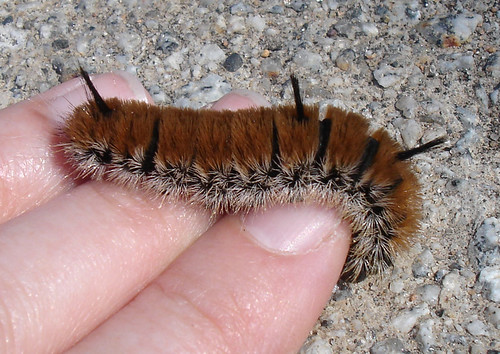
What: Caterpillar, unidentified and stationary
Where: Eye-level on a flowering plant, arbor at the north edge of the Sculpture Garden
Observers: Spotted by David, observed by Abbie and Elizabeth
Date/Time: Friday, August 26, 10:35 am


What: Another unidentified caterpillar, this one was scurrying across the sidewalk
Where: East edge of the Sculpture Garden, base of the stairs to the Irene Hixon Whitney Bridge.
Observers: Abbie and Kristen
Date/Time: Friday, August 26, at about 11:30 am

*Larva (plural larvae), is Latin for 'ghost.' A larva is the juvenile form of any animal that undergoes metamorphosis into its adult form. A caterpillar is the larval form of moths and caterpillars, while nymph is the larval form of dragonflies and damselflies. All this talk of larvae reminds me of the Goldenrod Gall Fly, that saccharine treat I learned about when Sarina joined Open Phenology on July 8.

Friday, August 19, 2011

The Garden as a place for questions

Today's conversation was enriched by Alex, a participant new to Open Phenology. As a sculpture technician, Alex works with Walker staff to keep the outdoor sculptures in good condition. I like to think of our parallel experiences: while I've been surveying the Garden's living residents, she's been tending to its non-living structures. As I've been witness to time passing in biological terms, for her time is evidenced by erosion, mineral deposition, oxidation, and other forces of the earth sciences.

Photo by Sharyn Morrow
Besides our shared landscape, what do Alex's and my experiences have in common? Questions! From "Will you take our picture?" to "So, why is this art?," Alex and I concur that Garden visitors are curious and inquisitive. What sculpture prompts the most questions? In Alex's experience, the winner is Dan Graham's Two-way Mirror Punched Steel Hedge Labyrinth. Maybe this work's deceptive simplicity inspires a skeptical response like, "But it's only glass windows! What's so great about that?" "Well," Alex reminds us, "We're only carbon." As an art history student with career plans in art conservation, Alex seems to enjoy the dual nature of things, simultaneously considering their material nature while contemplating their conceptual and expressive potential.

What: A Green Heron—Kudos to Alex who spotted this one just moments before it got skittish and flew. Maybe not a significant phenological marker, but one of my favorite birds to share with non-birders, who are usually struck by its short stature in comparison to the Great Blue Heron.
Where: At the pond's edge, near Spoonbridge and Cherry
Observers: Abbie, Alex, and Martha
Date/Time: Friday, August 19, around 10:15 am
Conditions: Slightly overcast and breezy, about 75°

What: Damselfly, unidentified species, possibly a sprite. We saw a variety of dragonflies and damselflies drifting along the water's edge and darting across the pond, but this is the only photo worth sharing.
Where: Pond's edge, near Spoonbridge and Cherry
Observers: Abbie, Alex, and Martha
Date/Time: Friday, August 19, 10:10 am
Conditions: Dragonflies are a challenge to observe and identify! I'm tempted to invest in a pair of close-focusing binoculars and a specialized field guide. If you can ID this one, please comment.

What: Butterfly, probably a Monarch, on swamp milkweed flower. (Seeing this made me wish I were a more diligent phenologist, the type who dependably notes the season's first sighting. And speaking of first occurrences I've failed to record, most of the common milkweed plants I see around town finished flowering a while ago and have sizable green pods by now.)
Where: Arlene Grossman Memorial Arbor and Flower Garden
Observers: Abbie, Alex, and Martha
Date/Time: Friday, August 19, around 10:40 am
Conditions: Abuzz with insects. Also a good locale to spy Black-capped Chickadees and Mourning Doves.

Friday, July 29, 2011

Simulated Soundwalk

A soundwalk is any excursion whose main purpose is listening to the environment. Today I was joined by Brian, a friend, composer, sound engineer, and educator. The sound collage below roughly represents a few of the auditory sensations along our path through the Sculpture Garden. (And just like in real life, some of these sounds are soft and others a little louder...)


Above: YouTube media by waitingline


Above: Vimeo media by Maureen Mcsmith


Above: YouTube media by jkontrad


Above: YouTube media by Greg Holmes of thelope.com


Above: YouTube media by yaaren

What: Part of our process was imagining how the Walker's sound environment changes through the seasons. For example, by late July, the Red-Winged Blackbirds don't sound like this anymore. A detailed map of our soundwalk is available here, with descriptions at each placemarker. If you're interested in trying a soundwalk on your own, here is a suggested 'score' I adapted from an essay by Hildegard Westerkamp. Additional thanks to Frauke Behrendt for support and resources.
Where: Minneapolis Sculpture Garden
Observers (Listeners): Abbie and Brian
Date/Time: Friday, July 29, 10 to 11 am
Conditions: Hot, sunny, sonic

Sunday, July 17, 2011

"Now I will do nothing but listen. . . . I hear all sounds running together, combined, fused or following, sounds of the city and sounds out of the city, sounds of the day and night. . ."
Walt Whitman

St. Mary's Basilica bells, YouTube media by Markitectonic

If you say hello to me tomorrow morning between 8 and 8:30 am, I won't reply. But I'll most certainly hear you because I'll be engaged in a soundwalk. What is a soundwalk? Jim Cummings, founder of the Acoustic Ecology Institute, defines it as follows:
At its simplest, a soundwalk is just what its name implies: a walk during which you simply pay attention to each sound you encounter. More complex variations can include seeking out the most distant sound audible, or the faintest. Soundwalks are just as interesting in cities as in nature, and indeed, urban acoustic ecology offers many points for reflection and even aesthetic appreciation.

Tuesday, July 12, 2011

Cicada, droning unseen

Redirects page to MP3 file
What: Cicada song, probably a 'dog day cicada.' (No, this isn't my field recording. This audio is a different species, Tibicen auriferus, courtesy the outstanding library of cicada recordings at InsectSingers.com.)
Where: W 22nd St between Garfield and Harriet Avenues
Observer: Abbie
Date/Time: July 12, 5:50 pm
Conditions: Sunny, warm, pleasant
Before this Open Phenology experiment, my inner monologue might have been:
Cicada? Ah, summer! [. . .on to the next thought. . .]
But with the Open Phenology mindset, my awareness behaves differently:
Cicada? And it's... July 12! Hey, isn't that the first I've heard this year? [inventorying recent memory...] No, no, none yet—I would have noticed. Will it sing again? Only that once? Eventually, (when, do you think?) the cicada chorus will be a regular feature of the summer afternoon sounds. Late summer, that is. Sigh...

Friday, July 1, 2011

Constant Vigilance Post Script

Returning to my desk after Open Phenology, my colleague Scott Artley is thrilled to report a hawk seen soaring over the Sculpture Garden. And I recollect that yes, I heard what must have been a hawk's cry. But I was so preoccupied watching thirteen-lined ground squirrels and robins that I didn't look up. Come to think of it, I bet that hawk had the little ground animals in its sights, too!

Next Friday (July 8), Scott Artley will join Open Phenology. In hopes that the hawk might make another appearance, I'm studying the field marks and calls of a few likely species: Red-tailed Hawk, Sharp-shinned Hawk, and American Kestrel.

Post-post script: Here's something to ponder: Where are the grackles today? Usually (so far this summer, that is), Common Grackles are emphatically abundant in the garden, but today I didn't see them. Could it be the heat? Hmm...

Sunday, June 5, 2011

Nocturnal beings and night visions

Click to enlarge --- it's worth it!
What: A Polyphemus moth
Where: Window screen at my home
Observer: Abbie
Date/Time: June 5, midnight to 1 am
Conditions: Still and partly overcast
 
Zoom out with me, if you will, from Open Phenology's 'micro-local' focus to a 'macro-local' look at our cities on the 45th parallel. It was the night of Northern Spark, the Twin Cities' first nuit blanche featuring participatory art activities from dusk to dawn across Minneapolis and St. Paul. I was at home working on a painting when this spectacular moth alit on my screen. It clung motionless and permit me a few photographs. While it's difficult to judge scale from this image, this species has a wingspan of about 6". As my friend David aptly observed, it's like a lucky rabbit's foot with wings attached.

The Polyphemus is an astonishing creature. Its larva hatch in synchronized broods and undergo a series of moltings followed by a final metamorphosis into the adult moth. Their existence as moths is remarkably fleeting. Individuals live only a few days, just long enough to mate and start the next generation.


Above: Vortex Navigation Company perform "Let's Light a Light," YouTube media by Sean Connaughty (recorded March 2010)

View from within Sky Pesher
By 2 am I had left the lone moth and was nestled into Sky Pesher for Nightshift's headphone concerts. As I listened to Vortex Navigation Company perform "Let's Light a Light," I gazed into the square of sky and envisioned a choreography of great moths, aloft on plumes of pheromones and lured by the light. And I thought of the city, pulsing with blinking bike lights and illuminated with creative phenomena.

Open Phenology is teaching me that for every event I witness, a staggering multitude of events go unseen. As I drove home in the 4 am darkness, the American Robins discerned and heralded the light, commencing a dawn chorus 90 minutes prior to sunrise.

Wednesday, May 25, 2011

Now you see it, now you don't!

Phenology makes a science of witnessing change. Open Phenology makes a practice of witnessing changes together. And through this practice, we may find ourselves reflecting on notions of ephemerality, locality, and interrelatedness.

My parents participated in the project last Friday. As we set off from FlatPak to survey the scene, I introduced Open Phenology as a project that borrows from science but does not purport to be science. 'Scientific truth' is just one of the project's foci. Other objectives include interaction with the public, awareness of our shared environment/ecology, and learning through sharing knowledge and skills.

Ruby-crowned Kinglet
Ruby-crowned Kinglet, courtesy J Jongsma's Flickr photostream
Speaking of skills, having my parents as participants meant I could tap into their ornithological expertise. When I mentioned seeing Kinglets at Loring Park on May 3, my dad said they'd be gone by now, but we can look forward to their passing through again in the fall. (Click the image below to enlarge a graph representing Ruby-crowned Kinglet sightings in Hennepin County throughout the year.)

e-Bird histogram data for Ruby-crowned Kinglet observations in Hennepin County (2007-2011)
There's an intrinsic delight in noticing the ephemeral and being in the right place at the right time. I look forward to sharing this experience with members of the public this summer. If you're a person who hopes to find yourself in the right place at the right time, join Open Phenology by being at the FlatPak House on Fridays at 10 am.