Showing posts with label migration. Show all posts

Friday, April 20, 2012

Meanwhile, in the Garden

I've recently seen a few things in the Minneapolis Sculpture Garden that are worth noting.
What: American Robin with partial leucism
Where: by the grove where the Pierre Huyghe chimes are installed
When: Wednesday and Thursday, April 18 and 19, both times seen in the morning
Observer: Abbie and Lindsay
Photo by Steve Burt, Flickr
What: Red Admiral Butterflies
Where: the Arlene Grossman Memorial Arobr
When: Wednesday, April 18, about 9: 20 am
Observer: Abbie and Lindsay


Photo by David Maher, Flickr
What: Chipping Sparrow
Where: atop a pine tree, near the Arbor at the north edge of the Garden
When: Friday, April 20, about 8:20 am
Observer: Abbie

Monday, March 12, 2012

First Killdeer

Photo by Dan Dzurisin, via Flickr 
What: A pair of Killdeer, early arrivals.
Where: Bryn Mawr Meadows Park (just west and a little north of the Walker Art Center, on the other side of Highway 394). The grassy field was animated by about 12 American Robins, bobbing about, tugging worms out of the soil. And then these two Killdeer, who moved with the swift, smooth locomotion characteristic of plovers.
Observer: Abbie, biking to work
Date/Time: Monday, March 12, 8:30 am
Conditions: Overcast, a little hazy and cool

Sunday, March 11, 2012

Melospiza melodia

What: I'm thrilled to hear the first Song Sparrow (click to listen) of the year!
Where: Duluth Road, Golden Valley
Observer (listener): Abbie
Date/Time: Sunday, March 11, 9:30 am
Conditions: Overcast

Tuesday, November 8, 2011

Honk If You Love

Canada Geese! Arriving to work this morning, I counted zero geese on the field. (But evidence of their recent "occupation" was scattered generously underfoot, if you know what I mean.) As we wound our way into the offices, my colleague Christopher and I chatted about the phenomenon—how the passing weeks saw their numbers increase, peak, and then diminish. Where are they now?

Where do Canada Geese go? As you've probably noticed, some of them will stick around over the winter months. But most of them make their way to the mid and southern United States. Here's a link to a distribution map, on Wikipedia: http://en.wikipedia.org/wiki/File:Branta_canadensis_map.png.

Four more facts about the Canada Goose:
  • Scientists have tracked geese that have flown up to 1,000 km in a day. (You didn't expect a figure in miles, did you? Of course it would have to be metric since they're Canada Geese. 1000 km = 620 miles, approximately)
  • Maybe to you or me all Canada Geese look the same, but most scientists believe that there as many as eleven different races.
  • Canada Geese are monogamous and most couples stay together all of their lives.
  • The Canada Goose was once considered endangered. Game laws and habitat preservation programs have turned that around so effectively that they are now sometimes considered a pest.
Thank you, Internet, for these handy facts!

    Thursday, October 27, 2011

    Overheard in my Inbox: Geese on the Field

    What: My colleague Sharon e-mails me about the Canada Geese overtaking the field. This morning I counted upwards of 50. They're like little cows with wings—black and white and preoccupied with grazing.
    Where: Walker Open Field
    Observers: Sharon, Abbie, Jenny—everyone who looks, really
    Date/Time: Thursday, October 27 at 11:17 am
    Conditions: Anticipating winter
    Every morning I watch the geese roaming the field, their numbers ramping up every week. The phenomenon of their increasing numbers—or more accurately, the phenomenon of noticing this phenomenon—wakes me up. I've been dozing off, letting the Open Phenology project hibernate. But Sharon's message reminded me of the impulse to notice, record, and investigate. Recently I've been fantasizing about a superhuman ability to make observations that are perfectly focused and filtered. For example:
    • The volume and variety of bird songs heard from my driveway at 8:30 am. Since my attention has waxed and waned, I missed, for example, marking the moment when I stopped hearing the House Wren, or noticing how August's lull is sandwiched between American Robins singing in June and Black-Capped Chickadees buzzing in October.
    • The volume and frequency of cicada songs. In late summer, the cicadas' sirens are so constant you can wander for blocks and always be in ear-shot. It's like the auditory equivalent of Tarzan swinging from vine to vine—an uninterrupted passage.
    • The number of geese on the Open Field.
    What if we were to graph these phenomena through time? What kinds of bell curves, peaks and valleys, or anomalies would appear?

    Friday, September 2, 2011

    Of Cities and Ecosystems

    Beginning our walk, my colleague Scott and I corroborate a sighting: Twenty Canada Geese on the field at 9 am. Now's the time of year to look around for Canada Geese staging or look up for their V-shaped flight formations. Fall is settling in—just read the signs.

    One such sign is seen on the Irene Hixon Whitney Bridge.
    What: A clothesline, punctuated with colorful scarves and hats, extends the length of the ramp on both ends of the bridge. Since June, The Swatch Team have called fellow knitters, crochet practitioners, and yarn bombers to unite! And last night, their row-by-row radicalism culminated in this guerrilla installation. A clothesline full of utilitarian, handmade textiles surprised the public with its unfettered generosity. Committed to 'yarn bombing with a message,' the flyer from last evening's give-away reads,
    Help yourself to the warm items you will need this winter. If you would like to contribute, add a drawing, poem, opinion, or creative expression to this line. We are all connected!
    Where: Bridge between the Minneapolis Sculpture Garden and Loring Park
    Observers: Abbie and Scott
    Date/Time: Friday, September 2, 10:20 am
    Conditions: Partly cloudy, with a view of the park and the city

    Once across the bridge we encounter . . .
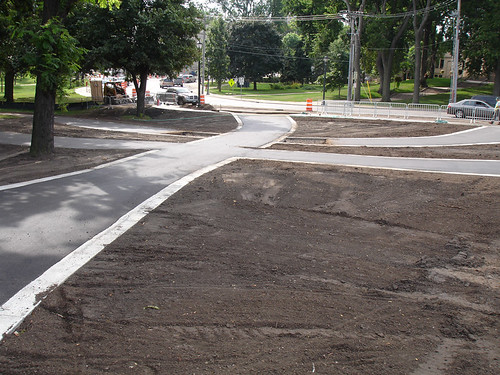
    What: A network of freshly paved paths. Scott explains how neighborhood groups, the Parks Board, and municipal entities agreed upon this new configuration to improve safety for pedestrians and cyclists at this high-traffic corner. Scott, having attended Marcy Schulte's Community Walk About (presented as part of Living Classroom), relays a wealth of information about the park's history and its citizen advocates.
    Where: Loring Park's southwest corner
    Observers: Scott and Abbie
    Date/Time: Friday, September 2, 10:30 am
    Conditions: The dwindling summer season leaves just enough time for the project's finishing touches—signage and landscaping details.
    Conversing with Scott is like paging through a neighborhood directory. His familiarity with area residents, business owners, and organizations prompts me to exclaim, "Here I thought this was the city, but it turns out it's a small town!" Listening to Scott talk about the neighborhood, the metaphor I'm imagining is an ecosystem, a network of interrelated parts.

    Scott also calls my attention to the squirrels as a marker of ecological intervention. The ubiquitous gray squirrel was introduced to the area in the early twentieth century. And concurrent with the gray squirrel's introduction was the extermination of the red squirrel.

    Before crossing Lyndale/Hennepin, our attention is drawn to St. Mark's beautiful lawn shaded by majestic elms. Scanning the lawn, we spot a blue tag on just about every tree trunk. Taking a cue from the Walker's free audio guide, Art on Call, Scott dials up "Trees on Call" to see who's on the other end of the line.

    ART ON CALL
    is to
    ART
    as . . .

    (Images courtesy 
    Walker Art Center)


    TREES ON CALL
    is to
    TREES


    What: Scott's call connects us to a tree specialist. The story behind the little blue tags is Dutch Elm Disease. Since nearby trees had been infected, the church took measures to protect these specimens by having a fungicide administered. Dutch Elm Disease (DED) is caused by a fungus, which in turn is transmitted by elm beetles. This makes the beetle the disease vector. And since this is a phenology blog, I speculate about the beetle's life cycle. September is the time that adult beetles make their way to the base of healthy elm trees to overwinter underground. Next year around mid-late April they'll emerge and fly to the elm's tree top to feed on leaves.
    Where: St. Mark's Episcopal Cathedral's front lawn
    Observers: Scott and Abbie
    Date/Time: September 2, 11:40 am
    Conditions: Curiosity satiated (for the time being)

    Wednesday, May 25, 2011

    Now you see it, now you don't!

    Phenology makes a science of witnessing change. Open Phenology makes a practice of witnessing changes together. And through this practice, we may find ourselves reflecting on notions of ephemerality, locality, and interrelatedness.

    My parents participated in the project last Friday. As we set off from FlatPak to survey the scene, I introduced Open Phenology as a project that borrows from science but does not purport to be science. 'Scientific truth' is just one of the project's foci. Other objectives include interaction with the public, awareness of our shared environment/ecology, and learning through sharing knowledge and skills.

    Ruby-crowned Kinglet
    Ruby-crowned Kinglet, courtesy J Jongsma's Flickr photostream
    Speaking of skills, having my parents as participants meant I could tap into their ornithological expertise. When I mentioned seeing Kinglets at Loring Park on May 3, my dad said they'd be gone by now, but we can look forward to their passing through again in the fall. (Click the image below to enlarge a graph representing Ruby-crowned Kinglet sightings in Hennepin County throughout the year.)

    e-Bird histogram data for Ruby-crowned Kinglet observations in Hennepin County (2007-2011)
    There's an intrinsic delight in noticing the ephemeral and being in the right place at the right time. I look forward to sharing this experience with members of the public this summer. If you're a person who hopes to find yourself in the right place at the right time, join Open Phenology by being at the FlatPak House on Fridays at 10 am.