Showing posts with label education. Show all posts
Showing posts with label education. Show all posts
Saturday, January 7, 2012
Wondering about Winter?
The whys and hows of winter are addressed and celebrated on Science Friday: http://www.sciencefriday.com/program/archives/201201065

Tuesday, September 6, 2011
Field Trip: Birding with Nathalie and Hans
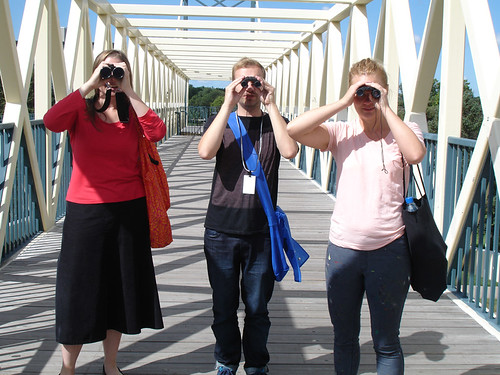 |
| Left to right: Abbie, Hans, and Nathalie |
Our excursion began at the picnic tables as Abbie distributed binoculars and describes Open Phenology, her series of nature walks focused on observing ecological phenomena in the Walker’s vicinity.
Abbie: I’m interested in noticing the life forms around us and observing how they change through the seasons. This means looking for birds migrating, insects molting, flowers blooming, etc. These observations, in turn, are the basis for conversation and learning.
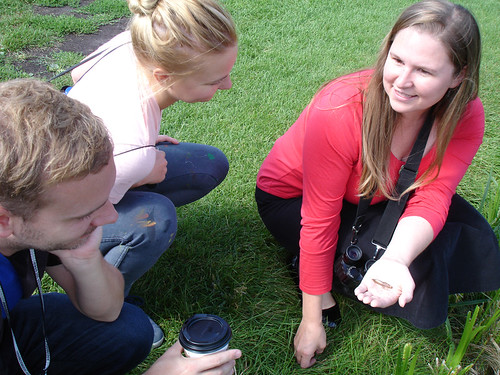
Abbie: See these?
Hans: Like ghosts.
Abbie: Larvae is actually Latin for ‘ghost.’
Hans [on metamorphosis]: It’s like one-day evolution.
Nathalie [clearly curious as to why an art educator takes such interest in biology]: So, what exactly do you do at the museum?
Abbie: Yes, I see what you mean. I’m a biology geek who works in an art museum. So beyond my job, which is supporting the Walker’s education and community programs, I’ve appointed myself as the Walker’s in-house amateur naturalist.
 |
| The Parade: Nathalie Djurberg with music by Hans Berg |
Susy: Why birds?
Nathalie: Before, birds were the least interesting to me—flock animals. Boring. I love animals and watch a lot of nature programs, but avoided bird programs. Then I came across David Attenborough.
Abbie: His documentary on birds of paradise?
Nathalie: Yeah, that guy!
Abbie: After watching Attenborough in Paradise, I felt like this planet is suddenly a totally different world! An astonishing place, but weird, right?
Nathalie: Yeah, though it was before that one that I got into him. And it changed how I see birds. I had no empathy for birds before. Now I really do.
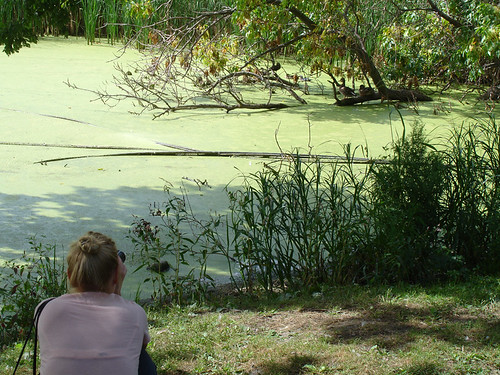
Abbie [chasing after Nathalie]: I love the investigative impulse!
Abbie [catching up and training binoculars]: You can recognize the Wood Duck by size and shape as well as by its plumage. Their nesting habitat is a tree cavity. Now we build boxes to help them out.
Hans: Are they rare?
Abbie: They’re not too rare, but many birds nest in dead trees, which we cut down. There’s a dead tree by my house that every morning is full of woodpeckers. It’s marvelous to see them. It’s a dead tree, but it’s living to them, because it’s full of bugs.
Nathalie [focusing her binoculars on a male Wood Duck]: Look at its eyes! They’re bright red.
Abbie: The Wood Duck is the showiest bird here.
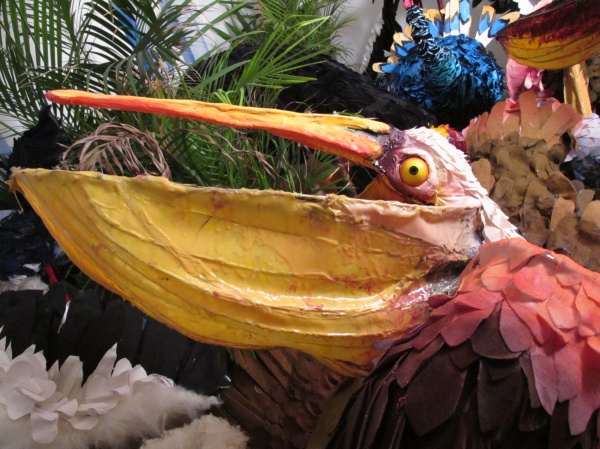 |
| Nathalie Djurberg, studio view of a work in progress, 2010 Courtesy the artists, Zach Feuer Gallery, New York and Giò Marconi, Milan |
Susy: How much of your birds come from actual birds in the world, and how much are derived from sheer imagination?
Nathalie: Most started by my looking at pictures, then really transformed in the process of making them. There were about thirty that came from my imagination. The rest were something specific at the start. Some have transformed so much I couldn’t recognize how they started.
Susy: How do you chose your birds?
Nathalie: I choose the ones I find interesting. Their personalities. How they move their heads. Their colors and patterns.
To witness the pageantry of these feathered forms with your own eyes, venture into the Walker’s Burnet Gallery—The Parade is on view through December 31. In addition to a flock of over eighty delightfully varied bird sculptures, the walls are brought to life by a selection of the artists’ claymation films and the entire space is awash in Hans’ music.
Birding and conversing with Nathalie and Hans has amplified my enjoyment of the show, which is emphatically rich and wild as it is. But after discovering a shared enthusiasm for Attenborough’s BBC documentaries, I found myself thinking, “Wouldn’t David Attenborough just have a field day here!” In a flight of fancy, I imagine a gallery tour led by Attenborough: Clad in khakis with a field guide in his vest pocket, he trains his binoculars on the multitude of exotic species. His hushed voice can hardly contain the exhilaration of catching sight of such strange birds. And lucky for us, this episode of Attenborough’s adventures doesn’t entail travel to an inaccessible tropical paradise, but unfolds in our own back yard.
—Co-authored by Abbie Anderson and Susy Bielak
Friday, August 19, 2011
The Garden as a place for questions
Today's conversation was enriched by Alex, a participant new to Open Phenology. As a sculpture technician, Alex works with Walker staff to keep the outdoor sculptures in good condition. I like to think of our parallel experiences: while I've been surveying the Garden's living residents, she's been tending to its non-living structures. As I've been witness to time passing in biological terms, for her time is evidenced by erosion, mineral deposition, oxidation, and other forces of the earth sciences.
Besides our shared landscape, what do Alex's and my experiences have in common? Questions! From "Will you take our picture?" to "So, why is this art?," Alex and I concur that Garden visitors are curious and inquisitive. What sculpture prompts the most questions? In Alex's experience, the winner is Dan Graham's Two-way Mirror Punched Steel Hedge Labyrinth. Maybe this work's deceptive simplicity inspires a skeptical response like, "But it's only glass windows! What's so great about that?" "Well," Alex reminds us, "We're only carbon." As an art history student with career plans in art conservation, Alex seems to enjoy the dual nature of things, simultaneously considering their material nature while contemplating their conceptual and expressive potential.
 What: A Green Heron—Kudos to Alex who spotted this one just moments before it got skittish and flew. Maybe not a significant phenological marker, but one of my favorite birds to share with non-birders, who are usually struck by its short stature in comparison to the Great Blue Heron.
Where: At the pond's edge, near Spoonbridge and Cherry
Observers: Abbie, Alex, and Martha
Date/Time: Friday, August 19, around 10:15 am
Conditions: Slightly overcast and breezy, about 75°
 What: Damselfly, unidentified species, possibly a sprite. We saw a variety of dragonflies and damselflies drifting along the water's edge and darting across the pond, but this is the only photo worth sharing.
Where: Pond's edge, near Spoonbridge and Cherry
Observers: Abbie, Alex, and Martha
Date/Time: Friday, August 19, 10:10 am
Conditions: Dragonflies are a challenge to observe and identify! I'm tempted to invest in a pair of close-focusing binoculars and a specialized field guide. If you can ID this one, please comment.
 What: Butterfly, probably a Monarch, on swamp milkweed flower. (Seeing this made me wish I were a more diligent phenologist, the type who dependably notes the season's first sighting. And speaking of first occurrences I've failed to record, most of the common milkweed plants I see around town finished flowering a while ago and have sizable green pods by now.)
Where: Arlene Grossman Memorial Arbor and Flower Garden
Observers: Abbie, Alex, and Martha
Date/Time: Friday, August 19, around 10:40 am
Conditions: Abuzz with insects. Also a good locale to spy Black-capped Chickadees and Mourning Doves.
 |
| Photo by Sharyn Morrow |
Where: At the pond's edge, near Spoonbridge and Cherry
Observers: Abbie, Alex, and Martha
Date/Time: Friday, August 19, around 10:15 am
Conditions: Slightly overcast and breezy, about 75°
Where: Pond's edge, near Spoonbridge and Cherry
Observers: Abbie, Alex, and Martha
Date/Time: Friday, August 19, 10:10 am
Conditions: Dragonflies are a challenge to observe and identify! I'm tempted to invest in a pair of close-focusing binoculars and a specialized field guide. If you can ID this one, please comment.
Where: Arlene Grossman Memorial Arbor and Flower Garden
Observers: Abbie, Alex, and Martha
Date/Time: Friday, August 19, around 10:40 am
Conditions: Abuzz with insects. Also a good locale to spy Black-capped Chickadees and Mourning Doves.
Wednesday, August 17, 2011
No Lake is an Island
Today at 1 pm there's a public event to launch the islands.
Read more about who's involved in this management initiative and how the islands work at Josephine Marcotty's True North Star Tribune blog: http://www.startribune.com/local/blogs/127522343.html.
Friday, July 29, 2011
Simulated Soundwalk
A soundwalk is any excursion whose main purpose is listening to the environment. Today I was joined by Brian, a friend, composer, sound engineer, and educator. The sound collage below roughly represents a few of the auditory sensations along our path through the Sculpture Garden. (And just like in real life, some of these sounds are soft and others a little louder...)
Above: YouTube media by waitingline
Above: Vimeo media by Maureen Mcsmith
Above: YouTube media by jkontrad
Above: YouTube media by Greg Holmes of thelope.com
Above: YouTube media by yaaren
What: Part of our process was imagining how the Walker's sound environment changes through the seasons. For example, by late July, the Red-Winged Blackbirds don't sound like this anymore. A detailed map of our soundwalk is available here, with descriptions at each placemarker. If you're interested in trying a soundwalk on your own, here is a suggested 'score' I adapted from an essay by Hildegard Westerkamp. Additional thanks to Frauke Behrendt for support and resources.
Where: Minneapolis Sculpture Garden
Observers (Listeners): Abbie and Brian
Date/Time: Friday, July 29, 10 to 11 am
Conditions: Hot, sunny, sonic
Above: YouTube media by waitingline
Above: Vimeo media by Maureen Mcsmith
Above: YouTube media by jkontrad
Above: YouTube media by Greg Holmes of thelope.com
Above: YouTube media by yaaren
What: Part of our process was imagining how the Walker's sound environment changes through the seasons. For example, by late July, the Red-Winged Blackbirds don't sound like this anymore. A detailed map of our soundwalk is available here, with descriptions at each placemarker. If you're interested in trying a soundwalk on your own, here is a suggested 'score' I adapted from an essay by Hildegard Westerkamp. Additional thanks to Frauke Behrendt for support and resources.
Where: Minneapolis Sculpture Garden
Observers (Listeners): Abbie and Brian
Date/Time: Friday, July 29, 10 to 11 am
Conditions: Hot, sunny, sonic
Friday, July 8, 2011
You gonna' eat that?
Open Phenology collaborator Sarina was our guide to the veritable supermarket of the urban Loring Park.
Photos, left to right: Pepperweed by Dan Mullen; Dock weed by Abbie; Wood sorrel by Judi Cox; Arrowhead by Dave
Thinking of plants in these terms (edible/non-edible) must play a role in learning, because Sarina was identifying plants left and right, up and down, and sharing this knowledge with other eager participants.
Care to join us for dessert? Perhaps later this season we'll harvest some goldenrod galls. Here's a fact that's hard to believe (but easy to remember): Inside each gall is a larval fly absorbing sugar from the plant, and if you get it at the right time of year, it's a sweet treat! That's right—to eat!
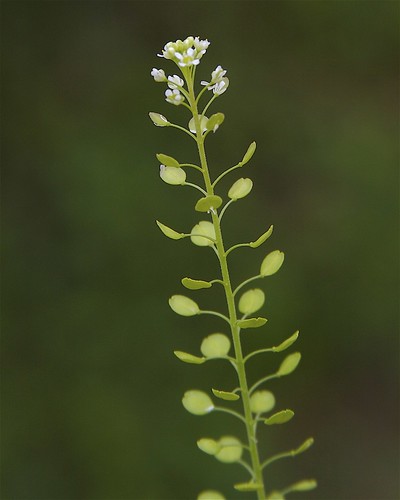 |
| Pepper/Spice? |
 |
| Cereal? |
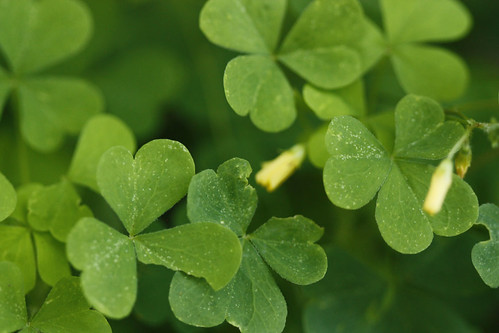 |
| Tangy greens? |
 |
| Duck Potato? |
Thinking of plants in these terms (edible/non-edible) must play a role in learning, because Sarina was identifying plants left and right, up and down, and sharing this knowledge with other eager participants.
Care to join us for dessert? Perhaps later this season we'll harvest some goldenrod galls. Here's a fact that's hard to believe (but easy to remember): Inside each gall is a larval fly absorbing sugar from the plant, and if you get it at the right time of year, it's a sweet treat! That's right—to eat!
What else did the ten of us see today? Click here to review some of our observations.
Guest Blog: Scott Artley joins in on July 8th

On the morning of July 8th, seven people stood at the FlatPak House on the West end of the Minneapolis Sculpture Garden, looking much like some of the other tourists wandering through the area. Only instead of capturing photos of artworks, they donned binoculars to catch a momentary glance of birds. Instead of maps filled with the names of public artists, they held pocket-sized plant identification handbooks and ornithology guides.
Abbie greeted us and explained the concept of phenology: the study of the natural world through the seasons, seeking markers of time and change. It’s a science requiring sustained attention to subtlety—an artistic eye is an asset to environmental inquiry. Abbie’s mantra during the excursion was simple: “What do you notice?”
Although I went to Open Phenology to learn about the natural world around the Walker Art Center campus, I found myself fascinated by the way this group became a community as we wandered over the Whitney Bridge into Loring Park. Although Abbie’s is the only Open Field project that engages with the world of science, it does demonstrate aspects familiar to other Open Field activities:
- the facilitation of curiosity
- an ongoing commitment of time and space to step out of the everyday, and
- the ultimate outcome of sharing an experience together.
Thanks for inviting me along, Abbie, I’m looking forward to joining again.
--Scott Artley
Open Field Coordinator and Open Phenology guest blogger
Open Phenology print by Abigail Woods Anderson
Friday, June 24, 2011
Going West in Search of Wild
 |
| Open Phenology collaborator Jim shares his field guide and expertise. |
 Well, that begs the question: "What is wild?" What do terms like 'wilderness' or 'nature' denote, and what do we mean to exclude by using these words? It's an enigma to ponder because 'nature' seems to encompass everything, and yet most of us harbor the notion that nature has boundaries.
Once outside the urban yard's monoculture and the garden's cultivated display, does the land revert to its natural state? To the casual glance, perhaps it appears so. But upon examination, the answer is emphatically no. At every turn, introduced species were flourishing. And so we challenged ourselves to piece together, through observation and speculation, a semblance of this ecosystem's 'natural state.' And we wondered about the near future of this piece of land. Would our city or this neighborhood support and sustain the maintenance work necessary to keep invasives at bay?
What: Select observations described below
Where: Less than 1/2 mile west of FlatPak House, map above
Observers: Abbie, Jim, Martha, Renner
Date/Time: June 24, 10 to 11:30 am
Conditions: Sunny and warm
- Cottony wisps (likely cottonwood and aspen seeds) are aloft and litter the ground (Related resource: 'Plant profile' video about the cottonwood)
- Motherwort, flowering
- Cow parsnip, stalks are tall (some about 6') and seeds are forming (Related vocabulary: Umbel)
- Garlic mustard, second year plants have seed pods (Related resource: Why this plant is an ecological threat and what to do about it)
- Garlic mustard, first year plants are only basal rosettes, with no tall flowering stalk (Related hypothesis: We encountered a plot of exclusively first year plants and speculated that it might be the leading edge of the invasion)
- Elderberry plant, flowering
- Elderberry plant, berries ripening
- Deadly nightshade, flowering
- Jack-in-the-pulpit, berries ripening but still very green
- Mulberry, fruits ripening, but many are still pale
- Fleabane, flowering, a small bee (~3 or 4mm) observed
- Burdock, stalks are about 3' and still no flowers, aphids are observed on some individual plants
- Buckthorn, fruits ripening, but still green (Related resource: Why is buckthorn such a problem and what you can do about it)
- Spittle bug, shrouded in its spittle foam
- Wild ginger, flowers appear to be fading
- Wild sarsaparilla, leafstalks getting tall but no flowers observed
Thursday, June 9, 2011
Further Opening Phenology
The "Open" in Open Phenology has multiple meanings.
June 10, 10 am: Open Phenology led by Adriana
Join guest facilitator Adriana for the weekly experiment that is Open Phenology. As usual, the exploration and the conversation start at FlatPak House in the Garden.
June 17, 10 am: Open Phenology led by Lindsay
Join Lindsay, volunteer explorer and nature enthusiast, for this installment of Open Phenology. Meet at FlatPak House in the Garden to see for yourself what's going on around the Walker.
- Making the science of phenology accessible to more people
- Welcoming all levels of expertise and involvement
- Valuing transparency, collaboration, and spontaneity
- Expanding the scope of phenology—observations are not limited to 'biological phenomena,' but encompass the social, cultural, and technological aspects of our environment
- Acknowledging a blend of objective and subjective approaches
June 10, 10 am: Open Phenology led by Adriana
Join guest facilitator Adriana for the weekly experiment that is Open Phenology. As usual, the exploration and the conversation start at FlatPak House in the Garden.
June 17, 10 am: Open Phenology led by Lindsay
Join Lindsay, volunteer explorer and nature enthusiast, for this installment of Open Phenology. Meet at FlatPak House in the Garden to see for yourself what's going on around the Walker.
Subscribe to:
Posts (Atom)