- June 8: Nestlings seen, just barely visible by their movement and still within the nest
- June 18: 3 chicks seen out of the nest and up in the pine branches, documented by my colleague Christina (photo)
- July 2: We see one dead chick on the ground
- July 11: We notice the nest is significantly dismantled (photo). Is this evidence of predation?
- Mid-July: We see a second dead heron chick on the ground
- August 4: Wildlife rescue service picks up a third chick, reportedly not doing well
Showing posts with label human intervention. Show all posts
Showing posts with label human intervention. Show all posts
Saturday, September 15, 2012
What Little I Know
Gentle reader, I owe you an update about the green herons and their brood. I would have been more forthcoming had there been happy news to share. But I haven't been eager to report the sad things we've witnessed in the Garden. Here's an outline of what little I know:

Thursday, July 26, 2012
Attention as Place: Surveying One Square Meter
If you follow the Walker Art Center via blogs, Facebook, or Twitter, you've caught word of ROLU-in-Residence. When I heard that a component of ROLU's residency bears the title "Attention as Place," I was intrigued. Notions of "attention" and "place" are at the core of Open Phenology.
"Attention as Place" is a showcase of interactive and intellectually compelling projects culled from ROLU's Web-based network and temporarily localized in the Walker's Cargill Lounge. While most works in this showcase have a physical aspect, they are more fundamentally about the intangible, the indeterminate, the speculative, or the experiential. And for that reason, viewers can have an intimate, give-and-take experience with any of the 22 projects that compose "Attention as Place."
Take, for instance, Amy Franceschini's SURVEYING ONE METER, an action-based project with the following prompt:
 Look for the roped-off One Square Meter at the base of Open Field's hill, near the parking ramp entrance.
Catalog in writing everything you see in a one meter square in Open Field. This could be a text, a poem, or a list. Get as detailed as possible.
Since Tuesday, I've completed two surveys of the square meter, each time depositing my written observations in a designated box in Cargill Lounge. You are welcome to participate in Franceschini's SURVEYING ONE METER. Visit the Walker's Cargill Lounge where a staff person will give you a clipboard with paper and pencil. Venture out to the square meter and tell us what you see.
"Attention as Place" is a showcase of interactive and intellectually compelling projects culled from ROLU's Web-based network and temporarily localized in the Walker's Cargill Lounge. While most works in this showcase have a physical aspect, they are more fundamentally about the intangible, the indeterminate, the speculative, or the experiential. And for that reason, viewers can have an intimate, give-and-take experience with any of the 22 projects that compose "Attention as Place."
Take, for instance, Amy Franceschini's SURVEYING ONE METER, an action-based project with the following prompt:
Catalog in writing everything you see in a one meter square in Open Field. This could be a text, a poem, or a list. Get as detailed as possible.
| The parameters of Franceschini's project calls to my mind The Forest Unseen (book trailer, left) by David G. Haskell. And though the Walker's Open Field is no old growth wilderness, Franceschini's project urges us to see it as it is, how it is, and where it is. Like Open Phenology, Franceschini's project is based on the ethos that our immediate environment has great potential as the stage for re-enchantment and discovery. |
Since Tuesday, I've completed two surveys of the square meter, each time depositing my written observations in a designated box in Cargill Lounge. You are welcome to participate in Franceschini's SURVEYING ONE METER. Visit the Walker's Cargill Lounge where a staff person will give you a clipboard with paper and pencil. Venture out to the square meter and tell us what you see.
Tuesday, May 1, 2012
New landmarks on the Field
Last Thursday, there was a dedication ceremony for the Walker's newest outdoor sculptures, Jim Hodges' Untitled (2011). I'm curious about how these structures will alter the micro-environment for birds, plants, and insects.
 |
| Panoramic view of the newly installed sculptures Photo courtesy Greg Beckel's blog post, Walker Art Center |
Friday, September 2, 2011
Of Cities and Ecosystems
Beginning our walk, my colleague Scott and I corroborate a sighting: Twenty Canada Geese on the field at 9 am. Now's the time of year to look around for Canada Geese staging or look up for their V-shaped flight formations. Fall is settling in—just read the signs.
One such sign is seen on the Irene Hixon Whitney Bridge.
Once across the bridge we encounter . . .
Conversing with Scott is like paging through a neighborhood directory. His familiarity with area residents, business owners, and organizations prompts me to exclaim, "Here I thought this was the city, but it turns out it's a small town!" Listening to Scott talk about the neighborhood, the metaphor I'm imagining is an ecosystem, a network of interrelated parts.
Scott also calls my attention to the squirrels as a marker of ecological intervention. The ubiquitous gray squirrel was introduced to the area in the early twentieth century. And concurrent with the gray squirrel's introduction was the extermination of the red squirrel.
Before crossing Lyndale/Hennepin, our attention is drawn to St. Mark's beautiful lawn shaded by majestic elms. Scanning the lawn, we spot a blue tag on just about every tree trunk. Taking a cue from the Walker's free audio guide, Art on Call, Scott dials up "Trees on Call" to see who's on the other end of the line.
What: Scott's call connects us to a tree specialist. The story behind the little blue tags is Dutch Elm Disease. Since nearby trees had been infected, the church took measures to protect these specimens by having a fungicide administered. Dutch Elm Disease (DED) is caused by a fungus, which in turn is transmitted by elm beetles. This makes the beetle the disease vector. And since this is a phenology blog, I speculate about the beetle's life cycle. September is the time that adult beetles make their way to the base of healthy elm trees to overwinter underground. Next year around mid-late April they'll emerge and fly to the elm's tree top to feed on leaves.
Where: St. Mark's Episcopal Cathedral's front lawn
Observers: Scott and Abbie
Date/Time: September 2, 11:40 am
Conditions: Curiosity satiated (for the time being)
One such sign is seen on the Irene Hixon Whitney Bridge.
 |
What: A clothesline, punctuated with colorful scarves and hats, extends the length of the ramp on both ends of the bridge. Since June, The Swatch Team have called fellow knitters, crochet practitioners, and yarn bombers to unite! And last night, their row-by-row radicalism culminated in this guerrilla installation. A clothesline full of utilitarian, handmade textiles surprised the public with its unfettered generosity. Committed to 'yarn bombing with a message,' the flyer from last evening's give-away reads, Help yourself to the warm items you will need this winter. If you would like to contribute, add a drawing, poem, opinion, or creative expression to this line. We are all connected! Where: Bridge between the Minneapolis Sculpture Garden and Loring Park Observers: Abbie and Scott Date/Time: Friday, September 2, 10:20 am Conditions: Partly cloudy, with a view of the park and the city |
Once across the bridge we encounter . . .
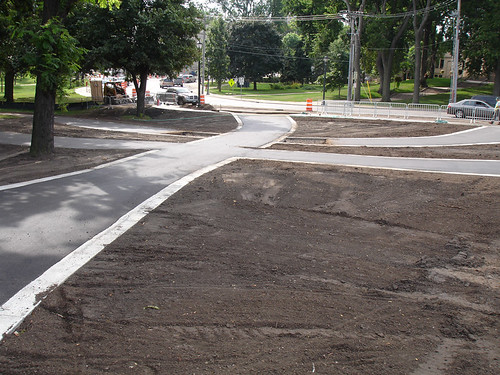 |
| What: A network of freshly paved paths. Scott explains how neighborhood groups, the Parks Board, and municipal entities agreed upon this new configuration to improve safety for pedestrians and cyclists at this high-traffic corner. Scott, having attended Marcy Schulte's Community Walk About (presented as part of Living Classroom), relays a wealth of information about the park's history and its citizen advocates. Where: Loring Park's southwest corner Observers: Scott and Abbie Date/Time: Friday, September 2, 10:30 am Conditions: The dwindling summer season leaves just enough time for the project's finishing touches—signage and landscaping details. |
Scott also calls my attention to the squirrels as a marker of ecological intervention. The ubiquitous gray squirrel was introduced to the area in the early twentieth century. And concurrent with the gray squirrel's introduction was the extermination of the red squirrel.
Before crossing Lyndale/Hennepin, our attention is drawn to St. Mark's beautiful lawn shaded by majestic elms. Scanning the lawn, we spot a blue tag on just about every tree trunk. Taking a cue from the Walker's free audio guide, Art on Call, Scott dials up "Trees on Call" to see who's on the other end of the line.
 | ART ON CALL is to ART as . . . (Images courtesy Walker Art Center) |  |
 | TREES ON CALL is to TREES |  |
What: Scott's call connects us to a tree specialist. The story behind the little blue tags is Dutch Elm Disease. Since nearby trees had been infected, the church took measures to protect these specimens by having a fungicide administered. Dutch Elm Disease (DED) is caused by a fungus, which in turn is transmitted by elm beetles. This makes the beetle the disease vector. And since this is a phenology blog, I speculate about the beetle's life cycle. September is the time that adult beetles make their way to the base of healthy elm trees to overwinter underground. Next year around mid-late April they'll emerge and fly to the elm's tree top to feed on leaves.
Where: St. Mark's Episcopal Cathedral's front lawn
Observers: Scott and Abbie
Date/Time: September 2, 11:40 am
Conditions: Curiosity satiated (for the time being)
Monday, August 22, 2011
Make hay while the sun shines
Well, someone did! Just as I was thinking about revisiting the medians (between Hennepin and Lyndale Avenues, see my post from July 26) to find some grasshoppers and crickets, I discover I'm too late. On Monday I notice the tall grasses, thistles, sun flowers, dock weed, and more have been completely mowed to the ground.
Wednesday, August 17, 2011
No Lake is an Island
Today at 1 pm there's a public event to launch the islands.
Read more about who's involved in this management initiative and how the islands work at Josephine Marcotty's True North Star Tribune blog: http://www.startribune.com/local/blogs/127522343.html.
Tuesday, July 26, 2011
Median: No Man's Land or Guerilla Garden
 | |||
| Abbie in the 'median garden' Photo by Christina |
Where: Median between Hennepin and Lyndale Avenues (see the Walker in the background)
Observers: Christina and Abbie
Date/Time: Tuesday, July 26, about 3 pm
Conditions: Sunny, hot, traffic
Rumor has it these sunflowers are non-conformists, the rogue plantings of horticultural vandals. The next median to the north (behind me in the photo) is uniformly planted with tall grasses, evidence of some management plan though I don't know the details.
If you know the dirt on medians, roadsides, highway clover-leafs, or the centers of round-abouts, and the powers that battle over these marginalized territories, please do tell! Broadcast your comments here.
Wednesday, July 6, 2011
The Savanna Syndrome
 |
| July 6, 9 am: A palette of new sod |
Friday, July 1, 2011
Constant Vigilance!
I was chatting with my colleague Christina when I hit upon this truism: constant vigilance is the foundation of good phenological practice. Christina, catching the reference I unwittingly made, explained that Harry Potter's Professor Alastor "Mad-Eye" Moody employs this same motto of "Constant Vigilance!" to teach Defense Against the Dark Arts. But now back to my familiar domain, that of Muggles, Citizen Science, and natural phenomena in the Walker's vicinity. In my June 23 post, I anticipated seeing changes, these being among them:


What: Nasturtium flowering, leaf at ~5" diameter
Where: Arlene Grossman Memorial Arbor
Observers: Abbie (July 1)
Date/Time: May 27 (left) and about 10:20 am on July 1 (right)
Conditions: Sweltering heat (July 1)


What: American Robin juvenile. While these pictures document different individuals, the emphasis is on change over time (June 10 to July 1)—most noticeably, the development of functional flight feathers.The robin on the right, though about the same size as an adult, can be recognized as juvenile by the plumage. See the speckled breast?
Where: Sculpture Garden, by Scott Burton's Seat-Leg Table (July 1)
Observers: Abbie (July 1)
Date/Time: June 10 (left) and about 10:30 am on July 1 (right)
Conditions: Sweltering heat (July 1) (eighty-some degrees)
So, besides Alastor Moody and myself, who else might call for "constant vigilance?" A gardener, naturally. Not to battle the Dark Arts so much as to keep horticultural entropy at bay. On today's survey, I noticed a team of three gardeners tending to the arbor.
 What: Iris leaves, tied in a knot and trimmed, to keep the garden looking orderly. And, in practical terms, this fastidious management allows light to reach the iris' neighbors
Where: Arlene Grossman Memorial Arbor
Observers: Abbie
Date/Time: July 1, about 10:15 am
Conditions: Sunny, hot (eighty-some degrees), and humid
 What: Clematis—about 5' tall and flowering—trained with twine to climb the arbor
Where: Arlene Grossman Memorial Arbor
Observers: Abbie
Date/Time: July 1, about 10:15 am
Conditions: Sunny, hot (eighty-some degrees), and humid
Constant vigilance is hyperbole, of course, but it's something to strive for. Anticipation has a positive influence on awareness.Take for example the Como Park Zoo and Conservatory's corpse flower. Again, props to my colleague Christina who watched the flower webcam with steadfast attention and even made a timely pilgrimage to witness the rare bloom. My vigilance, on the other hand, faltered, and I'm kicking myself for missing it.
If you'd like to prepare for July in hopes of not missing out, here's a tool to help you anticipate: Jim Gilbert's phenology report for July 2010 (PDF, 416 kb).

What: Nasturtium flowering, leaf at ~5" diameter
Where: Arlene Grossman Memorial Arbor
Observers: Abbie (July 1)
Date/Time: May 27 (left) and about 10:20 am on July 1 (right)
Conditions: Sweltering heat (July 1)

What: American Robin juvenile. While these pictures document different individuals, the emphasis is on change over time (June 10 to July 1)—most noticeably, the development of functional flight feathers.The robin on the right, though about the same size as an adult, can be recognized as juvenile by the plumage. See the speckled breast?
Where: Sculpture Garden, by Scott Burton's Seat-Leg Table (July 1)
Observers: Abbie (July 1)
Date/Time: June 10 (left) and about 10:30 am on July 1 (right)
Conditions: Sweltering heat (July 1) (eighty-some degrees)
So, besides Alastor Moody and myself, who else might call for "constant vigilance?" A gardener, naturally. Not to battle the Dark Arts so much as to keep horticultural entropy at bay. On today's survey, I noticed a team of three gardeners tending to the arbor.
Where: Arlene Grossman Memorial Arbor
Observers: Abbie
Date/Time: July 1, about 10:15 am
Conditions: Sunny, hot (eighty-some degrees), and humid
Where: Arlene Grossman Memorial Arbor
Observers: Abbie
Date/Time: July 1, about 10:15 am
Conditions: Sunny, hot (eighty-some degrees), and humid
Constant vigilance is hyperbole, of course, but it's something to strive for. Anticipation has a positive influence on awareness.Take for example the Como Park Zoo and Conservatory's corpse flower. Again, props to my colleague Christina who watched the flower webcam with steadfast attention and even made a timely pilgrimage to witness the rare bloom. My vigilance, on the other hand, faltered, and I'm kicking myself for missing it.
If you'd like to prepare for July in hopes of not missing out, here's a tool to help you anticipate: Jim Gilbert's phenology report for July 2010 (PDF, 416 kb).
Friday, June 17, 2011
Music and Musings
While Abbie spends this week exploring Canadian flora and fauna I will be filling in with my own (more primitive) Minnesota observations.
I rolled out of bed this morning with the expectation of spending a quiet, meandering morning being delighted by childlike discoveries of my surroundings in and around the Walker Sculpture Garden. Though my wanderings were pleasant, the field and garden were fluttering with activity. Of course! It's a mere day before Rock The Garden, the Walker's annual outdoor music festival. The field and garden were bustling with Walker staff, news crews, and contracted help zipping around like Fraggle Rock (the garden) Doozers to prepare for the event. There also appeared to be a morning wedding ceremony taking place in the Cowles Conservatory. In the midst of all the bustling I did manage to make some exciting discoveries.
 I begin with my red-winged blackbird sighting not because they are uncommon to the area but because of my fondness for them. When I moved to Minnesota they were the first new bird I was able to identify.
What: Foraging red-winged blackbird
Where: West side of Walker Sculpture Garden
Observer: Lindsay
Date/Time: June 17, 10:15am
Conditions: Sunny and humid


What: Musicians warming up before a ceremony
Where: Cowles Conservatory
Observer: Lindsay
Date/Time: June 17, 10:18am
Conditions: Cool and stagnant

I have just recently become interested in the act of birding and have great respect for those who do it well primarily because I am realizing that it requires a level of patience that I have not yet cultivated. The above image is one I made while stalking a cardinal, a beautiful bright red cardinal that was not interested in my photographic advances.

I like the anticipation of this image. When will the dahlias begin popping out of the soil? I'll have to go back throughout the summer and check in.
What: Honka dahlia markers
Where: Alene Grossman Memorial Arbor and Flower Garden
Observer: Lindsay
Date/Time: June 17, 10:35am
Conditions: Sunny and humid

I love watching ducklings following their mothers. They look like they must be attached by a magnetic force of some kind. When I was a child I had this game called "Are You My Mother?". It's a little traumatizing now that I think about it. It was a board game with a farm scene depicted on it. Around the board there were little cardboard hens with magnetic bases. The player was a baby chick that also had a magnetic base. The object of the game was to move around the board and find out which of the hens was the chick's mother. The parent hen would reveal itself through its "attraction" to the chick (or a magnet with the opposite charge). Clever, really. Because of this game I will forever associate motherhood with magnets.
What: Ducklings dutifully following mother duck
Where: Under Oldenburg's Spoonbridge and Cherry
Observer: Lindsay
Date/Time: June 17, 10:45am
Conditions: Sunny and humid
Thank you to Abbie for letting me fill in. What a pleasure to spend the morning taking in the activities of a sunny June day, camera in hand and eyes wide open. It should be a mandatory activity for us all.
I rolled out of bed this morning with the expectation of spending a quiet, meandering morning being delighted by childlike discoveries of my surroundings in and around the Walker Sculpture Garden. Though my wanderings were pleasant, the field and garden were fluttering with activity. Of course! It's a mere day before Rock The Garden, the Walker's annual outdoor music festival. The field and garden were bustling with Walker staff, news crews, and contracted help zipping around like Fraggle Rock (the garden) Doozers to prepare for the event. There also appeared to be a morning wedding ceremony taking place in the Cowles Conservatory. In the midst of all the bustling I did manage to make some exciting discoveries.

 I begin with my red-winged blackbird sighting not because they are uncommon to the area but because of my fondness for them. When I moved to Minnesota they were the first new bird I was able to identify.
What: Foraging red-winged blackbird
Where: West side of Walker Sculpture Garden
Observer: Lindsay
Date/Time: June 17, 10:15am
Conditions: Sunny and humid


What: Musicians warming up before a ceremony
Where: Cowles Conservatory
Observer: Lindsay
Date/Time: June 17, 10:18am
Conditions: Cool and stagnant

I have just recently become interested in the act of birding and have great respect for those who do it well primarily because I am realizing that it requires a level of patience that I have not yet cultivated. The above image is one I made while stalking a cardinal, a beautiful bright red cardinal that was not interested in my photographic advances.

I like the anticipation of this image. When will the dahlias begin popping out of the soil? I'll have to go back throughout the summer and check in.
What: Honka dahlia markers
Where: Alene Grossman Memorial Arbor and Flower Garden
Observer: Lindsay
Date/Time: June 17, 10:35am
Conditions: Sunny and humid
I love watching ducklings following their mothers. They look like they must be attached by a magnetic force of some kind. When I was a child I had this game called "Are You My Mother?". It's a little traumatizing now that I think about it. It was a board game with a farm scene depicted on it. Around the board there were little cardboard hens with magnetic bases. The player was a baby chick that also had a magnetic base. The object of the game was to move around the board and find out which of the hens was the chick's mother. The parent hen would reveal itself through its "attraction" to the chick (or a magnet with the opposite charge). Clever, really. Because of this game I will forever associate motherhood with magnets.
What: Ducklings dutifully following mother duck
Where: Under Oldenburg's Spoonbridge and Cherry
Observer: Lindsay
Date/Time: June 17, 10:45am
Conditions: Sunny and humid
Thank you to Abbie for letting me fill in. What a pleasure to spend the morning taking in the activities of a sunny June day, camera in hand and eyes wide open. It should be a mandatory activity for us all.
Friday, June 3, 2011
Google placemarks make the scene
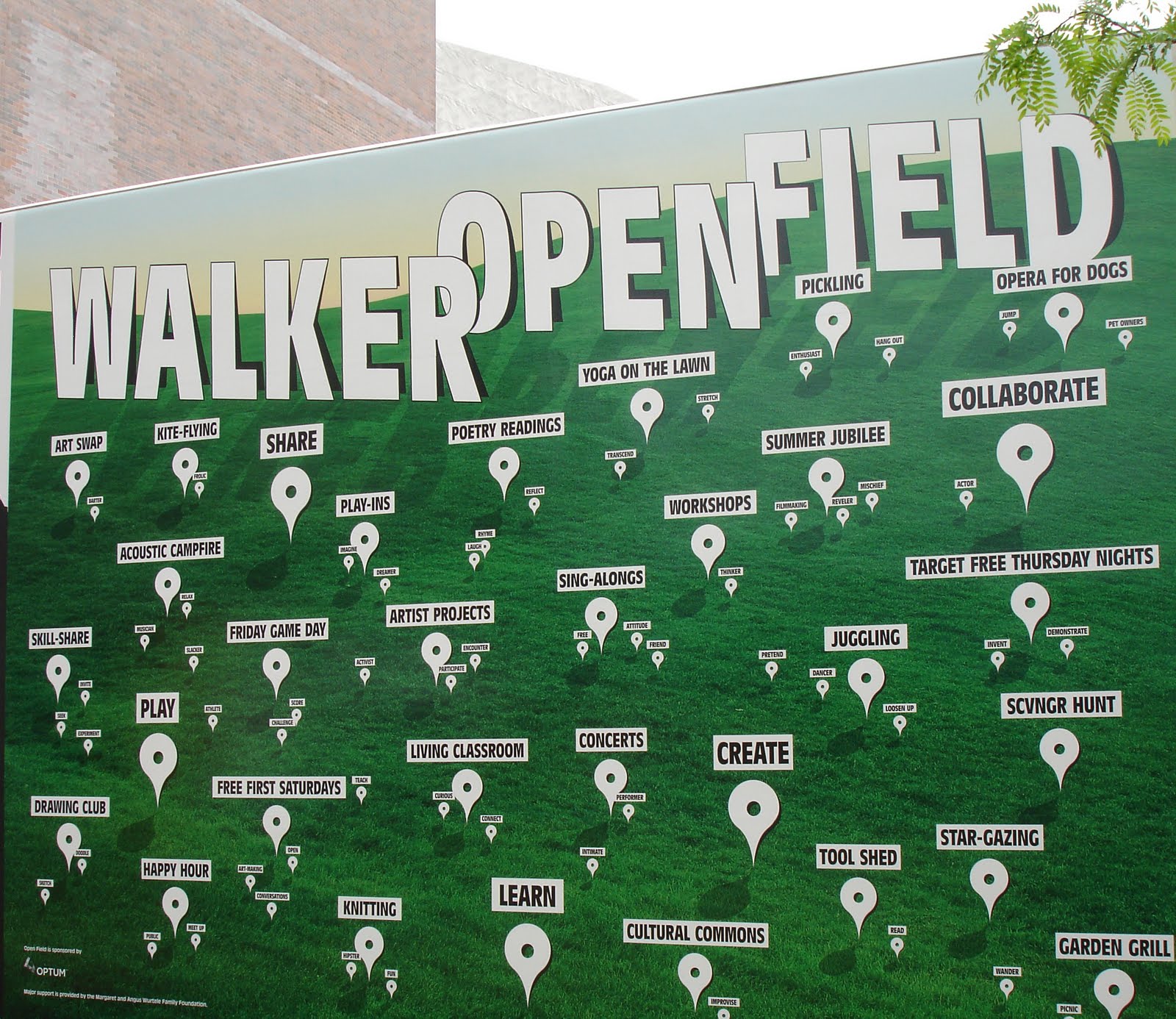 |
| Today on Walker Open Field, a team installed this vinyl graphic. |
 |
| And I added another marker to the Open Phenology Loci map. |
Friday, May 27, 2011
Cool, windy, with a chance of Dreams
"In an object you can tell where the boundaries are, but in the weather it’s impossible to say when something begins or ends."—John Cage, 1981

Above: YouTube media by mostlymark (Recorded August 2009)
The 'dream' in Huyghe's work refers to John Cage's 1948 composition. Use the player below to listen to "Dream" performed by Stephen Drury.
Above: YouTube media by NewMusicXX
 |
| May 27 conditions, Wunderground.com (Weather station at Marriott City Center, Minneapolis) |

What: Pierre Huyghe's Wind Chime (after "Dream") transforms the sound environment. Sample its enchanting effect using the player below.
Where: A stand of trees, just north of Spoonbridge and Cherry
Observers: Martha, Renner, Abbie
Date/Time: Installed in mid-May, this work remains on view over the summer months.
Conditions: Cool, windy, and overcast
Above: YouTube media by mostlymark (Recorded August 2009)
The 'dream' in Huyghe's work refers to John Cage's 1948 composition. Use the player below to listen to "Dream" performed by Stephen Drury.
Above: YouTube media by NewMusicXX
Subscribe to:
Posts (Atom)