Showing posts with label locality. Show all posts

Tuesday, July 17, 2012

The Suddenly Uncommon Common Grackle

(Or less common, anyhow.)

Phenomena are often detected by the presence of something. But sometimes they are inferred by the absence of something.

In May and June, I couldn't step foot in the Minneapolis Sculpture Garden without seeing and hearing Common Grackles. Usually dozens of them. But in the heat of July, they seem to have disappeared. I noticed this same phenomenon last year (post from July 1, 2011), too.

Curious about their peculiar absence, I surf over to E-Bird to explore the data. It looks as though my observations might fit the general pattern.
Here's a data visualization showing the frequency of Common Grackles on checklists submitted for Hennepin County, 2000-2012. The frequency of Common Grackles peak the week of May 1 at about 35%. Then frequency drops off and by mid-July it reaches lows close to 10%. I'm not sure how to explain this. But based on my observations of the Sculpture Garden, Common Grackles (adults as well as the new brood) vacate the nesting area once young reach the juvenile stage. It could be that during the juvenile stage of their development, Common Grackles redistribute & congregate in specific locations---locations where only 10% of checklists are generated. And that by contrast, during the nesting & fledgling phasea, Common Grackles are seen in 30% of locations where E-Bird checklists are generated.

To view a larger version of this interactive graph, courtesy E-Bird, click here.
What is "frequency"? Refer to the E-Bird glossary by clicking here.


Friday, May 11, 2012

Green Herons, Amazingly Enough

What: Amazingly enough, a pair of Green Herons are nesting in a pine tree, with a view of the Minneapolis Sculpture Garden.
Where: Hoping that these birds will successfully raise their young, I won't be too specific about the exact location. Except to say that it is remarkable they didn't choose a spot further from city noise and disruption.
When: After repeat sightings on May 9, 10, and 11, we're concluding that these herons are not just passing through --- they are established residents with a nest and hopefully offspring.
Observers: Christina, Rachel, Abbie

Friday, September 2, 2011

Of Cities and Ecosystems

Beginning our walk, my colleague Scott and I corroborate a sighting: Twenty Canada Geese on the field at 9 am. Now's the time of year to look around for Canada Geese staging or look up for their V-shaped flight formations. Fall is settling in—just read the signs.

One such sign is seen on the Irene Hixon Whitney Bridge.
What: A clothesline, punctuated with colorful scarves and hats, extends the length of the ramp on both ends of the bridge. Since June, The Swatch Team have called fellow knitters, crochet practitioners, and yarn bombers to unite! And last night, their row-by-row radicalism culminated in this guerrilla installation. A clothesline full of utilitarian, handmade textiles surprised the public with its unfettered generosity. Committed to 'yarn bombing with a message,' the flyer from last evening's give-away reads,
Help yourself to the warm items you will need this winter. If you would like to contribute, add a drawing, poem, opinion, or creative expression to this line. We are all connected!
Where: Bridge between the Minneapolis Sculpture Garden and Loring Park
Observers: Abbie and Scott
Date/Time: Friday, September 2, 10:20 am
Conditions: Partly cloudy, with a view of the park and the city

Once across the bridge we encounter . . .
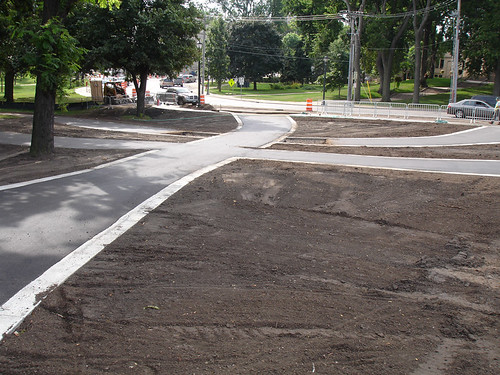
What: A network of freshly paved paths. Scott explains how neighborhood groups, the Parks Board, and municipal entities agreed upon this new configuration to improve safety for pedestrians and cyclists at this high-traffic corner. Scott, having attended Marcy Schulte's Community Walk About (presented as part of Living Classroom), relays a wealth of information about the park's history and its citizen advocates.
Where: Loring Park's southwest corner
Observers: Scott and Abbie
Date/Time: Friday, September 2, 10:30 am
Conditions: The dwindling summer season leaves just enough time for the project's finishing touches—signage and landscaping details.
Conversing with Scott is like paging through a neighborhood directory. His familiarity with area residents, business owners, and organizations prompts me to exclaim, "Here I thought this was the city, but it turns out it's a small town!" Listening to Scott talk about the neighborhood, the metaphor I'm imagining is an ecosystem, a network of interrelated parts.

Scott also calls my attention to the squirrels as a marker of ecological intervention. The ubiquitous gray squirrel was introduced to the area in the early twentieth century. And concurrent with the gray squirrel's introduction was the extermination of the red squirrel.

Before crossing Lyndale/Hennepin, our attention is drawn to St. Mark's beautiful lawn shaded by majestic elms. Scanning the lawn, we spot a blue tag on just about every tree trunk. Taking a cue from the Walker's free audio guide, Art on Call, Scott dials up "Trees on Call" to see who's on the other end of the line.

ART ON CALL
is to
ART
as . . .

(Images courtesy 
Walker Art Center)


TREES ON CALL
is to
TREES


What: Scott's call connects us to a tree specialist. The story behind the little blue tags is Dutch Elm Disease. Since nearby trees had been infected, the church took measures to protect these specimens by having a fungicide administered. Dutch Elm Disease (DED) is caused by a fungus, which in turn is transmitted by elm beetles. This makes the beetle the disease vector. And since this is a phenology blog, I speculate about the beetle's life cycle. September is the time that adult beetles make their way to the base of healthy elm trees to overwinter underground. Next year around mid-late April they'll emerge and fly to the elm's tree top to feed on leaves.
Where: St. Mark's Episcopal Cathedral's front lawn
Observers: Scott and Abbie
Date/Time: September 2, 11:40 am
Conditions: Curiosity satiated (for the time being)

Saturday, August 27, 2011

Subdividing the Summer

A month ago, when cicada calls sparked my curiosity, I corresponded with a cicada enthusiast who remarked,
"I love the way cicadas subdivide the summer for me. I suppose studying any summer fauna does the same."
And though I'm very green at my 'studies,' I share this impression. I say 'impression' because my haphazard observations are painted with a broad brush rather than rendered by well-informed study and systematic record-keeping. None-the-less, here's how my sub-divided summer has played out:

August 12: Eastern Forktails on the scene, abundant


August 19: Abundant and diverse dragonflies and damselflies. A lot of unfinished work in terms identification.


August 26: Emergence of an unidentified dragonfly, as inferred by the presence of abundant exuviae.

August 26: Damselflies (possibly a species of sprite) mating; Eastern Forktails are still present but (by my estimation) less abundant than 2 weeks prior.


If I added some expertise and methodology (some science, if you will) to my practice, how sophisticated could this chronology become? But rather than pursuing a single focus (dragonflies, for example), Open Phenology cast its net broadly. I've had the opportunity to share this project with collaborators with diverse specialties, ranging from ornithology to botany, audio engineering to phenology, sculpture conservation to ecology. Open Phenology's expansive approach is key to its strenghths:
  • Accessible to multiple publics, Open Phenology has no prerequisite knowledge base or skill set.
  • Open Phenology values synthesis and interconnections as a way of understanding the world.
  • Open Phenology promotes non-hierarchical exchange of information.
  • Through facilitated conversations and discovery, Open Phenology emphasizes empirical observation. A frame is drawn around this activity, calling attention to its legitimacy and authenticity.
  • In addition to recording what we do see, participants are encouraged to consider what we don't see and this leads to speculations, hyphotheses, and sustained curiosity.
Throughout the summer I've been negotiating Open Phenology's ambiguous relation to science. I have maintained all along that Open Phenology is not science, and while I'm content with this, it makes me wonder about lost opportunities. How would I modify Open Phenology to bring it into alignment with scientific inquiry? Specialization is the answer. Here are some citizen science endeavors on my radar:

Wednesday, August 17, 2011

No Lake is an Island

Biking to work yesterday, I happened upon a crew busying themselves at Spring Lake's shore. "What's this all about?" I asked a guy dressed in bib waders. Ted from BlueWing Environmental Solutions and Technologies, as he turned out to be, explained that he's part of a project to improve Spring Lake's water quality. Ted was working with people from Midwest Floating Island and members of the American Society of Landscape Architects to install seven "floating treatment wetlands." Once in place, these islands made of recycled plastics and foam are colonized by microbes and plants which do the work of extracting excess nutrients from the impaired wetland.

Today at 1 pm there's a public event to launch the islands.

Read more about who's involved in this management initiative and how the islands work at Josephine Marcotty's True North Star Tribune blog: http://www.startribune.com/local/blogs/127522343.html.

Friday, August 5, 2011

Noisy Streets and Quiet Gardens


The morning of August 5th was a hot one. Two brave phenologists were not deterred. We met at the FlatPak House, and feeling bold, decided to make a trip across the Armajani bridge to Loring Park. Our plan was take the stroll and observe carefully, embracing the time in our morning to appreciate our surroundings. As we walked up the steps we were struck with the loud roar of traffic from below. The sound and speed of the moving cars took on a different meaning from our elevated prospect. We reflected on the chaos of everyday life, and became more aware of the drone of noise always around us in a city. From this position we even spotted some sunflowers on the side of the road. Such a thing would surely go unnoticed from our car. We were off to great start!


The sound of traffic went as suddenly as it came. Once across the bridge we were greeted with green grass and peaceful quiet. In the morning heat the park was lush and filled with many shades of green. Tall grasses and cattails had completely overtaken a section of the pond. Not even a patch of open water could be seen. In them we heard the rusting of birds and other animals. It seemed a nice and shady spot for many small critters.


Our stroll through the park gave us an opportunity to appreciate the overwhelming amount of growth during the season. Beautiful flowers were everywhere as were mallards and butterflies. As we made our way back to the bridge we felt energized and rejuvenated from the trip. Taking in our surroundings in this way was refreshing. We discussed how easy it is to miss all the exciting things happening in your immediate surroundings. As we climbed up the steps, my fellow phenologist commented that the sky looked unmistakably of summer. I agreed and we wondered if our conclusion was due to context or if we were on to something. Does the look of the sky really change through the seasons? If so, in what ways? Readers, if you were to picture a quintessential summertime sky, would it look like this?


Tuesday, July 26, 2011

Median: No Man's Land or Guerilla Garden

Abbie in the 'median garden'
Photo by Christina

What: Measuring the height of sunflowers
Where: Median between Hennepin and Lyndale Avenues (see the Walker in the background)
Observers: Christina and Abbie
Date/Time: Tuesday, July 26, about 3 pm
Conditions: Sunny, hot, traffic

Rumor has it these sunflowers are non-conformists, the rogue plantings of horticultural vandals. The next median to the north (behind me in the photo) is uniformly planted with tall grasses, evidence of some management plan though I don't know the details.

If you know the dirt on medians, roadsides, highway clover-leafs, or the centers of round-abouts, and the powers that battle over these marginalized territories, please do tell! Broadcast your comments here.

Wednesday, July 6, 2011

The Savanna Syndrome

July 6, 9 am: A palette of new sod
Could the appeal of a lush, trim lawn have roots in human evolution? The "Savanna Syndrome," a theory put forth by ecologist John Falk, proposes that our modern-day lawn shares important characteristics with the African savanna inhabited by our ancestors. A grassy plain indicates fruitful foraging. Low-to-the-ground foliage offers unobstructed sight lines, desirable to stay safe from predators. So perhaps there's something essentially adaptive in our attraction to the American lawn and our impulse to cut it.

Friday, July 1, 2011

Constant Vigilance!

I was chatting with my colleague Christina when I hit upon this truism: constant vigilance is the foundation of good phenological practice. Christina, catching the reference I unwittingly made, explained that Harry Potter's Professor Alastor "Mad-Eye" Moody employs this same motto of "Constant Vigilance!" to teach Defense Against the Dark Arts. But now back to my familiar domain, that of Muggles, Citizen Science, and natural phenomena in the Walker's vicinity. In my June 23 post, I anticipated seeing changes, these being among them:


What: Nasturtium flowering, leaf at ~5" diameter
Where: Arlene Grossman Memorial Arbor
Observers: Abbie (July 1)
Date/Time: May 27 (left) and about 10:20 am on July 1 (right)
Conditions: Sweltering heat (July 1)


What: American Robin juvenile. While these pictures document different individuals, the emphasis is on change over time (June 10 to July 1)—most noticeably, the development of functional flight feathers.The robin on the right, though about the same size as an adult, can be recognized as juvenile by the plumage. See the speckled breast?
Where: Sculpture Garden, by Scott Burton's Seat-Leg Table (July 1)
Observers: Abbie (July 1)
Date/Time: June 10 (left) and about 10:30 am on July 1 (right)
Conditions: Sweltering heat (July 1) (eighty-some degrees)

So, besides Alastor Moody and myself, who else might call for "constant vigilance?" A gardener, naturally. Not to battle the Dark Arts so much as to keep horticultural entropy at bay. On today's survey, I noticed a team of three gardeners tending to the arbor.

What: Iris leaves, tied in a knot and trimmed, to keep the garden looking orderly. And, in practical terms, this fastidious management allows light to reach the iris' neighbors
Where: Arlene Grossman Memorial Arbor
Observers: Abbie
Date/Time: July 1, about 10:15 am
Conditions: Sunny, hot (eighty-some degrees), and humid


What: Clematis—about 5' tall and flowering—trained with twine to climb the arbor
Where: Arlene Grossman Memorial Arbor 
Observers: Abbie
Date/Time: July 1, about 10:15 am
Conditions: Sunny, hot (eighty-some degrees), and humid


Constant vigilance is hyperbole, of course, but it's something to strive for. Anticipation has a positive influence on awareness.Take for example the Como Park Zoo and Conservatory's corpse flower. Again, props to my colleague Christina who watched the flower webcam with steadfast attention and even made a timely pilgrimage to witness the rare bloom. My vigilance, on the other hand, faltered, and I'm kicking myself for missing it.

If you'd like to prepare for July in hopes of not missing out, here's a tool to help you anticipate: Jim Gilbert's phenology report for July 2010 (PDF, 416 kb).

Friday, June 24, 2011

Going West in Search of Wild

Open Phenology collaborator Jim shares his field guide and expertise.
As Open Phenology attracts participants, the project's collaborative nature is taking shape. For example, this week's survey benefited from Jim's knowledge of botany and his intrepid impulse to explore the western fringe of the Walker's vicinity. So we left the manicured landscape of lawn and garden to investigate the wilder environs of wetland and forest.

Well, that begs the question: "What is wild?" What do terms like 'wilderness' or 'nature' denote, and what do we mean to exclude by using these words? It's an enigma to ponder because 'nature' seems to encompass everything, and yet most of us harbor the notion that nature has boundaries.

Once outside the urban yard's monoculture and the garden's cultivated display, does the land revert to its natural state? To the casual glance, perhaps it appears so. But upon examination, the answer is emphatically no. At every turn, introduced species were flourishing. And so we challenged ourselves to piece together, through observation and speculation, a semblance of this ecosystem's 'natural state.' And we wondered about the near future of this piece of land. Would our city or this neighborhood support and sustain the maintenance work necessary to keep invasives at bay?

What: Select observations described below
Where: Less than 1/2 mile west of FlatPak House, map above
Observers: Abbie, Jim, Martha, Renner
Date/Time: June 24, 10 to 11:30 am
Conditions: Sunny and warm

Thursday, June 23, 2011

The Myth of Phenological Time Travel

In the 14 days since my last post, I traveled from the forty-fifth to the fiftieth parallel and back. Could a trip to Canada be phenological time travel? Would I find myself stepping back to an earlier point in spring?
Spoonbridge and Cherry at the Minneapolis Sculpture Garden
Location A (Minneapolis Sculpture Garden)
DSC00726
Location B (western Ontario)
Well, that's a nice theory, but it turns out that contrasting Location A with Location B is a bit like the proverbial comparison of apples to oranges. Sure, up North the foliage was still tinged with spring's yellow-green, the lilacs were freshly blooming, and the water was colder. But the ecological landscapes were vastly different from one another. By traveling 5° north, I had left the deciduous forest and entered the boreal forest. The phenological players (plants, animals, etc) were so different that their life cycle events were not so much behind as they were simply incomparable. So, while I was on leave from Location A, here's a quick survey of phenological events at Location B:
    Common Loons with chicks; Yellow Warblers tending a nest; Small-mouth bass nesting; dragonflies abundant; mayflies present; tiger swallowtails frequently sighted; mosquitoes scarce; no saturniids (Luna or Polyphemus moths) observed; Flowering plants included: pink lady slippers, star flowers, mountain ash, wild blueberries, wild iris, bunch berry, wild rose, columbine, and spotted coral root; Mosses' calyptra were still in place over developing capsules (click here for diagram, here for photo)
And as for Location A? A quick glance back to how I left things:
May 27: Nasturtium in the Garden's Arbor
June 10: American Robin


Phenology is about continuity. To succeed at this science, one must tend to a given locality with regularity. So, tomorrow as I resume my periodic surveys of the familiar Location A, I wonder what changes (incremental or monumental) may have occurred for this nasturtium plant? Or this robin?

Friday, June 10, 2011

The Mysterious West End

I accepted Abbie’s invitation to guest host during her absence this week and realized that I hadn’t walked the entire length of the Garden for more than a year. Well acquainted with the east entrance of the garden, my objective was to explore the unknown west end. Laura Robards Gantenbein, MN Artist Fellow, joined me on my excursion, where we passed by little creatures moving about. What really caught my eye however, was the space beyond the garden, a patch of trees on the west wall of the entrance near Dunwoody Blvd.

This mostly banal and unimpressive landscape included a particularly curious tree. Aesthetically I've always been drawn to the grotesque, and this tree was oozing with it, literally.


I’m not much of an arboriculturist, but I’m identifying this as a pine tree, what do you think? This particular pine was completely unabashedly secreting sap amongst its more modest peers. The sap was in various stages of sticky liquid and crystallized residue; I was fascinated. I don’t often analyze sappy trees, but this was the perfect opportunity to indulge.

Nestled in the tree was a morning dove, which didn’t seem to mind the sappy contents. Laura and I tenderly named the bird Cargill, after one of the lounges in the Walker. Having our fill of sap and new friend Cargill we made our way back to the museum and spotted a chipmunk. We named it Bazinet.

Bazzie, Bazzie 2, Bazinetta, were other chipmunks we spotted on the way back that crossed our path shortly after, but to be fair, the original Bazinet stole the chipmunk show.

Thank you for reading and stay tuned for next week’s sightings!

Friday, June 3, 2011

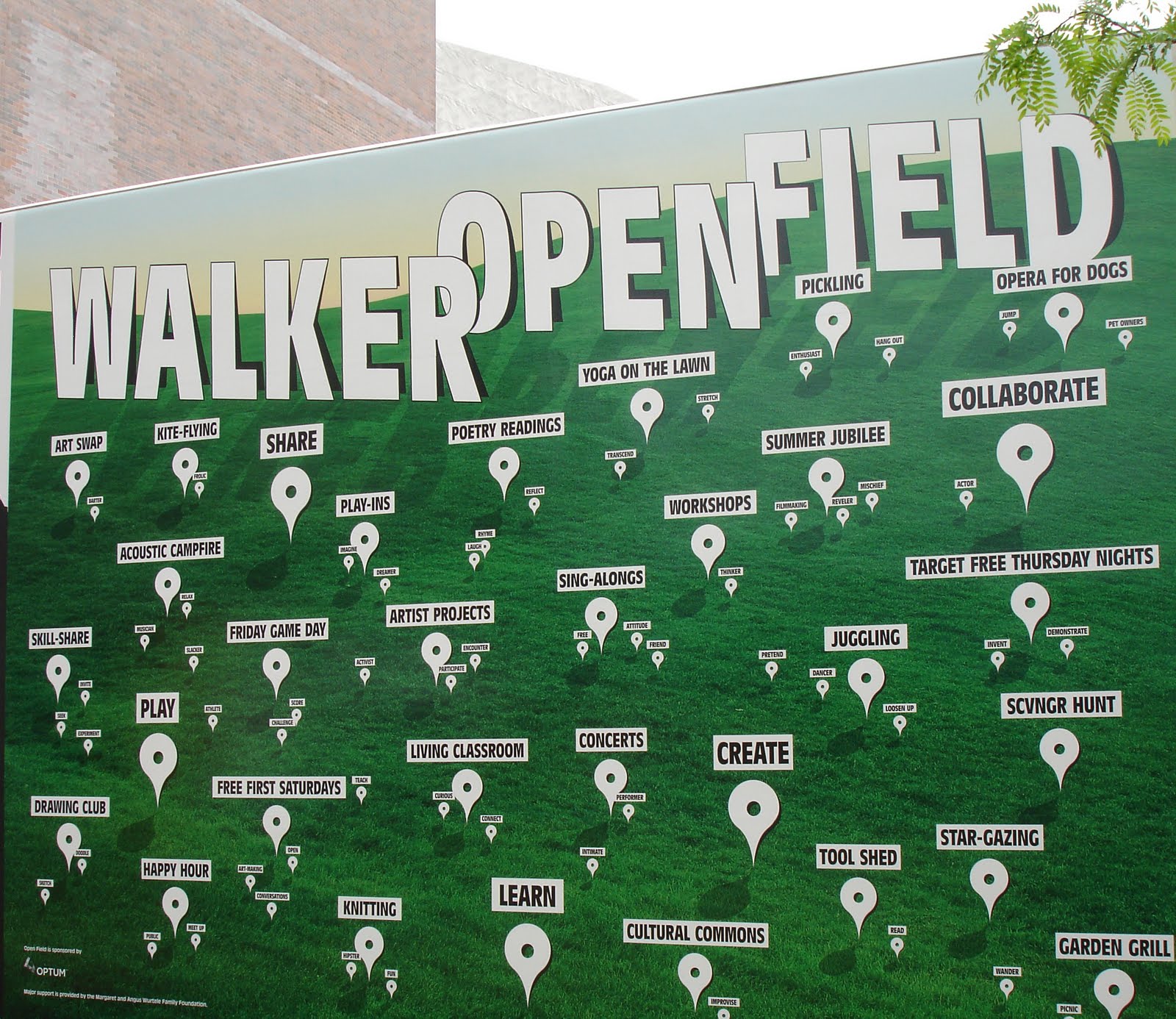
Google placemarks make the scene

Today on Walker Open Field, a team installed this vinyl graphic.

And I added another marker to the Open Phenology Loci map.

Friday, May 27, 2011

Cool, windy, with a chance of Dreams

"In an object you can tell where the boundaries are, but in the weather it’s impossible to say when something begins or ends."—John Cage, 1981

May 27 conditions, Wunderground.com (Weather station at Marriott City Center, Minneapolis)


What: Pierre Huyghe's Wind Chime (after "Dream") transforms the sound environment. Sample its enchanting effect using the player below.
Where: A stand of trees, just north of Spoonbridge and Cherry
Observers: Martha, Renner, Abbie
Date/Time: Installed in mid-May, this work remains on view over the summer months.
Conditions: Cool, windy, and overcast


Above: YouTube media by mostlymark (Recorded August 2009)

The 'dream' in Huyghe's work refers to John Cage's 1948 composition. Use the player below to listen to "Dream" performed by Stephen Drury.

Above: YouTube media by NewMusicXX

Wednesday, May 25, 2011

Now you see it, now you don't!

Phenology makes a science of witnessing change. Open Phenology makes a practice of witnessing changes together. And through this practice, we may find ourselves reflecting on notions of ephemerality, locality, and interrelatedness.

My parents participated in the project last Friday. As we set off from FlatPak to survey the scene, I introduced Open Phenology as a project that borrows from science but does not purport to be science. 'Scientific truth' is just one of the project's foci. Other objectives include interaction with the public, awareness of our shared environment/ecology, and learning through sharing knowledge and skills.

Ruby-crowned Kinglet
Ruby-crowned Kinglet, courtesy J Jongsma's Flickr photostream
Speaking of skills, having my parents as participants meant I could tap into their ornithological expertise. When I mentioned seeing Kinglets at Loring Park on May 3, my dad said they'd be gone by now, but we can look forward to their passing through again in the fall. (Click the image below to enlarge a graph representing Ruby-crowned Kinglet sightings in Hennepin County throughout the year.)

e-Bird histogram data for Ruby-crowned Kinglet observations in Hennepin County (2007-2011)
There's an intrinsic delight in noticing the ephemeral and being in the right place at the right time. I look forward to sharing this experience with members of the public this summer. If you're a person who hopes to find yourself in the right place at the right time, join Open Phenology by being at the FlatPak House on Fridays at 10 am.