Showing posts with label mapping. Show all posts

Thursday, July 26, 2012

Attention as Place: Surveying One Square Meter

If you follow the Walker Art Center via blogs, Facebook, or Twitter, you've caught word of ROLU-in-Residence. When I heard that a component of ROLU's residency bears the title "Attention as Place," I was intrigued. Notions of "attention" and "place" are at the core of Open Phenology.

"Attention as Place" is a showcase of interactive and intellectually compelling projects culled from ROLU's Web-based network and temporarily localized in the Walker's Cargill Lounge. While most works in this showcase have a physical aspect, they are more fundamentally about the intangible, the indeterminate, the speculative, or the experiential. And for that reason, viewers can have an intimate, give-and-take experience with any of the 22 projects that compose "Attention as Place."

Take, for instance, Amy Franceschini's SURVEYING ONE METER, an action-based project with the following prompt:

Look for the roped-off One Square Meter at the base of Open Field's hill, near the parking ramp entrance.

Catalog in writing everything you see in a one meter square in Open Field. This could be a text, a poem, or a list. Get as detailed as possible.

The parameters of Franceschini's project calls to my mind The Forest Unseen (book trailer, left) by David G. Haskell. And though the Walker's Open Field is no old growth wilderness, Franceschini's project urges us to see it as it is, how it is, and where it is. Like Open Phenology, Franceschini's project is based on the ethos that our immediate environment has great potential as the stage for re-enchantment and discovery.

Since Tuesday, I've completed two surveys of the square meter, each time depositing my written observations in a designated box in Cargill Lounge. You are welcome to participate in Franceschini's SURVEYING ONE METER. Visit the Walker's Cargill Lounge where a staff person will give you a clipboard with paper and pencil. Venture out to the square meter and tell us what you see.

Tuesday, July 17, 2012

The Suddenly Uncommon Common Grackle

(Or less common, anyhow.)

Phenomena are often detected by the presence of something. But sometimes they are inferred by the absence of something.

In May and June, I couldn't step foot in the Minneapolis Sculpture Garden without seeing and hearing Common Grackles. Usually dozens of them. But in the heat of July, they seem to have disappeared. I noticed this same phenomenon last year (post from July 1, 2011), too.

Curious about their peculiar absence, I surf over to E-Bird to explore the data. It looks as though my observations might fit the general pattern.
Here's a data visualization showing the frequency of Common Grackles on checklists submitted for Hennepin County, 2000-2012. The frequency of Common Grackles peak the week of May 1 at about 35%. Then frequency drops off and by mid-July it reaches lows close to 10%. I'm not sure how to explain this. But based on my observations of the Sculpture Garden, Common Grackles (adults as well as the new brood) vacate the nesting area once young reach the juvenile stage. It could be that during the juvenile stage of their development, Common Grackles redistribute & congregate in specific locations---locations where only 10% of checklists are generated. And that by contrast, during the nesting & fledgling phasea, Common Grackles are seen in 30% of locations where E-Bird checklists are generated.

To view a larger version of this interactive graph, courtesy E-Bird, click here.
What is "frequency"? Refer to the E-Bird glossary by clicking here.


Tuesday, November 8, 2011

Honk If You Love

Canada Geese! Arriving to work this morning, I counted zero geese on the field. (But evidence of their recent "occupation" was scattered generously underfoot, if you know what I mean.) As we wound our way into the offices, my colleague Christopher and I chatted about the phenomenon—how the passing weeks saw their numbers increase, peak, and then diminish. Where are they now?

Where do Canada Geese go? As you've probably noticed, some of them will stick around over the winter months. But most of them make their way to the mid and southern United States. Here's a link to a distribution map, on Wikipedia: http://en.wikipedia.org/wiki/File:Branta_canadensis_map.png.

Four more facts about the Canada Goose:
  • Scientists have tracked geese that have flown up to 1,000 km in a day. (You didn't expect a figure in miles, did you? Of course it would have to be metric since they're Canada Geese. 1000 km = 620 miles, approximately)
  • Maybe to you or me all Canada Geese look the same, but most scientists believe that there as many as eleven different races.
  • Canada Geese are monogamous and most couples stay together all of their lives.
  • The Canada Goose was once considered endangered. Game laws and habitat preservation programs have turned that around so effectively that they are now sometimes considered a pest.
Thank you, Internet, for these handy facts!

    Sunday, October 9, 2011

    Wait, wait—what season is it?

    What: Autumn day with signs of . . . spring? In the picture to the left, just about dead-center, is a pink blossom (click to enlarge)
    Where: Lake of the Isles (click here for map)
    Observers: Abbie and Mary
    Date/Time: 10:30 am, Sunday, October 9
    Conditions: Unseasonably warm, the day's temperature was to reach 80°
    Is this a cherry tree blooming in October? The very same cherry tree whose flowers are a pan-cultural icon of spring and ephemerality? I counted about 5 clusters of blooms distributed across the tree, each cluster consisting of 3 or 4 individual flowers.

    Is this an "autumn blooming cherry," or is has the tree's clock been confused by recent weather patterns?

    Wednesday, August 17, 2011

    No Lake is an Island

    Biking to work yesterday, I happened upon a crew busying themselves at Spring Lake's shore. "What's this all about?" I asked a guy dressed in bib waders. Ted from BlueWing Environmental Solutions and Technologies, as he turned out to be, explained that he's part of a project to improve Spring Lake's water quality. Ted was working with people from Midwest Floating Island and members of the American Society of Landscape Architects to install seven "floating treatment wetlands." Once in place, these islands made of recycled plastics and foam are colonized by microbes and plants which do the work of extracting excess nutrients from the impaired wetland.

    Today at 1 pm there's a public event to launch the islands.

    Read more about who's involved in this management initiative and how the islands work at Josephine Marcotty's True North Star Tribune blog: http://www.startribune.com/local/blogs/127522343.html.

    Friday, July 29, 2011

    Simulated Soundwalk

    A soundwalk is any excursion whose main purpose is listening to the environment. Today I was joined by Brian, a friend, composer, sound engineer, and educator. The sound collage below roughly represents a few of the auditory sensations along our path through the Sculpture Garden. (And just like in real life, some of these sounds are soft and others a little louder...)


    Above: YouTube media by waitingline


    Above: Vimeo media by Maureen Mcsmith


    Above: YouTube media by jkontrad


    Above: YouTube media by Greg Holmes of thelope.com


    Above: YouTube media by yaaren

    What: Part of our process was imagining how the Walker's sound environment changes through the seasons. For example, by late July, the Red-Winged Blackbirds don't sound like this anymore. A detailed map of our soundwalk is available here, with descriptions at each placemarker. If you're interested in trying a soundwalk on your own, here is a suggested 'score' I adapted from an essay by Hildegard Westerkamp. Additional thanks to Frauke Behrendt for support and resources.
    Where: Minneapolis Sculpture Garden
    Observers (Listeners): Abbie and Brian
    Date/Time: Friday, July 29, 10 to 11 am
    Conditions: Hot, sunny, sonic

    Thursday, June 23, 2011

    The Myth of Phenological Time Travel

    In the 14 days since my last post, I traveled from the forty-fifth to the fiftieth parallel and back. Could a trip to Canada be phenological time travel? Would I find myself stepping back to an earlier point in spring?
    Spoonbridge and Cherry at the Minneapolis Sculpture Garden
    Location A (Minneapolis Sculpture Garden)
    DSC00726
    Location B (western Ontario)
    Well, that's a nice theory, but it turns out that contrasting Location A with Location B is a bit like the proverbial comparison of apples to oranges. Sure, up North the foliage was still tinged with spring's yellow-green, the lilacs were freshly blooming, and the water was colder. But the ecological landscapes were vastly different from one another. By traveling 5° north, I had left the deciduous forest and entered the boreal forest. The phenological players (plants, animals, etc) were so different that their life cycle events were not so much behind as they were simply incomparable. So, while I was on leave from Location A, here's a quick survey of phenological events at Location B:
      Common Loons with chicks; Yellow Warblers tending a nest; Small-mouth bass nesting; dragonflies abundant; mayflies present; tiger swallowtails frequently sighted; mosquitoes scarce; no saturniids (Luna or Polyphemus moths) observed; Flowering plants included: pink lady slippers, star flowers, mountain ash, wild blueberries, wild iris, bunch berry, wild rose, columbine, and spotted coral root; Mosses' calyptra were still in place over developing capsules (click here for diagram, here for photo)
    And as for Location A? A quick glance back to how I left things:
    May 27: Nasturtium in the Garden's Arbor
    June 10: American Robin


    Phenology is about continuity. To succeed at this science, one must tend to a given locality with regularity. So, tomorrow as I resume my periodic surveys of the familiar Location A, I wonder what changes (incremental or monumental) may have occurred for this nasturtium plant? Or this robin?

    Friday, June 3, 2011

    Google placemarks make the scene

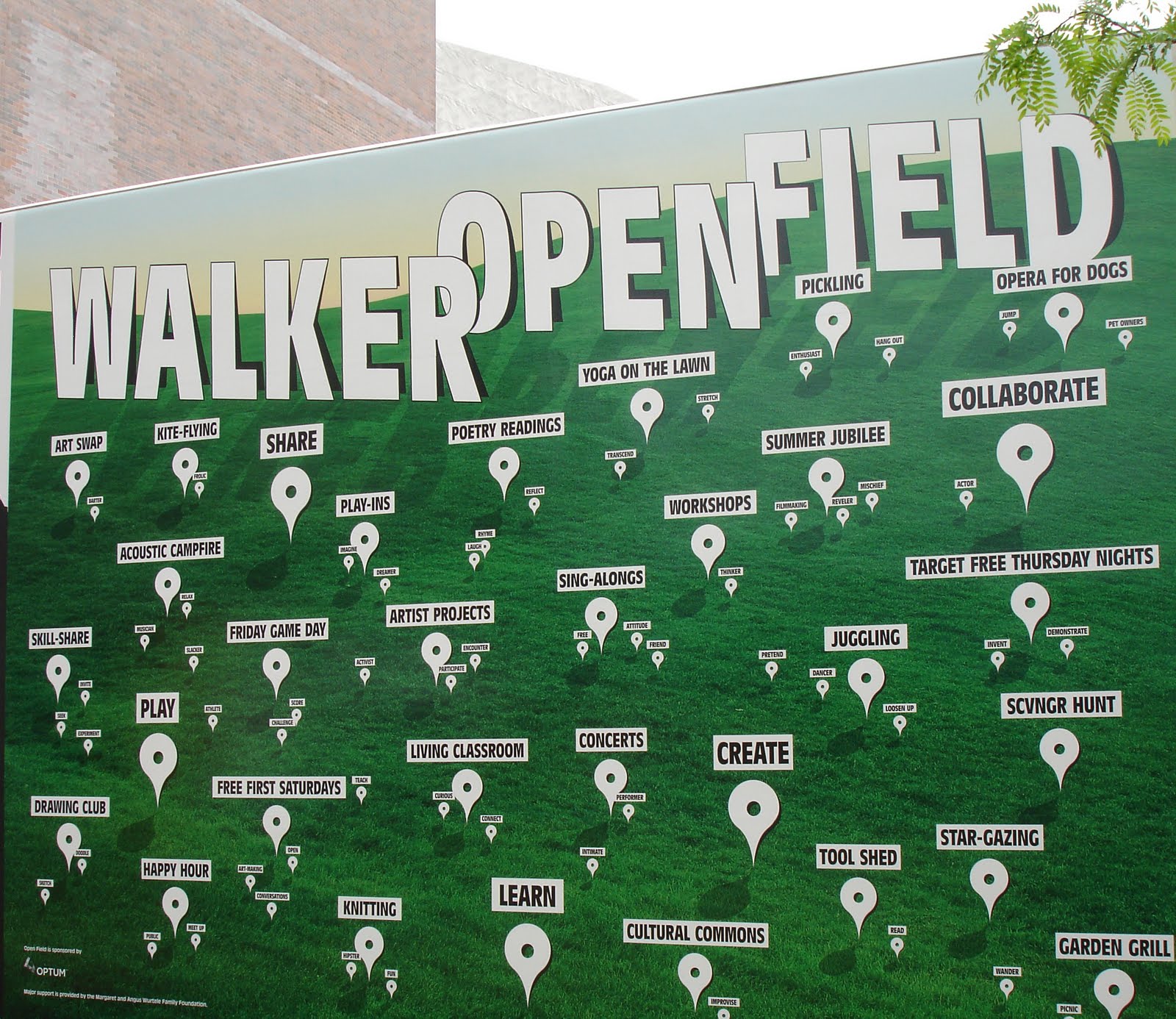
    Today on Walker Open Field, a team installed this vinyl graphic.

    And I added another marker to the Open Phenology Loci map.