- June 8: Nestlings seen, just barely visible by their movement and still within the nest
- June 18: 3 chicks seen out of the nest and up in the pine branches, documented by my colleague Christina (photo)
- July 2: We see one dead chick on the ground
- July 11: We notice the nest is significantly dismantled (photo). Is this evidence of predation?
- Mid-July: We see a second dead heron chick on the ground
- August 4: Wildlife rescue service picks up a third chick, reportedly not doing well
Showing posts with label development. Show all posts
Showing posts with label development. Show all posts
Saturday, September 15, 2012
What Little I Know
Gentle reader, I owe you an update about the green herons and their brood. I would have been more forthcoming had there been happy news to share. But I haven't been eager to report the sad things we've witnessed in the Garden. Here's an outline of what little I know:

Thursday, June 7, 2012
Yes! Young!
What: The Green Herons have young in the nest! For the first time, we see it with our own eyes! We struggle to document it, but the nest's too far, obscured, and poorly lit. But through binoculars, you can see a parent perched on the nest and at the nest's brim, movement of a little beak and the top of a fuzzy head.
Where: East border of the Minneapolis Sculpture Garden
When: Thursday, June 7, 2012 at about 5:30 pm
Observers: Abbie and Christina
Conditions: Sunny and hot.
Where: East border of the Minneapolis Sculpture Garden
When: Thursday, June 7, 2012 at about 5:30 pm
Observers: Abbie and Christina
Conditions: Sunny and hot.
Thursday, March 15, 2012
Poking up through the Earth
What: Tiny, firm, green spires poke up through cracking soil. Examining the ground more closely, we spot a few three-petaled white flowers, low-to-the-ground and nodding. Other plants bear tiny clusters of blue-green buds, which I interpret as future hyacinth blooms.
Where: In the Arbor that forms the north border of the Sculpture Garden.
Observers: Rachel and Abbie
Date/Time: March 15, 2012 at 3:40 pm
Conditions: Without snow for a week or more, the weather is pleasant and the skies are clear.
What: A 13-lined ground squirrel, the first I've seen this year.
Where: By the leafless lilac trees that form a backdrop to the Lipchitz, the solitary squirrel stands upright to survey the scene. Then it scurries across the gravel path and disappears into the gaps in the low, granite block wall.
Observers: Rachel and Abbie
Date/Time: March 15, 2012, at 3:45 pm
Conditions: Apparently warm enough to rise from hibernation, emerge from the burrow's depths, and greet again the outside world!
Where: In the Arbor that forms the north border of the Sculpture Garden.
Observers: Rachel and Abbie
Date/Time: March 15, 2012 at 3:40 pm
Conditions: Without snow for a week or more, the weather is pleasant and the skies are clear.
What: A 13-lined ground squirrel, the first I've seen this year.
Where: By the leafless lilac trees that form a backdrop to the Lipchitz, the solitary squirrel stands upright to survey the scene. Then it scurries across the gravel path and disappears into the gaps in the low, granite block wall.
Observers: Rachel and Abbie
Date/Time: March 15, 2012, at 3:45 pm
Conditions: Apparently warm enough to rise from hibernation, emerge from the burrow's depths, and greet again the outside world!
Friday, August 26, 2011
Larvae* at Large
You can see a lot just by observing.—Yogi Berra
What you see is what you see.—Frank Stella
So, just what was to be seen today? The first animal that got our attention was a hawk, in flight and calling. David and I agreed it was either a Sharp-shinned or Cooper's and a good start to the day. And heading over to the pond, seeing a single nymph (below) led to seeing dozens.

Where: Clinging to aquatic plants growing in the shallow west edge of the pond at Spoonbridge and Cherry
Observers: Abbie, David, and Elizabeth
Date/Time: Friday, August 26, about 10:10 am
Conditions: Sunny. July's oppressive heat is a thing of the past.
As a phenologist, albeit an amateur, this observation prompts important questions. First, what species were we seeing? Just one or a few varieties? These exuviae were about 1.5" long, and had I been vigilant, I might have glimpsed a dragonfly making its exit. Second, when exactly did these nymphs emerge? I didn't notice them last week, but had I simply failed to see them? Or was this legitimately a recent phenomenon?

Where: Eye-level on a flowering plant, arbor at the north edge of the Sculpture Garden
Observers: Spotted by David, observed by Abbie and Elizabeth
Date/Time: Friday, August 26, 10:35 am
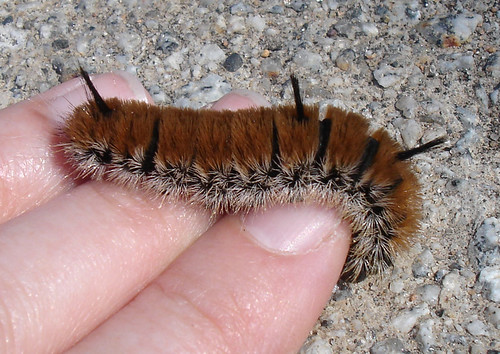
Where: East edge of the Sculpture Garden, base of the stairs to the Irene Hixon Whitney Bridge.
Observers: Abbie and Kristen
Date/Time: Friday, August 26, at about 11:30 am
*Larva (plural larvae), is Latin for 'ghost.' A larva is the juvenile form of any animal that undergoes metamorphosis into its adult form. A caterpillar is the larval form of moths and caterpillars, while nymph is the larval form of dragonflies and damselflies. All this talk of larvae reminds me of the Goldenrod Gall Fly, that saccharine treat I learned about when Sarina joined Open Phenology on July 8.

Friday, August 19, 2011
The Garden as a place for questions
Today's conversation was enriched by Alex, a participant new to Open Phenology. As a sculpture technician, Alex works with Walker staff to keep the outdoor sculptures in good condition. I like to think of our parallel experiences: while I've been surveying the Garden's living residents, she's been tending to its non-living structures. As I've been witness to time passing in biological terms, for her time is evidenced by erosion, mineral deposition, oxidation, and other forces of the earth sciences.
Besides our shared landscape, what do Alex's and my experiences have in common? Questions! From "Will you take our picture?" to "So, why is this art?," Alex and I concur that Garden visitors are curious and inquisitive. What sculpture prompts the most questions? In Alex's experience, the winner is Dan Graham's Two-way Mirror Punched Steel Hedge Labyrinth. Maybe this work's deceptive simplicity inspires a skeptical response like, "But it's only glass windows! What's so great about that?" "Well," Alex reminds us, "We're only carbon." As an art history student with career plans in art conservation, Alex seems to enjoy the dual nature of things, simultaneously considering their material nature while contemplating their conceptual and expressive potential.
 What: A Green Heron—Kudos to Alex who spotted this one just moments before it got skittish and flew. Maybe not a significant phenological marker, but one of my favorite birds to share with non-birders, who are usually struck by its short stature in comparison to the Great Blue Heron.
Where: At the pond's edge, near Spoonbridge and Cherry
Observers: Abbie, Alex, and Martha
Date/Time: Friday, August 19, around 10:15 am
Conditions: Slightly overcast and breezy, about 75°
 What: Damselfly, unidentified species, possibly a sprite. We saw a variety of dragonflies and damselflies drifting along the water's edge and darting across the pond, but this is the only photo worth sharing.
Where: Pond's edge, near Spoonbridge and Cherry
Observers: Abbie, Alex, and Martha
Date/Time: Friday, August 19, 10:10 am
Conditions: Dragonflies are a challenge to observe and identify! I'm tempted to invest in a pair of close-focusing binoculars and a specialized field guide. If you can ID this one, please comment.
 What: Butterfly, probably a Monarch, on swamp milkweed flower. (Seeing this made me wish I were a more diligent phenologist, the type who dependably notes the season's first sighting. And speaking of first occurrences I've failed to record, most of the common milkweed plants I see around town finished flowering a while ago and have sizable green pods by now.)
Where: Arlene Grossman Memorial Arbor and Flower Garden
Observers: Abbie, Alex, and Martha
Date/Time: Friday, August 19, around 10:40 am
Conditions: Abuzz with insects. Also a good locale to spy Black-capped Chickadees and Mourning Doves.
 |
| Photo by Sharyn Morrow |
Where: At the pond's edge, near Spoonbridge and Cherry
Observers: Abbie, Alex, and Martha
Date/Time: Friday, August 19, around 10:15 am
Conditions: Slightly overcast and breezy, about 75°
Where: Pond's edge, near Spoonbridge and Cherry
Observers: Abbie, Alex, and Martha
Date/Time: Friday, August 19, 10:10 am
Conditions: Dragonflies are a challenge to observe and identify! I'm tempted to invest in a pair of close-focusing binoculars and a specialized field guide. If you can ID this one, please comment.
Where: Arlene Grossman Memorial Arbor and Flower Garden
Observers: Abbie, Alex, and Martha
Date/Time: Friday, August 19, around 10:40 am
Conditions: Abuzz with insects. Also a good locale to spy Black-capped Chickadees and Mourning Doves.
Tuesday, July 26, 2011
WAS // NOW
On my bike ride to work this morning, I made a short list of how things were but are no longer:
- Dock weed
- was: green flower stalks . . .
- now: rusty spindles
- Canada thistle
- was: flowering . . .
- now: almost all gone to down
- Bee balm
- was: unnoticed . . .
- now: beautiful pale violet blossoms
- Cow parsnip
- was: green umbels with seeds forming . . .
- now: umbels are brown in color
- Clovers
- was: in June, only white clover flowers
- now: by July, the purple clovers complement the scenery
Friday, July 15, 2011
A study in green
The color green can look remarkably vibrant in rainy conditons. Today's report comes from that chromacentric point of view.
General observation for today: Birds were abundant. Those on the ground busied themselves by foraging (gorging?), and those perched were entirely preoccupied with preening. My complete bird list for the day: Northern Cardinal, White-breasted Nuthatch, Rock Pigeon, American Robin, Green Heron, House Finch, Red-winged Blackbird, Mourning Dove, Common Grackle
 |
Photo by Len Blumin What: A Green Heron. With the rain and poor lighting, I couldn't get a good shot, so I borrowed this stunning image from a fellow Flickr photographer. I observed it for few minutes, during which it ceaselessly preened itself. This sighting isn't ephemeral or critical to phenology, but it was fun to see in an urban park. Where: Perched about 15' high in a pine tree, on the eastern edge of the Garden, a lot of traffic noise coming from Hennepin Avenue. Observer: Abbie Date/Time: July 15, 10:35 am Conditions: On-and-off rain, humid, low-hanging clouds obscuring the city skyline. |
 |
What: A Japanese beetle, about 3/8" in length. Kinda' pretty but totally pesky! This observation is a good phenological marker, as you can see from this diagram of the Japanese beetle's life cycle. Where: Water's edge at Spoonbridge and Cherry. Observer: Abbie Date/Time: July 15, 10:20 am Conditions: Wet but not raining |
 |
What: Green grass and a troop of mushrooms. Or are these gregarious? Mushrooms in a close group (but not so close as to be a cluster) are said to be a troop. If the group is more scattered and irregular, they are said to be gregarious. Eager for more vocabulary for fungi growth habits? Check it out: http://www.mushroomthejournal.com/greatlakesdata/Terms/troop269.html Where: Open Field, north edge along Vineland Place Observer: Abbie Date/Time: July 15, 10: 45 am Conditions: Good for growing |
Friday, June 3, 2011
Just able to fly

Where: Between Mark di Suvero's Arikidea and Jenny Holzer's The Living Series
Observer: Abbie
Date/Time: June 3, 9:10 am
Conditions: Warm, sunny, hazy
Thursday, June 2, 2011
A feast fit for a fledgling
What: A fledgling American Robin being fed by a parent, perched within the protection of the hedges. (The young individual was not in a nest and I didn't spot the nest or any siblings nearby.) The adult made ceaseless and hurried runs from the fledgling's open beak to the ground directly below and back up again, always with a little worm, grub, or bug to bear. Who knew the dirt was brimming with such bounty!
Where: Arborvitae hedges, east edge of Arikidea's quadrant
Observers: Abbie
Date/Time: June 1, 2011 at about 5:30 pm
Conditions: Mostly sunny
Where: Arborvitae hedges, east edge of Arikidea's quadrant
Observers: Abbie
Date/Time: June 1, 2011 at about 5:30 pm
Conditions: Mostly sunny
Subscribe to:
Posts (Atom)