Wednesday, November 30, 2011

Mesmerized by the Murmuration

Today presented a delightful opportunity to return to the Open Phenology philosophy:
Witness. Change. Together.

What: A murmuration of starlings! A truly mesmerizing sight! Curious about this? Read more here.
Where: At the south edge of the Minneapolis Sculpture Garden. Other observers report that the flock makes its way here from Loring Park and then tends to continue West.
Observers: Abbie, Masami, Michael, Ben, Courtney, and others. Actually, this one is a real crowd pleaser. Everone walking by paused and commented.
Date/Time: Wednesday, November 30, 4:30 pm. The phenomena concluded by about 4:45.
Conditions: Overcast, around 40 degrees

Tuesday, November 8, 2011

Honk If You Love

Canada Geese! Arriving to work this morning, I counted zero geese on the field. (But evidence of their recent "occupation" was scattered generously underfoot, if you know what I mean.) As we wound our way into the offices, my colleague Christopher and I chatted about the phenomenon—how the passing weeks saw their numbers increase, peak, and then diminish. Where are they now?

Where do Canada Geese go? As you've probably noticed, some of them will stick around over the winter months. But most of them make their way to the mid and southern United States. Here's a link to a distribution map, on Wikipedia: http://en.wikipedia.org/wiki/File:Branta_canadensis_map.png.

Four more facts about the Canada Goose:
  • Scientists have tracked geese that have flown up to 1,000 km in a day. (You didn't expect a figure in miles, did you? Of course it would have to be metric since they're Canada Geese. 1000 km = 620 miles, approximately)
  • Maybe to you or me all Canada Geese look the same, but most scientists believe that there as many as eleven different races.
  • Canada Geese are monogamous and most couples stay together all of their lives.
  • The Canada Goose was once considered endangered. Game laws and habitat preservation programs have turned that around so effectively that they are now sometimes considered a pest.
Thank you, Internet, for these handy facts!

    Thursday, October 27, 2011

    Overheard in my Inbox: Geese on the Field

    What: My colleague Sharon e-mails me about the Canada Geese overtaking the field. This morning I counted upwards of 50. They're like little cows with wings—black and white and preoccupied with grazing.
    Where: Walker Open Field
    Observers: Sharon, Abbie, Jenny—everyone who looks, really
    Date/Time: Thursday, October 27 at 11:17 am
    Conditions: Anticipating winter
    Every morning I watch the geese roaming the field, their numbers ramping up every week. The phenomenon of their increasing numbers—or more accurately, the phenomenon of noticing this phenomenon—wakes me up. I've been dozing off, letting the Open Phenology project hibernate. But Sharon's message reminded me of the impulse to notice, record, and investigate. Recently I've been fantasizing about a superhuman ability to make observations that are perfectly focused and filtered. For example:
    • The volume and variety of bird songs heard from my driveway at 8:30 am. Since my attention has waxed and waned, I missed, for example, marking the moment when I stopped hearing the House Wren, or noticing how August's lull is sandwiched between American Robins singing in June and Black-Capped Chickadees buzzing in October.
    • The volume and frequency of cicada songs. In late summer, the cicadas' sirens are so constant you can wander for blocks and always be in ear-shot. It's like the auditory equivalent of Tarzan swinging from vine to vine—an uninterrupted passage.
    • The number of geese on the Open Field.
    What if we were to graph these phenomena through time? What kinds of bell curves, peaks and valleys, or anomalies would appear?

    Sunday, October 9, 2011

    Wait, wait—what season is it?

    What: Autumn day with signs of . . . spring? In the picture to the left, just about dead-center, is a pink blossom (click to enlarge)
    Where: Lake of the Isles (click here for map)
    Observers: Abbie and Mary
    Date/Time: 10:30 am, Sunday, October 9
    Conditions: Unseasonably warm, the day's temperature was to reach 80°
    Is this a cherry tree blooming in October? The very same cherry tree whose flowers are a pan-cultural icon of spring and ephemerality? I counted about 5 clusters of blooms distributed across the tree, each cluster consisting of 3 or 4 individual flowers.

    Is this an "autumn blooming cherry," or is has the tree's clock been confused by recent weather patterns?

    Tuesday, September 6, 2011

    Field Trip: Birding with Nathalie and Hans

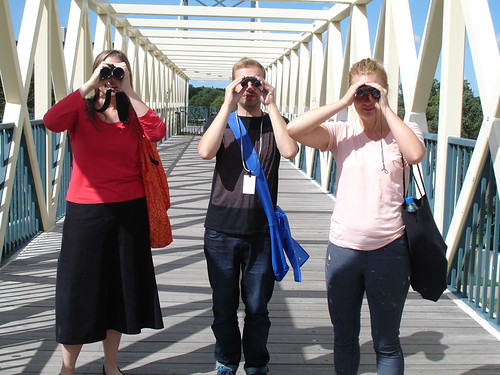
    Left to right: Abbie, Hans, and Nathalie
    One Tuesday morning in early September, artists Nathalie Djurberg and Hans Berg took a break from marshalling in The Parade to go birding. With binoculars at the ready, they flew the coop, accompanied by Susy Bielak and Abbie Anderson. What follows is a glimpse into their field trip, but first, a brief background on our birders. Nathalie and Hans were spending a week in Minneapolis to install their exhibition, The Parade, which  includes new sculptures informed by the psychology and natural history of birds. Abbie just concluded a summer of weekly nature walks around the Walker and was eager share that experience with visiting artists. Susy, in addition to serving as photographer, interviewer, and scribe for this outing, manages public and interpretive programs at the Walker.
    Our excursion began at the picnic tables as Abbie distributed binoculars and describes Open Phenology, her series of nature walks focused on observing ecological phenomena in the Walker’s vicinity. 

    Abbie: I’m interested in noticing the life forms around us and observing how they change through the seasons. This means looking for birds migrating, insects molting, flowers blooming, etc. These observations, in turn, are the basis for conversation and learning.

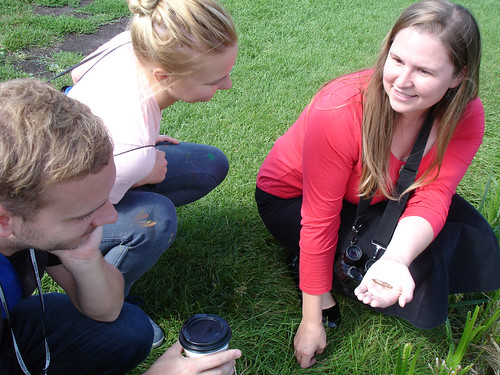
    Before spotting any avian species, Abbie gathered the group to inspect the insect world. Getting low to the ground at the water’s edge near Spoonbridge and Cherry, the group examined the exoskeletons left behind by metamorphosing dragonflies.  

    Abbie: See these?
    Hans: Like ghosts.
    Abbie: Larvae is actually Latin for ‘ghost.’
    Hans [on metamorphosis]: It’s like one-day evolution.
    Nathalie [clearly curious as to why an art educator takes such interest in biology]: So, what exactly do you do at the museum?
    Abbie: Yes, I see what you mean. I’m a biology geek who works in an art museum. So beyond my job, which is supporting the Walker’s education and community programs, I’ve appointed myself as the Walker’s in-house amateur naturalist.

    The Parade: Nathalie Djurberg with music by Hans Berg
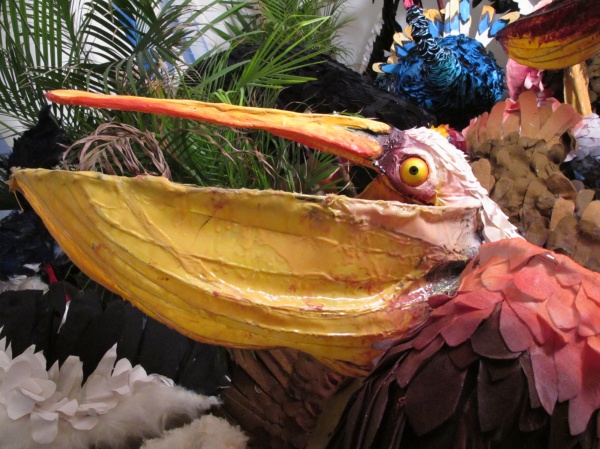
    As the group marched over to Loring Park, the conversation shifted to Nathalie’s recent body of work, a veritable parade of sculpted birds (left, click to view larger image).

    Susy: Why birds?
    Nathalie: Before, birds were the least interesting to me—flock animals. Boring. I love animals and watch a lot of nature programs, but avoided bird programs. Then I came across David Attenborough.
    Abbie: His documentary on birds of paradise?
    Nathalie: Yeah, that guy!
    Abbie: After watching Attenborough in Paradise, I felt like this planet is suddenly a totally different world! An astonishing place, but weird, right?
    Nathalie: Yeah, though it was before that one that I got into him. And it changed how I see birds. I had no empathy for birds before. Now I really do.

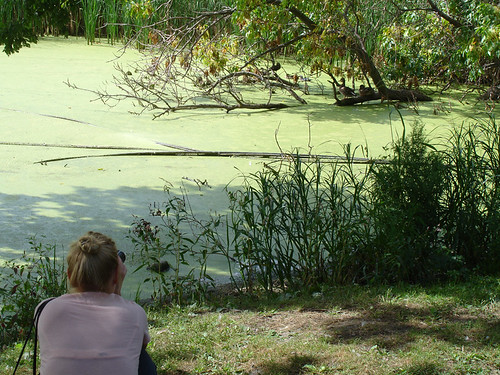
    Once across the Hixon Whitney bridge, we again gravitated to water, looking for birds around the pond. By the reeds we discover ducks—not only Mallards, but Wood Ducks, a regal looking waterfowl with a crested head, thin neck, and striking plumage. We spot them as we approach the pond, then peer from the bridge for a clear view. Nathalie runs with her binoculars to the water’s edge for a closer look. We follow.

    Abbie [chasing after Nathalie]: I love the investigative impulse!
    Abbie [catching up and training binoculars]: You can recognize the Wood Duck by size and shape as well as by its plumage. Their nesting habitat is a tree cavity. Now we build boxes to help them out.
    Hans: Are they rare?
    Abbie: They’re not too rare, but many birds nest in dead trees, which we cut down. There’s a dead tree by my house that every morning is full of woodpeckers. It’s marvelous to see them. It’s a dead tree, but it’s living to them, because it’s full of bugs.
    Nathalie [focusing her binoculars on a male Wood Duck]: Look at its eyes! They’re bright red.
    Abbie: The Wood Duck is the showiest bird here.

    Nathalie Djurberg, studio view of a work in progress, 2010
    Courtesy the artists, Zach Feuer Gallery, New York and Giò Marconi, Milan
    After this satisfying encounter, we make our way around the pond, geting back to talking about Nathalie’s sculptures.

    Susy: How much of your birds come from actual birds in the world, and how much are derived from sheer imagination?
    Nathalie: Most started by my looking at pictures, then really transformed in the process of making them. There were about thirty that came from my imagination. The rest were something specific at the start. Some have transformed so much I couldn’t recognize how they started.
    Susy: How do you chose your birds?
    Nathalie: I choose the ones I find interesting. Their personalities. How they move their heads. Their colors and patterns.
    To witness the pageantry of these feathered forms with your own eyes, venture into the Walker’s Burnet Gallery—The Parade is on view through December 31. In addition to a flock of over eighty delightfully varied bird sculptures, the walls are brought to life by a selection of the artists’ claymation films and the entire space is awash in Hans’ music.
    Birding and conversing with Nathalie and Hans has amplified my enjoyment of the show, which is emphatically rich and wild as it is. But after discovering a shared enthusiasm for Attenborough’s BBC documentaries, I found myself thinking, “Wouldn’t David Attenborough just have a field day here!” In a flight of fancy, I imagine a gallery tour led by Attenborough: Clad in khakis with a field guide in his vest pocket, he trains his binoculars on the multitude of exotic species. His hushed voice can hardly contain the exhilaration of catching sight of such strange birds. And lucky for us, this episode of Attenborough’s adventures doesn’t entail travel to an inaccessible tropical paradise, but unfolds in our own back yard.
    —Co-authored by Abbie Anderson and Susy Bielak

    Friday, September 2, 2011

    Of Cities and Ecosystems

    Beginning our walk, my colleague Scott and I corroborate a sighting: Twenty Canada Geese on the field at 9 am. Now's the time of year to look around for Canada Geese staging or look up for their V-shaped flight formations. Fall is settling in—just read the signs.

    One such sign is seen on the Irene Hixon Whitney Bridge.
    What: A clothesline, punctuated with colorful scarves and hats, extends the length of the ramp on both ends of the bridge. Since June, The Swatch Team have called fellow knitters, crochet practitioners, and yarn bombers to unite! And last night, their row-by-row radicalism culminated in this guerrilla installation. A clothesline full of utilitarian, handmade textiles surprised the public with its unfettered generosity. Committed to 'yarn bombing with a message,' the flyer from last evening's give-away reads,
    Help yourself to the warm items you will need this winter. If you would like to contribute, add a drawing, poem, opinion, or creative expression to this line. We are all connected!
    Where: Bridge between the Minneapolis Sculpture Garden and Loring Park
    Observers: Abbie and Scott
    Date/Time: Friday, September 2, 10:20 am
    Conditions: Partly cloudy, with a view of the park and the city

    Once across the bridge we encounter . . .
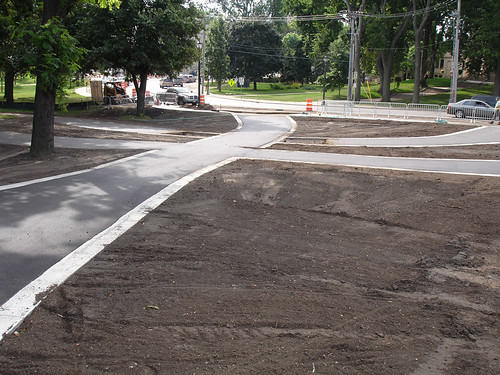
    What: A network of freshly paved paths. Scott explains how neighborhood groups, the Parks Board, and municipal entities agreed upon this new configuration to improve safety for pedestrians and cyclists at this high-traffic corner. Scott, having attended Marcy Schulte's Community Walk About (presented as part of Living Classroom), relays a wealth of information about the park's history and its citizen advocates.
    Where: Loring Park's southwest corner
    Observers: Scott and Abbie
    Date/Time: Friday, September 2, 10:30 am
    Conditions: The dwindling summer season leaves just enough time for the project's finishing touches—signage and landscaping details.
    Conversing with Scott is like paging through a neighborhood directory. His familiarity with area residents, business owners, and organizations prompts me to exclaim, "Here I thought this was the city, but it turns out it's a small town!" Listening to Scott talk about the neighborhood, the metaphor I'm imagining is an ecosystem, a network of interrelated parts.

    Scott also calls my attention to the squirrels as a marker of ecological intervention. The ubiquitous gray squirrel was introduced to the area in the early twentieth century. And concurrent with the gray squirrel's introduction was the extermination of the red squirrel.

    Before crossing Lyndale/Hennepin, our attention is drawn to St. Mark's beautiful lawn shaded by majestic elms. Scanning the lawn, we spot a blue tag on just about every tree trunk. Taking a cue from the Walker's free audio guide, Art on Call, Scott dials up "Trees on Call" to see who's on the other end of the line.

    ART ON CALL
    is to
    ART
    as . . .

    (Images courtesy 
    Walker Art Center)


    TREES ON CALL
    is to
    TREES


    What: Scott's call connects us to a tree specialist. The story behind the little blue tags is Dutch Elm Disease. Since nearby trees had been infected, the church took measures to protect these specimens by having a fungicide administered. Dutch Elm Disease (DED) is caused by a fungus, which in turn is transmitted by elm beetles. This makes the beetle the disease vector. And since this is a phenology blog, I speculate about the beetle's life cycle. September is the time that adult beetles make their way to the base of healthy elm trees to overwinter underground. Next year around mid-late April they'll emerge and fly to the elm's tree top to feed on leaves.
    Where: St. Mark's Episcopal Cathedral's front lawn
    Observers: Scott and Abbie
    Date/Time: September 2, 11:40 am
    Conditions: Curiosity satiated (for the time being)

    Saturday, August 27, 2011

    Subdividing the Summer

    A month ago, when cicada calls sparked my curiosity, I corresponded with a cicada enthusiast who remarked,
    "I love the way cicadas subdivide the summer for me. I suppose studying any summer fauna does the same."
    And though I'm very green at my 'studies,' I share this impression. I say 'impression' because my haphazard observations are painted with a broad brush rather than rendered by well-informed study and systematic record-keeping. None-the-less, here's how my sub-divided summer has played out:

    August 12: Eastern Forktails on the scene, abundant


    August 19: Abundant and diverse dragonflies and damselflies. A lot of unfinished work in terms identification.


    August 26: Emergence of an unidentified dragonfly, as inferred by the presence of abundant exuviae.

    August 26: Damselflies (possibly a species of sprite) mating; Eastern Forktails are still present but (by my estimation) less abundant than 2 weeks prior.


    If I added some expertise and methodology (some science, if you will) to my practice, how sophisticated could this chronology become? But rather than pursuing a single focus (dragonflies, for example), Open Phenology cast its net broadly. I've had the opportunity to share this project with collaborators with diverse specialties, ranging from ornithology to botany, audio engineering to phenology, sculpture conservation to ecology. Open Phenology's expansive approach is key to its strenghths:
    • Accessible to multiple publics, Open Phenology has no prerequisite knowledge base or skill set.
    • Open Phenology values synthesis and interconnections as a way of understanding the world.
    • Open Phenology promotes non-hierarchical exchange of information.
    • Through facilitated conversations and discovery, Open Phenology emphasizes empirical observation. A frame is drawn around this activity, calling attention to its legitimacy and authenticity.
    • In addition to recording what we do see, participants are encouraged to consider what we don't see and this leads to speculations, hyphotheses, and sustained curiosity.
    Throughout the summer I've been negotiating Open Phenology's ambiguous relation to science. I have maintained all along that Open Phenology is not science, and while I'm content with this, it makes me wonder about lost opportunities. How would I modify Open Phenology to bring it into alignment with scientific inquiry? Specialization is the answer. Here are some citizen science endeavors on my radar: