What: A dawn chorus of (presumably) European Starlings
Where: Too dark to see, the calls and chatter seemed to come from the arborvitae at the Sculpture Garden's south edge
Observer: Abbie
Date/Time: Monday, December 12, 7 am
Conditions: Overcast and warmer than previous days, so warm I had no need for gloves
Monday, December 12, 2011

Friday, December 9, 2011
Crows Roosting in the City
Crows gather on winter evenings, making a racket and attracting attention. This roosting phenomena is anticipated by many and inspires curiosity. Satisfy your curiosity by listening to the MPR news feature by Dan Olson (above), which combines informative reporting with the soundscape of cawing birds.
Wednesday, November 30, 2011
Mesmerized by the Murmuration
Today presented a delightful opportunity to return to the Open Phenology philosophy:
What: A murmuration of starlings! A truly mesmerizing sight! Curious about this? Read more here.
Where: At the south edge of the Minneapolis Sculpture Garden. Other observers report that the flock makes its way here from Loring Park and then tends to continue West.
Observers: Abbie, Masami, Michael, Ben, Courtney, and others. Actually, this one is a real crowd pleaser. Everone walking by paused and commented.
Date/Time: Wednesday, November 30, 4:30 pm. The phenomena concluded by about 4:45.
Conditions: Overcast, around 40 degrees
Witness. Change. Together.
What: A murmuration of starlings! A truly mesmerizing sight! Curious about this? Read more here.
Where: At the south edge of the Minneapolis Sculpture Garden. Other observers report that the flock makes its way here from Loring Park and then tends to continue West.
Observers: Abbie, Masami, Michael, Ben, Courtney, and others. Actually, this one is a real crowd pleaser. Everone walking by paused and commented.
Date/Time: Wednesday, November 30, 4:30 pm. The phenomena concluded by about 4:45.
Conditions: Overcast, around 40 degrees
Tuesday, November 8, 2011
Honk If You Love
Canada Geese! Arriving to work this morning, I counted zero geese on the field. (But evidence of their recent "occupation" was scattered generously underfoot, if you know what I mean.) As we wound our way into the offices, my colleague Christopher and I chatted about the phenomenon—how the passing weeks saw their numbers increase, peak, and then diminish. Where are they now?
Where do Canada Geese go? As you've probably noticed, some of them will stick around over the winter months. But most of them make their way to the mid and southern United States. Here's a link to a distribution map, on Wikipedia: http://en.wikipedia.org/wiki/File:Branta_canadensis_map.png.
Four more facts about the Canada Goose:
Where do Canada Geese go? As you've probably noticed, some of them will stick around over the winter months. But most of them make their way to the mid and southern United States. Here's a link to a distribution map, on Wikipedia: http://en.wikipedia.org/wiki/File:Branta_canadensis_map.png.

Four more facts about the Canada Goose:
- Scientists have tracked geese that have flown up to 1,000 km in a day. (You didn't expect a figure in miles, did you? Of course it would have to be metric since they're Canada Geese. 1000 km = 620 miles, approximately)
- Maybe to you or me all Canada Geese look the same, but most scientists believe that there as many as eleven different races.
- Canada Geese are monogamous and most couples stay together all of their lives.
- The Canada Goose was once considered endangered. Game laws and habitat preservation programs have turned that around so effectively that they are now sometimes considered a pest.
Thursday, October 27, 2011
Overheard in my Inbox: Geese on the Field
 |
| What: My colleague Sharon e-mails me about the Canada Geese overtaking the field. This morning I counted upwards of 50. They're like little cows with wings—black and white and preoccupied with grazing. Where: Walker Open Field Observers: Sharon, Abbie, Jenny—everyone who looks, really Date/Time: Thursday, October 27 at 11:17 am Conditions: Anticipating winter |
- The volume and variety of bird songs heard from my driveway at 8:30 am. Since my attention has waxed and waned, I missed, for example, marking the moment when I stopped hearing the House Wren, or noticing how August's lull is sandwiched between American Robins singing in June and Black-Capped Chickadees buzzing in October.
- The volume and frequency of cicada songs. In late summer, the cicadas' sirens are so constant you can wander for blocks and always be in ear-shot. It's like the auditory equivalent of Tarzan swinging from vine to vine—an uninterrupted passage.
- The number of geese on the Open Field.
Sunday, October 9, 2011
Wait, wait—what season is it?

Where: Lake of the Isles (click here for map)
Observers: Abbie and Mary
Date/Time: 10:30 am, Sunday, October 9
Conditions: Unseasonably warm, the day's temperature was to reach 80°

Is this an "autumn blooming cherry," or is has the tree's clock been confused by recent weather patterns?
Tuesday, September 6, 2011
Field Trip: Birding with Nathalie and Hans
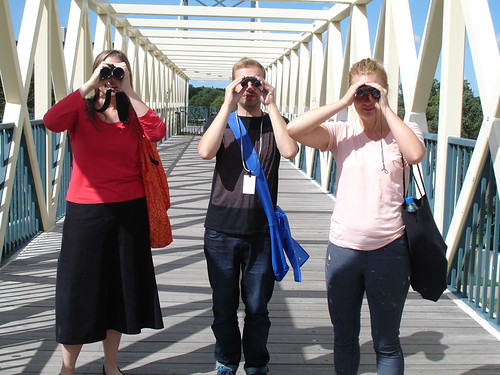 |
| Left to right: Abbie, Hans, and Nathalie |
Our excursion began at the picnic tables as Abbie distributed binoculars and describes Open Phenology, her series of nature walks focused on observing ecological phenomena in the Walker’s vicinity.
Abbie: I’m interested in noticing the life forms around us and observing how they change through the seasons. This means looking for birds migrating, insects molting, flowers blooming, etc. These observations, in turn, are the basis for conversation and learning.
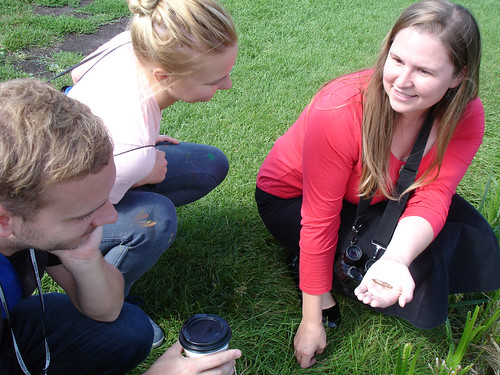
Abbie: See these?
Hans: Like ghosts.
Abbie: Larvae is actually Latin for ‘ghost.’
Hans [on metamorphosis]: It’s like one-day evolution.
Nathalie [clearly curious as to why an art educator takes such interest in biology]: So, what exactly do you do at the museum?
Abbie: Yes, I see what you mean. I’m a biology geek who works in an art museum. So beyond my job, which is supporting the Walker’s education and community programs, I’ve appointed myself as the Walker’s in-house amateur naturalist.
 |
| The Parade: Nathalie Djurberg with music by Hans Berg |
Susy: Why birds?
Nathalie: Before, birds were the least interesting to me—flock animals. Boring. I love animals and watch a lot of nature programs, but avoided bird programs. Then I came across David Attenborough.
Abbie: His documentary on birds of paradise?
Nathalie: Yeah, that guy!
Abbie: After watching Attenborough in Paradise, I felt like this planet is suddenly a totally different world! An astonishing place, but weird, right?
Nathalie: Yeah, though it was before that one that I got into him. And it changed how I see birds. I had no empathy for birds before. Now I really do.
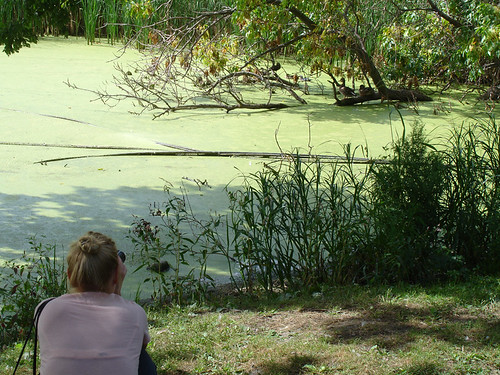
Abbie [chasing after Nathalie]: I love the investigative impulse!
Abbie [catching up and training binoculars]: You can recognize the Wood Duck by size and shape as well as by its plumage. Their nesting habitat is a tree cavity. Now we build boxes to help them out.
Hans: Are they rare?
Abbie: They’re not too rare, but many birds nest in dead trees, which we cut down. There’s a dead tree by my house that every morning is full of woodpeckers. It’s marvelous to see them. It’s a dead tree, but it’s living to them, because it’s full of bugs.
Nathalie [focusing her binoculars on a male Wood Duck]: Look at its eyes! They’re bright red.
Abbie: The Wood Duck is the showiest bird here.
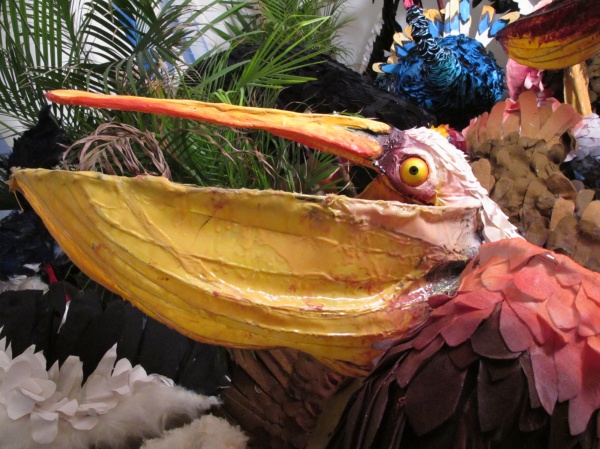 |
| Nathalie Djurberg, studio view of a work in progress, 2010 Courtesy the artists, Zach Feuer Gallery, New York and Giò Marconi, Milan |
Susy: How much of your birds come from actual birds in the world, and how much are derived from sheer imagination?
Nathalie: Most started by my looking at pictures, then really transformed in the process of making them. There were about thirty that came from my imagination. The rest were something specific at the start. Some have transformed so much I couldn’t recognize how they started.
Susy: How do you chose your birds?
Nathalie: I choose the ones I find interesting. Their personalities. How they move their heads. Their colors and patterns.
To witness the pageantry of these feathered forms with your own eyes, venture into the Walker’s Burnet Gallery—The Parade is on view through December 31. In addition to a flock of over eighty delightfully varied bird sculptures, the walls are brought to life by a selection of the artists’ claymation films and the entire space is awash in Hans’ music.
Birding and conversing with Nathalie and Hans has amplified my enjoyment of the show, which is emphatically rich and wild as it is. But after discovering a shared enthusiasm for Attenborough’s BBC documentaries, I found myself thinking, “Wouldn’t David Attenborough just have a field day here!” In a flight of fancy, I imagine a gallery tour led by Attenborough: Clad in khakis with a field guide in his vest pocket, he trains his binoculars on the multitude of exotic species. His hushed voice can hardly contain the exhilaration of catching sight of such strange birds. And lucky for us, this episode of Attenborough’s adventures doesn’t entail travel to an inaccessible tropical paradise, but unfolds in our own back yard.
—Co-authored by Abbie Anderson and Susy Bielak
Subscribe to:
Posts (Atom)